







How engineering software speeds review without losing control
2026-05-21
In offshore, maritime and energy projects, review speed is not a convenience. It can decide whether steel is released on time, whether a vessel keeps its mobilisation window, whether an MWS comment delays loadout, or whether a retrofit package can move from survey data to yard execution without another round of rework.
Engineering software is one of the strongest ways to shorten review cycles, but only when it is used with discipline. Faster calculations, automated drawings and live models are valuable. Uncontrolled assumptions, unclear revisions and black-box outputs are not. The objective is not to replace engineering judgement. It is to give reviewers better evidence, earlier visibility and cleaner documentation so they can make decisions with confidence.
For technical directors, lead engineers, EPC contractors, shipyards and marine contractors, the real question is practical: how can engineering software speed review without weakening safety, approval readiness or buildability?
Review speed is not just faster calculation
Engineering review is not a single check at the end of a design package. It is a chain of decisions that starts with the design basis and continues through modelling, load cases, drawings, fabrication details, marine operation procedures, approval comments and site queries.
In complex offshore and maritime scopes, delays rarely come from calculation time alone. They usually come from fragmented inputs, unclear design assumptions, late changes to weights or centres of gravity, mismatches between drawings and models, or documents that do not answer the reviewer’s most important questions.
A heavy lift design, for example, may involve structural engineers, naval architects, rigging specialists, vessel owners, fabrication teams, class representatives and marine warranty surveyors. If one group is checking an outdated revision of a grillage drawing while another is reviewing updated sling loads, review speed becomes meaningless. The project may appear active, but the decision trail is not under control.
Good engineering software reduces this friction by making information consistent and traceable. It does not simply produce outputs faster. It helps teams understand what changed, why it changed, who approved it and what effect it has on the next discipline or deliverable.
What engineering software should automate, and what it should not
Engineering software is best used to automate repetitive, rules-based and data-heavy work. That includes load combination generation, model updates, drawing extraction, clash detection, calculation formatting, revision comparison, document routing and design status tracking.
It should not automate accountability. Software cannot decide whether a padeye layout is practical to weld in a confined deck area, whether a vessel retrofit route is maintainable, whether local reinforcement is preferable to a heavier global solution, or whether a seafastening concept is robust enough for offshore execution. Those decisions require engineering judgement, project context and experience with marine environments.
The healthiest review workflow treats software output as structured evidence. It helps engineers and reviewers reach conclusions faster, but the acceptance of load paths, assumptions, safety factors, fabrication methods and approval strategy remains a human responsibility.
Where engineering software speeds review the most
Controlled design basis and revision visibility
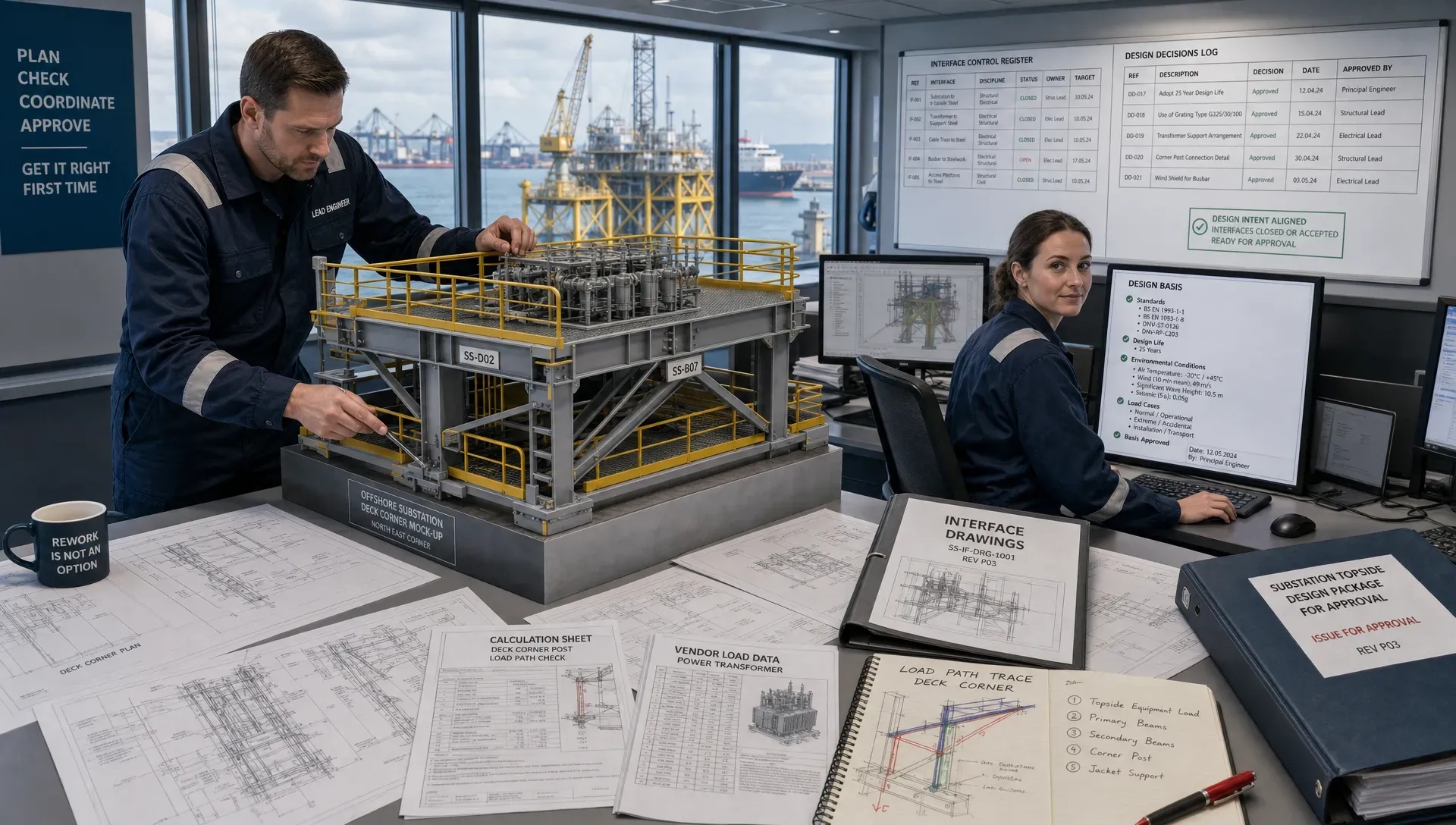
A controlled design basis is the foundation of fast review. For offshore transport, lifting, vessel retrofit, ship design or decommissioning work, the design basis may include vessel drawings, allowable deck loads, structural capacities, weights, centres of gravity, environmental conditions, motion criteria, class rules, lifting equipment data, mooring assumptions and installation constraints.
When these inputs are scattered across emails, PDFs, spreadsheets and outdated drawings, every review cycle starts with uncertainty. Engineering software can help by creating a single, controlled reference point for input data and revisions. Reviewers can see which values were used, when they changed and which calculations or drawings were affected.
This is particularly important when late information arrives. A revised component weight, changed rigging arrangement or updated underdeck detail should not trigger uncontrolled manual checking across the full package. With the right digital structure, the affected areas are easier to identify and prioritise.
Faster model and calculation iteration
Finite element models, stability calculations, lifting analyses, mooring checks and structural design spreadsheets all benefit from repeatable workflows. Once modelling standards and templates are established, engineers can test alternatives faster without rebuilding the logic each time.
For example, several grillage concepts can be compared for steel weight, weld complexity, load distribution and vessel interface impact. A lifting arrangement can be checked against different sling angles or lift point positions. A retrofit support frame can be adjusted to suit available structure, access limitations and piping interfaces.
The speed advantage is not only in running the calculation. It is in comparing options while the design is still flexible. Early iteration often avoids expensive fabrication changes later, where a technically correct solution may still be too slow, too heavy or too difficult to install.
Earlier interface detection
Many offshore and maritime problems are interface problems. A structural frame may clash with existing pipework. A seafastening support may sit above a weak underdeck area. A retrofit skid may block access to equipment that still needs maintenance. A lifting arrangement may work structurally but conflict with crane hook height, deck layout or rigging handling.
Model-based coordination helps these issues appear earlier. When structural design, naval architecture, piping and fabrication data are coordinated digitally, reviewers can assess the design as a system rather than as separate drawings.
This is where engineering software becomes valuable for more than the engineering department. Fabricators, operations teams and vessel stakeholders can review the same intent earlier, which reduces the chance of late site queries and approval comments.
Review-ready documentation
Automated reporting can save significant time, but only if the final package is understandable. Reviewers do not want an uncontrolled export of screenshots and numbers. They need a clear story: design basis, assumptions, load cases, model description, results, governing checks, conclusions and limitations.
Engineering software can help generate consistent calculation notes, drawing registers, model snapshots, material take-offs and comment logs. It can also reduce the risk that a value in a drawing differs from a value in a calculation report.
The strongest packages are not the longest ones. They are the ones that make the design logic easy to follow. For MWS, class and client review, clarity often saves more time than volume.
Clearer communication through visualisation
Technical animation and visualisation can help explain complex marine operations, especially during tenders, QHSE briefings, method reviews and stakeholder presentations. This is useful when a project involves a multi-stage lift, a tight transport sequence, a decommissioning operation or an offshore installation method that is difficult to understand from drawings alone.
Visualisation should not replace engineering documentation. It should support it. An animation of a lift sequence is only useful when it is consistent with approved rigging, structural capacity, vessel motions, clearance checks and operational limits.
Used correctly, visual tools reduce misunderstanding between engineering, operations, project management and site teams. They help reviewers see the sequence, not just the static design.
The control layer that keeps review safe
The most important part of a digital engineering workflow is not the software itself. It is the control layer around it. This defines how data is approved, how revisions are managed, how checks are performed and how responsibility is assigned.
A practical control layer should include:
- A clear design basis register with approved input data
- Named owners for models, calculations and drawings
- Defined review gates for concept, detailed design, fabrication and operations
- Independent checking of critical calculations and assumptions
- A revision history that shows what changed and why
- A comment close-out process for client, MWS and class review
- Frozen baselines before fabrication release or offshore execution
Without these controls, faster software can create faster errors. A model may be updated but the drawing may not. A calculation may be rerun with a new load case but without updating the conclusion. A visually polished package may hide weak assumptions.
Control is what turns software speed into project reliability.
Offshore and maritime scopes where review speed matters
Heavy lift engineering
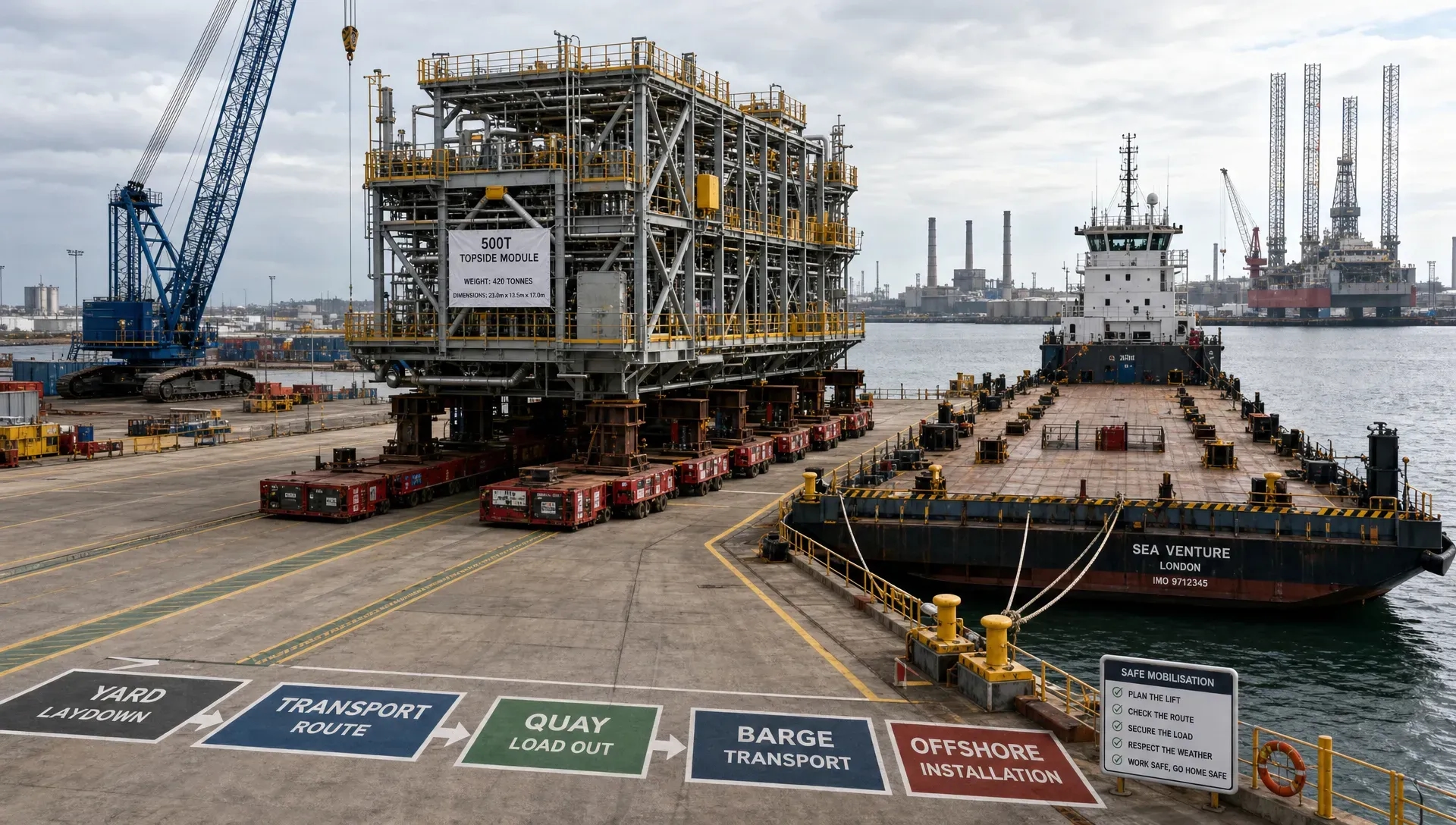
Heavy lift projects are sensitive to schedule, crane availability, weather windows and mobilisation costs. Engineering software helps teams evaluate rigging loads, lift point reactions, structural integrity, clearances and stability effects more efficiently.
For review, the benefit is traceability. A technical director or MWS reviewer needs to understand how the lift loads were derived, which dynamic factors were applied, how the structure behaves locally and globally, and whether the proposed arrangement is practical for execution.
A faster workflow is valuable only when it supports a clear lift package, including calculations, drawings, rigging arrangements, FEM checks and operational limitations.
Seafastening, grillages and transport structures
Transport engineering often requires a careful balance between strength, steel weight, weld volume, vessel capacity and fabrication time. Over-designed seafastening can increase cost and lead time. Under-designed seafastening creates unacceptable transport risk.
Engineering software allows teams to compare configurations, check vessel interfaces and optimise load paths. It also helps reviewers see how support reactions move through the grillage, vessel deck and underdeck structure.
This is especially important for offshore wind foundation transport, heavy modules, marine equipment and decommissioning components, where small changes in support location or load distribution can have a large effect on vessel and fabrication constraints.
Vessel retrofit and piping design
Retrofit work is often constrained by legacy vessel data, limited space, existing systems, class requirements and uncertain interfaces. Software helps coordinate structural supports, piping routes, equipment foundations and access requirements.
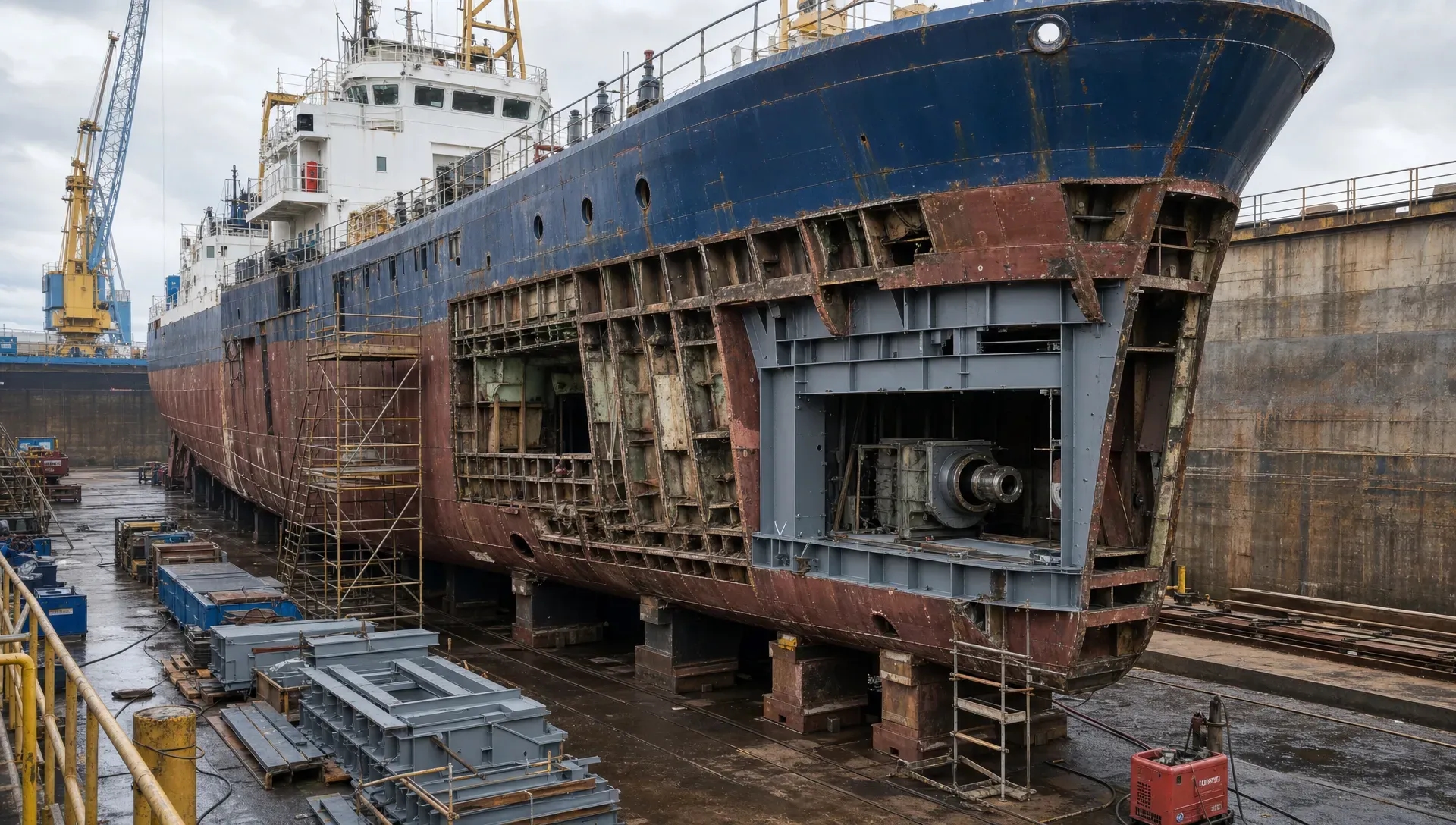
The review challenge is to avoid designing an isolated solution that cannot be installed or maintained. A retrofit package must consider existing structure, available tie-in points, installation sequence, prefabrication opportunities and inspection access.
Digital coordination can reduce clashes and improve review quality, but only if it is supported by accurate vessel information and practical site feedback.
Ship design and marine engineering
Ship design and marine engineering depend on disciplined coordination between hull structure, stability, systems, deck layouts and operational requirements. Software can accelerate hydrostatic checks, structural modelling, arrangement reviews and documentation updates.
The control issue is integration. A change that improves one discipline may create consequences elsewhere. For example, equipment relocation may affect stability, access, piping, power, structure and class documentation. Review speed improves when these connections are visible early.
Decommissioning and removal projects
Decommissioning projects often involve incomplete data, aged assets, uncertain weights and high consequence marine operations. Software can help build 3D models, assess lift integrity, test removal concepts and prepare clear documentation for review.
However, decommissioning also requires cautious engineering judgement. Unknowns must be managed through conservative assumptions, inspection data, contingency planning and clear limitations in the engineering package.
How software supports MWS and class review
MWS and class review processes are not slowed only by technical disagreement. They are often slowed by incomplete evidence. A reviewer may need clarification on load cases, environmental assumptions, model boundary conditions, weld details, fatigue relevance, stability margins or the connection between calculations and drawings.
Engineering software can support approval readiness by making these links clearer. When the calculation package, model outputs, drawings and revision history are aligned, review comments can be answered faster and with less ambiguity.
A strong approval package typically explains the applicable rules and standards, the design basis, the load cases, the modelling method, the governing results, the design checks and the operational limits. It also makes clear what is excluded or assumed.
For class societies such as DNV, Lloyd’s Register and ABS, and for marine warranty surveyors, the value is not that a model exists. The value is that the model is appropriate, the assumptions are justified and the outputs are translated into reviewable engineering conclusions.
Avoiding new risks introduced by software
Software can reduce risk, but it can also introduce new failure modes if used without discipline. Automation bias is one of the most common. When outputs look precise, teams may trust them without checking the input data, modelling assumptions or applicability of the method.
Another risk is version drift. A project may have multiple models, spreadsheets, drawings and reports moving at different speeds. If the control process is weak, reviewers may approve a package that no longer represents the latest design.
For engineering teams, the rule is simple. If the software speeds output but weakens traceability, it is not improving the project. If it speeds output and strengthens the review trail, it is adding real value.
A practical rollout for engineering teams
Engineering software works best when introduced around specific project bottlenecks rather than as a broad digital initiative. A focused rollout is easier to control, easier to validate and easier to measure.
- Identify the review bottleneck first: Decide whether the delay is caused by input data, modelling, drawing updates, internal checking, client comments, MWS review, fabrication queries or document control.
- Define what must remain human-controlled: Critical assumptions, safety factors, design acceptance, operational limitations and final approvals should have named responsible engineers.
- Standardise templates and naming rules: Consistent calculation templates, model structures, drawing names and revision rules reduce avoidable review friction.
- Pilot on a bounded scope: Use a contained work package, such as a grillage concept, lifting frame, retrofit support or piping module, before applying the workflow across a full project.
- Measure review quality as well as speed: Track comment volume, repeated comments, drawing mismatches, fabrication queries, approval duration and rework, not only calculation turnaround time.
- Keep improving the library: Lessons from completed projects should feed back into templates, checklists and standard details, while still allowing engineers to adapt to project-specific constraints.
This approach helps teams gain speed without losing engineering control. It also makes it easier to prove value to project directors, operations teams and approval stakeholders.
How Fusie Engineers applies this thinking
Fusie Engineers supports offshore, maritime and energy projects where speed, buildability and approval readiness matter. The team works across offshore structural design, heavy lift engineering, ship design, marine engineering, vessel retrofits, piping design, steel detailing, software and UI development, technical animation and VFX.
That combination is important because engineering software is most effective when it is connected to real execution constraints. A model is only useful if the design can be fabricated. A calculation is only useful if the assumptions are clear. A drawing is only useful if it supports yard work, class review and offshore operations.
For a seafastening or grillage scope, this may mean using digital tools to compare structural concepts, reduce unnecessary steel, coordinate vessel interfaces and prepare reviewable FEM calculations and drawings. For a vessel retrofit, it may mean coordinating structural, piping and marine engineering information so the package is practical to install and easier to approve. For a heavy lift or decommissioning project, it may mean presenting calculations, lift arrangements, stability checks and operational sequences in a form that supports fast, confident review.
The objective is consistent across all scopes: speed up engineering work while keeping control over safety, quality, documentation and project execution.
Frequently asked questions
Can engineering software replace manual engineering review? No. It can automate repetitive checks, improve traceability and speed documentation, but critical assumptions, design acceptance and approval decisions still require experienced engineers.
How does engineering software help MWS or class approval? It helps by aligning design basis data, calculations, drawings, model outputs and revision history. This makes it easier for reviewers to understand the design logic and close comments efficiently.
What is the biggest risk of using engineering software in offshore projects? The biggest risk is trusting outputs without validating inputs, assumptions and model limitations. Software must be governed by clear review gates, independent checks and responsible engineers.
Which project types benefit most from software-supported review? Heavy lift engineering, seafastening, grillages, vessel retrofits, piping design, ship design, decommissioning, mooring checks and offshore installation structures often benefit because they involve many interfaces and approval stakeholders.
When should a project team involve an engineering partner? Early involvement is best when design choices still influence steel weight, fabrication complexity, vessel suitability, approval strategy and offshore execution. Late support can still help, but options may be more constrained.
Need faster review with stronger control?
If your project needs extra engineering capacity, practical structural design, heavy lift support, vessel retrofit engineering, marine engineering or approval-ready documentation, Fusie Engineers can help connect digital efficiency with real project execution.
Work with a team that understands offshore conditions, vessel behaviour, fabrication constraints, class requirements and the cost of delayed decisions. Contact Fusie Engineers to discuss how to speed review without losing control over safety, quality and buildability.