





Ship design choices that improve safety and approval
2026-05-19
A safe vessel is not created at the approval stage. It is created much earlier, when the first assumptions are made about hull form, structural layout, machinery arrangement, access, fabrication and operating profile. By the time drawings reach class or flag review, many of the most important safety and approval outcomes have already been locked in.
For shipyards, vessel owners, naval architects and offshore contractors, this makes ship design a risk-management discipline as much as a technical design task. The right choices reduce rework, shorten review cycles and produce a vessel that can be built, inspected, operated and maintained without unnecessary complexity. Poor early choices can do the opposite, even when calculations are technically correct.
The goal is not to design only for minimum rule compliance. It is to design for a vessel that behaves predictably in service, gives reviewers clear evidence, and supports practical construction and operation from the first steel cut to long-term maintenance.
Approval starts with a clear design basis
Class approval becomes difficult when the design basis is vague. Before structural scantlings, general arrangements or system layouts are finalised, the project team needs a shared understanding of the vessel’s intended service, operating areas, load cases, class notation, flag requirements and owner-specific expectations.
This is especially important for vessels operating in offshore wind, dredging, heavy lift, decommissioning, service operations, cable lay, towage or vessel retrofit projects. These vessels often carry project-specific equipment, temporary sea fastenings, mission systems or deck loads that can influence global strength, stability, watertight integrity and safe access.
A robust design basis should clarify:
- Operating profile, including transit, standby, lifting, towing, installation or harbour conditions.
- Environmental assumptions, including wave, wind, current, temperature and corrosion exposure.
- Classification society, flag, notation and any Marine Warranty Surveyor requirements.
- Payloads, deck loads, lifting loads, mooring loads and mission equipment interfaces.
- Inspection, maintenance, emergency access and operational constraints.
This information should not sit only in commercial documents or scattered project emails. It needs to be reflected in the engineering assumptions, calculation reports, drawings and interface registers. When reviewers can trace the design back to a clear basis, comments are easier to resolve and approval risk is reduced.
Hull form choices affect safety long before rules are checked
Hull form is often discussed in terms of speed, fuel consumption and payload capacity, but it also has a direct effect on safety and approval. Initial stability, seakeeping, accelerations, slamming risk, deck wetness, manoeuvrability and station-keeping behaviour all begin with hull geometry.
For workboats, offshore support vessels and special purpose vessels, a small improvement in deck area or cargo capacity can create unintended consequences if it reduces reserve buoyancy, compromises stability margins or increases motions in operating conditions. A hull that looks efficient on paper can create operational limits that reduce vessel availability or increase risk during offshore work.
Early naval architecture should therefore connect hull form decisions with the real mission. For example, a vessel supporting offshore installation may need lower motions at a specific working heading, not simply a high transit speed. A retrofit vessel may need to absorb extra topside weight without eroding intact or damage stability margins. A heavy deck cargo vessel may need stronger coordination between deck layout, underdeck reinforcement and ballast strategy.
The most approval-ready designs show that the hull form, stability booklet, loading conditions and operational procedures all support the same use case. This reduces ambiguity during class review and gives owners a clearer understanding of operational limitations.
Stability should be treated as an operational design driver
Stability is sometimes treated as a verification step near the end of design. That is risky, particularly for vessels with high deck cargo, cranes, mission modules, battery systems, carbon capture skids, exhaust gas treatment systems or offshore equipment.
Good ship design brings stability into the concept phase. Weight growth, vertical centre of gravity, free surface effects, damage stability, watertight subdivision and load-out cases must be considered before arrangement choices become difficult to change.
This matters because stability approval is not only about passing a set of limiting curves. Reviewers need confidence that the vessel can be operated safely across realistic loading conditions. For project-driven vessels, this may include mobilisation, transit, installation, demobilisation, partial cargo conditions and emergency scenarios.
A practical approach includes early weight control, realistic margins, disciplined tracking of supplier data and clear communication between naval architecture, structural design and operations. If a new system is added late in the project, the impact on stability, structure, access, fire safety and piping should be assessed together, not as separate technical silos.
Structural layout must support clean load paths
A safe structural design is not just a collection of compliant plates, stiffeners and brackets. It is a coherent load path from the applied force to the supporting structure. This is critical for deck equipment, cranes, winches, A-frames, moonpools, sea fastening structures, foundations and heavy project cargo.
Class reviewers and Marine Warranty Surveyors are usually more comfortable with designs where the load path is simple, visible and supported by suitable calculations. Complex eccentric load paths, abrupt stiffness changes and difficult weld details may be possible to justify, but they often increase fatigue concerns, fabrication cost and review time.
Clean structural layout choices include aligning foundations with primary structure where possible, avoiding unnecessary load transfer through weak secondary members, providing adequate access for welding and inspection, and designing brackets and transitions that avoid stress concentrations. For offshore and maritime vessels, fatigue and corrosion must also be considered early, particularly around high-cycle equipment, splash zones and areas exposed to vibration.
The International Maritime Organization’s goal-based standards reinforce the principle that ships should be designed and constructed for safe operation throughout their life. In practical terms, that means structural choices should consider not only rule compliance at delivery, but also inspection, repair, maintainability and predictable behaviour in service.

Buildability is a safety factor, not only a cost factor
A design that is difficult to fabricate can become a safety risk. Tight weld access, over-complicated brackets, unnecessary material changes and poor sequencing can lead to welding defects, dimensional inaccuracies, inspection delays and late-stage rework.
For shipyards, buildability directly affects schedule and quality. For owners and contractors, it affects delivery dates, cost certainty and approval confidence. A class-compliant design that requires impractical fabrication methods may still create project risk if it slows production or introduces workmanship issues.
Good ship design considers fabrication early. That includes plate nesting, lifting of assemblies, welding sequence, tolerances, coating access, inspection openings and realistic workshop capabilities. Steel detailing should not be a disconnected drafting exercise. It should translate engineering intent into buildable assemblies that preserve strength, reduce unnecessary complexity and support inspection.
The same principle applies outside conventional shipbuilding. Even in smaller steel-shell projects such as container conversions, structural cut-outs, reinforcement and inspection discipline determine whether the final structure remains safe. This is why guidance on structural modifications to steel containers stresses professional engineering when openings, stacking or load paths are changed. Ships are far more complex, but the lesson is similar: altering a steel structure safely requires more than cutting and welding.
Machinery and piping arrangements influence approval risk
Machinery and piping design can create approval challenges if it is treated too late or only as a routing task. System arrangement affects fire safety, flooding risk, access, ventilation, class notation, maintainability and operational reliability.
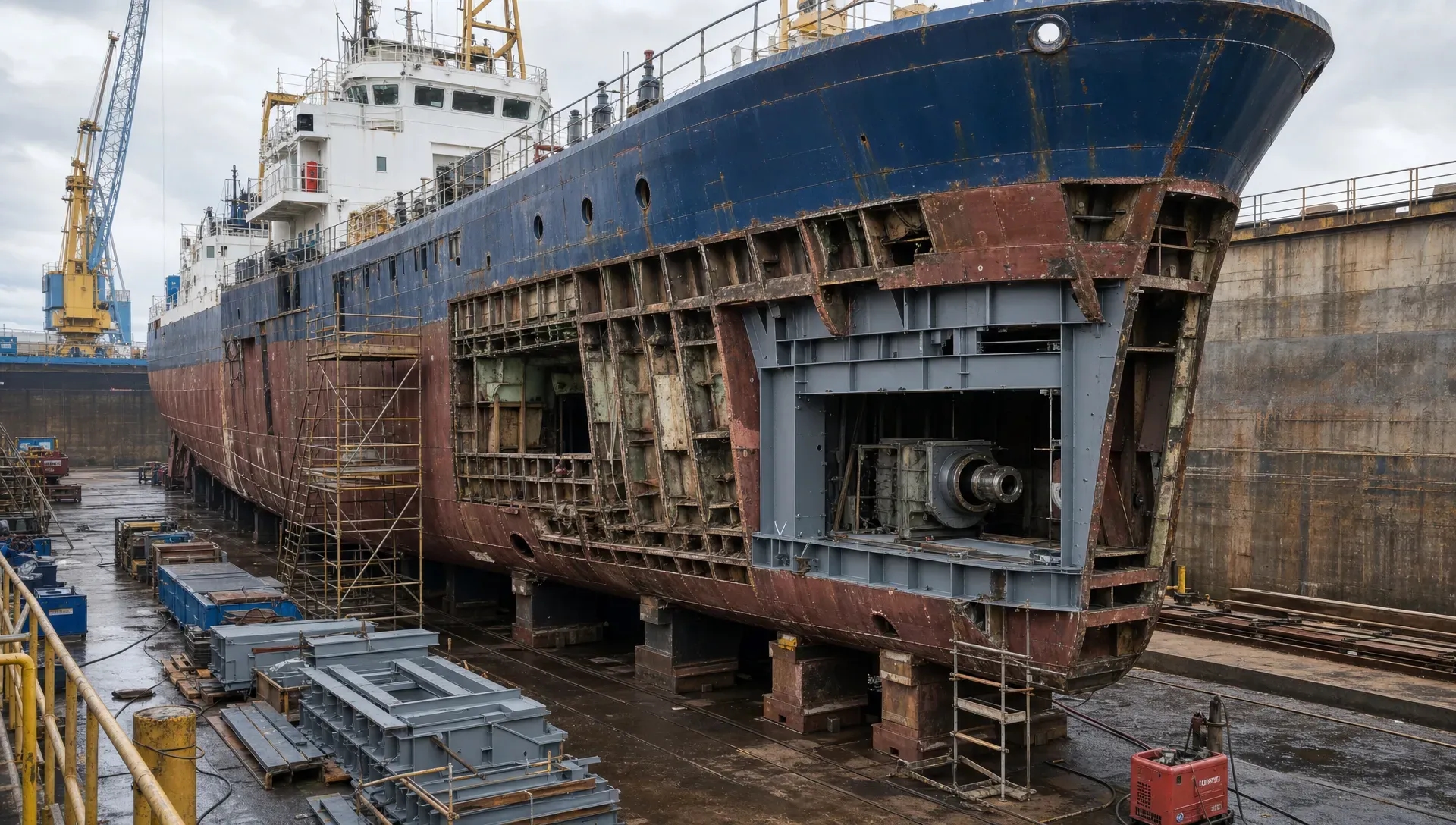
Retrofits are especially sensitive. Existing vessels may have incomplete legacy data, restricted spaces, limited structural capacity and interfaces with older systems. Adding new piping, skids, scrubbers, carbon capture systems, ballast modifications or alternative fuel systems can quickly affect classification requirements and vessel operation.
Practical machinery and piping design choices include clear segregation of hazardous and non-hazardous areas, maintainable valve access, logical routing, allowance for thermal movement, proper support design and avoidance of clashes with structure or escape routes. Pipe supports should be engineered, not improvised, because vibration, fatigue and local structure can become serious issues in marine environments.
Approval is easier when system diagrams, routing models, support details, penetration details and structural reinforcements are aligned. If class receives inconsistent information between drawings, calculations and layouts, review cycles become longer and more expensive.
Fire safety, escape and human access should not be squeezed in late
A vessel can satisfy structural and stability requirements but still face approval delays if fire safety, escape routes and operational access are compromised. These elements must be integrated into the general arrangement from the start.
Good layout decisions provide safe access to working areas, inspection points, emergency equipment, machinery spaces and accommodation. They also account for realistic human movement during normal operations and emergency scenarios. On vessels with offshore equipment, temporary project structures or retrofit systems, access can quickly become blocked or narrowed if interfaces are not coordinated.
Design teams should challenge arrangements that rely on difficult access, awkward maintenance positions or unclear emergency paths. In harsh marine operations, crews need arrangements that work under pressure, in poor weather and during time-critical tasks. Approval bodies look for compliance, but owners and operators need practical safety.
Class-friendly design is evidence-led design
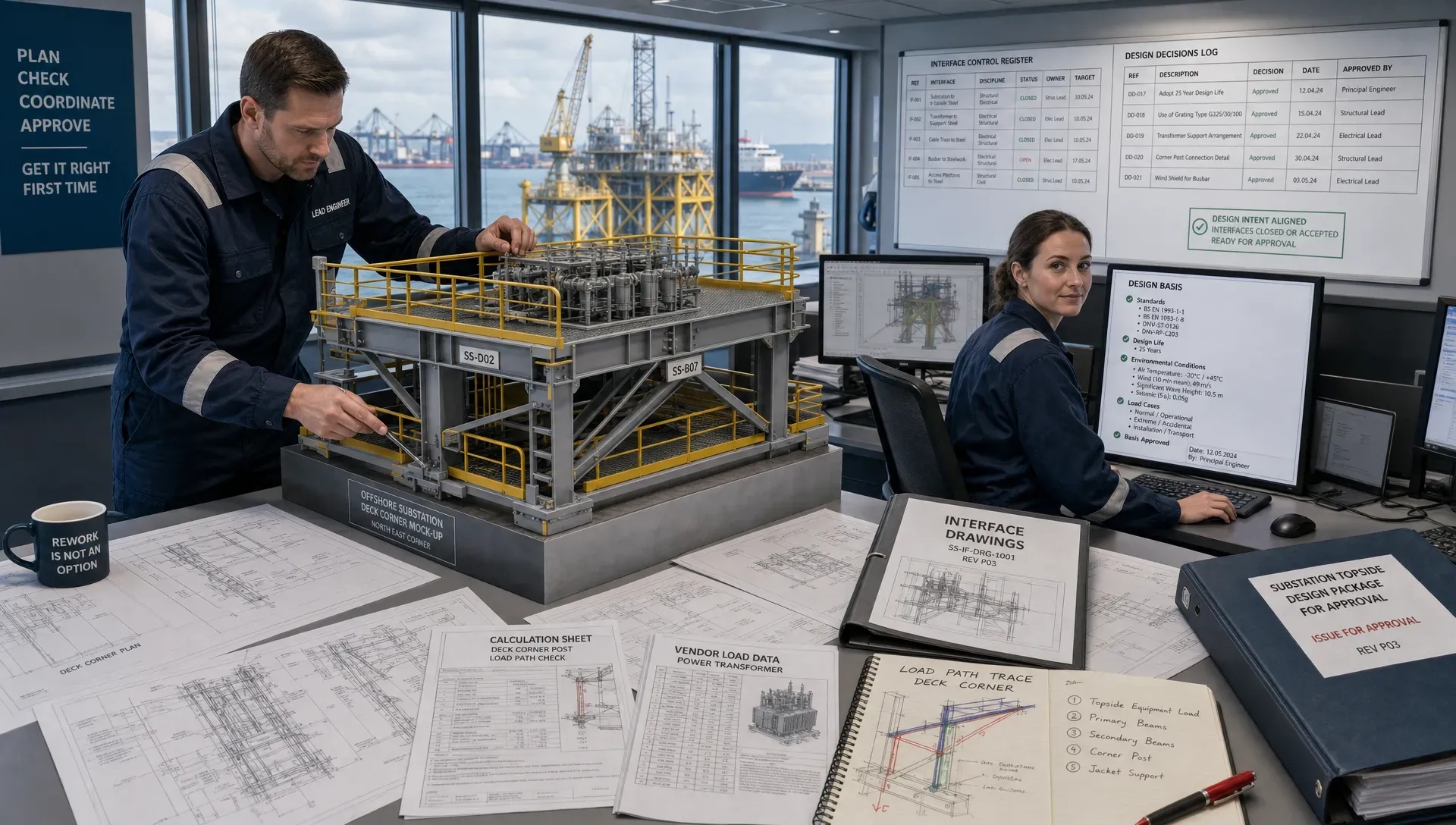
Class approval is not a negotiation of opinions. It is an evidence process. The more clearly a design explains assumptions, load cases, calculation methods and acceptance criteria, the faster technical comments can be addressed.
This is where documentation quality becomes an engineering deliverable in its own right. Calculation reports, FEM models, drawings, stability checks, motion analyses, lifting arrangements, mooring reports and design notes should tell the same technical story. Drawings should match the calculations. Load cases should match the operational procedure. Revisions should be controlled.
For complex vessels or project-specific modifications, it is useful to engage class and Marine Warranty Surveyors early. Early review does not remove the need for detailed engineering, but it can identify rule interpretations, notation issues or documentation expectations before the design is frozen.
The International Association of Classification Societies publishes unified requirements that many class societies apply or reference. While each project still needs its own class-specific review, understanding the broader classification framework helps design teams prepare documentation that is technically complete and easier to assess.
Retrofit design needs special discipline
Retrofit projects often carry more uncertainty than newbuilds. Existing structure may not match drawings. Weight records may be incomplete. Piping systems may have been modified several times. Access may be restricted. Class history, vessel condition and operational constraints all influence the design.
For this reason, retrofit ship design should start with verification of available data. Laser scans, onboard surveys, plate thickness measurements, updated weight estimates and interface checks can prevent expensive surprises. When uncertainty remains, it should be captured in the design assumptions and managed through inspection hold points or contingency measures.
Approval-ready retrofit engineering also needs clear boundaries. Reviewers must understand what is new, what is existing, what is being modified and how the modified area connects to the vessel’s approved condition. This is particularly important for vessel retrofits involving decarbonisation systems, mission equipment, deck reinforcements, piping changes or class notation upgrades.
Marine operations should influence the ship design
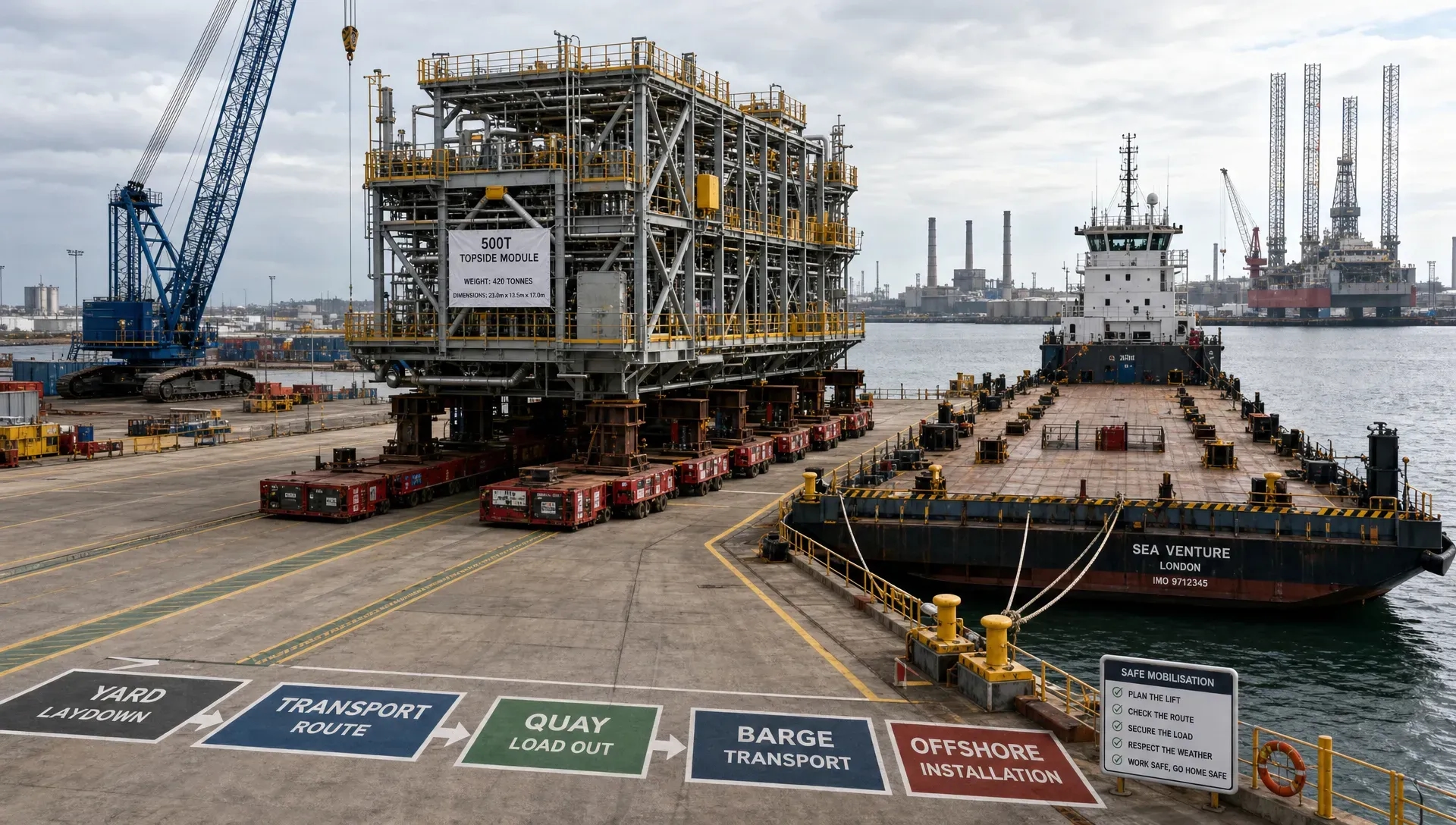
Many approval issues appear when the vessel design and marine operation are developed separately. A vessel may be structurally adequate but operationally awkward. A deck may have enough strength but insufficient access for rigging. A lifting arrangement may work in theory but conflict with vessel motions, crane outreach, sea fastening or mooring limits.
Ship design choices should therefore be tested against real operations. For offshore contractors, that includes mobilisation, deck loading, seafastening, transit, lifting, towing, installation, demobilisation and emergency response. For shipyards, it includes construction sequence, launching, commissioning and trials. For vessel owners, it includes routine maintenance, future modifications and operational flexibility.
This is where multidisciplinary coordination adds value. Naval architects, structural engineers, heavy lift engineers, marine engineers and operations teams need to work from the same assumptions. When they do, the final design is more likely to be safe, buildable and approval-ready.
Practical ship design choices that reduce approval comments
Approval comments cannot be eliminated, but their volume and severity can be reduced by disciplined design choices. The most effective decisions are often practical rather than exotic.
Strong approval performance usually comes from:
- Early confirmation of class notation, flag requirements and operational design cases.
- Consistent weight control, including supplier data, margins and centre of gravity tracking.
- Structural arrangements with direct load paths and accessible welds.
- FEM models that match the physical design and clearly show boundary conditions.
- Drawings that are complete, coordinated and aligned with calculation reports.
- General arrangements that protect escape routes, inspection access and maintenance space.
- Piping and equipment layouts that avoid late clashes with structure, ventilation and safety systems.
- Clear revision control and traceability from design basis to final deliverables.
These choices also support cost control. Fewer late changes mean fewer production interruptions, less rework, fewer emergency reinforcements and more predictable mobilisation planning.
How Fusie Engineers supports safer, approval-ready ship design
Fusie Engineers supports ship design, vessel retrofit, marine engineering, offshore structural design, heavy lift engineering, piping design and steel detailing for clients in maritime, offshore wind, energy, decommissioning, dredging and related sectors.
The value is not only extra engineering capacity. Complex marine projects need engineering judgement that connects calculations with fabrication, class review and offshore execution. Fusie Engineers brings mechanical designers, structural engineers, heavy lift engineers and naval architects together so that vessel behaviour, structural capacity, lifting operations, mooring constraints, fabrication and approval documentation are considered as one connected scope.
Depending on the project, deliverables can include FEM calculations, motion analyses, lifting arrangements, mooring reports, stability checks, drawings and approval documentation for class societies such as DNV, Lloyd’s Register and ABS, as well as Marine Warranty Surveyor review. This integrated approach helps clients reduce technical risk while keeping practical project constraints in focus.
Frequently asked questions
What ship design choices have the biggest impact on safety? The most important choices are the design basis, hull form, stability strategy, structural load paths, watertight subdivision, machinery layout, fire safety arrangement and access for inspection and maintenance. These decisions shape how the vessel behaves in service and how easily the design can be verified.
How can ship design reduce class approval delays? Approval delays are reduced by defining class and flag requirements early, maintaining consistent documentation, aligning calculations with drawings, controlling revisions and engaging reviewers before major design decisions are frozen. Clear evidence is usually more effective than late explanations.
Why is buildability important for vessel safety? Buildability affects weld quality, inspection access, assembly accuracy and production sequence. A design that is hard to fabricate may increase the risk of defects, rework and schedule pressure, all of which can influence safety and approval confidence.
When should stability be assessed in a ship design project? Stability should be assessed from the concept phase, not only near final approval. Early stability checks help manage weight growth, vertical centre of gravity, load cases, free surface effects and damage stability requirements before arrangements become difficult to change.
Do retrofit projects need a different ship design approach? Yes. Retrofit projects must account for existing structure, legacy drawings, vessel condition, restricted access, class history and unclear interfaces. Survey data, weight verification and clear documentation of new versus existing work are essential.
Need ship design support for a complex vessel or retrofit?
If your project involves a new vessel, retrofit, offshore installation vessel, mission equipment, heavy deck loads, piping changes or class approval pressure, early engineering decisions will determine how much risk you carry later.
Fusie Engineers supports clients from concept and calculations through detailed engineering, steel detailing and approval documentation. Our team focuses on practical, buildable and safe ship design that can stand up to fabrication, class review and real marine operations.