


Engineering fabrication choices that reduce yard delays
2026-07-18
Yard delays are often treated as fabrication problems, but many of them are created much earlier. A drawing issue, a late class comment, an inaccessible weld, a missing lifting detail or a poor material choice can hold up steelwork long before the first offshore mobilisation window is at risk.
For offshore, maritime and energy projects, engineering fabrication choices are not cosmetic decisions. They influence procurement, welding hours, inspection, coating, assembly sequence, loadout readiness and approval speed. When vessel time, crane campaigns and offshore weather windows are fixed, a practical design can protect the schedule as much as it protects the structure.
The key is to make fabrication reality part of engineering from the beginning, not something the yard is expected to solve after release for construction.
Yard delay starts when engineering and fabrication are separated
A technically correct design can still be slow to build. This happens when engineering is completed around analysis results only, while yard constraints are addressed later. The calculations may be sound, but the fabrication team may face awkward weld access, unnecessary material variety, difficult fit-up, heavy temporary works or unclear interface dimensions.
In marine and offshore work, those issues are rarely minor. A grillage may need to match deck capacity and underdeck structure. A lifting frame may require class or MWS review before use. A retrofit bracket may clash with existing piping or cable trays. A seafastening detail may be strong enough on paper, but hard to weld in the position available during mobilisation.
Good engineering fabrication practice brings analysis, detailing, procurement and yard execution into the same decision process. That does not mean compromising safety factors or reducing review discipline. It means designing a solution that is structurally valid, approval-ready and realistic to build within the project constraints.
This is why buildability should be treated as an engineering requirement. The same principle applies to offshore structures, vessel retrofits, ship design, decommissioning supports, dredging equipment modifications and renewable energy installation tools. If the design cannot be fabricated, inspected and installed efficiently, it has not solved the project problem.
For related guidance on early design decisions, Fusie Engineers has also discussed structural engineering choices that improve buildability offshore.
Fix the fabrication concept before optimising the steel
Many delays start when a design is optimised before the fabrication route is understood. The structure may look efficient in a finite element model, but later require complex weld sequencing, special handling, multiple trial fits or last-minute temporary supports.
Before reducing plate thickness or rearranging stiffeners, the project team should define the basic fabrication concept. This includes how the structure will be split into modules, where shop welds end and site welds begin, how the item will be turned, lifted, transported, coated and finally installed.
For example, a support frame for offshore installation equipment might be lighter if the bracing is tightly arranged around load paths. Yet if that layout blocks welding access or makes coating impossible after assembly, the yard may lose more time than the design saves in steel weight. A slightly heavier detail with better access, fewer weld positions and clearer inspection routes may reduce total project cost.
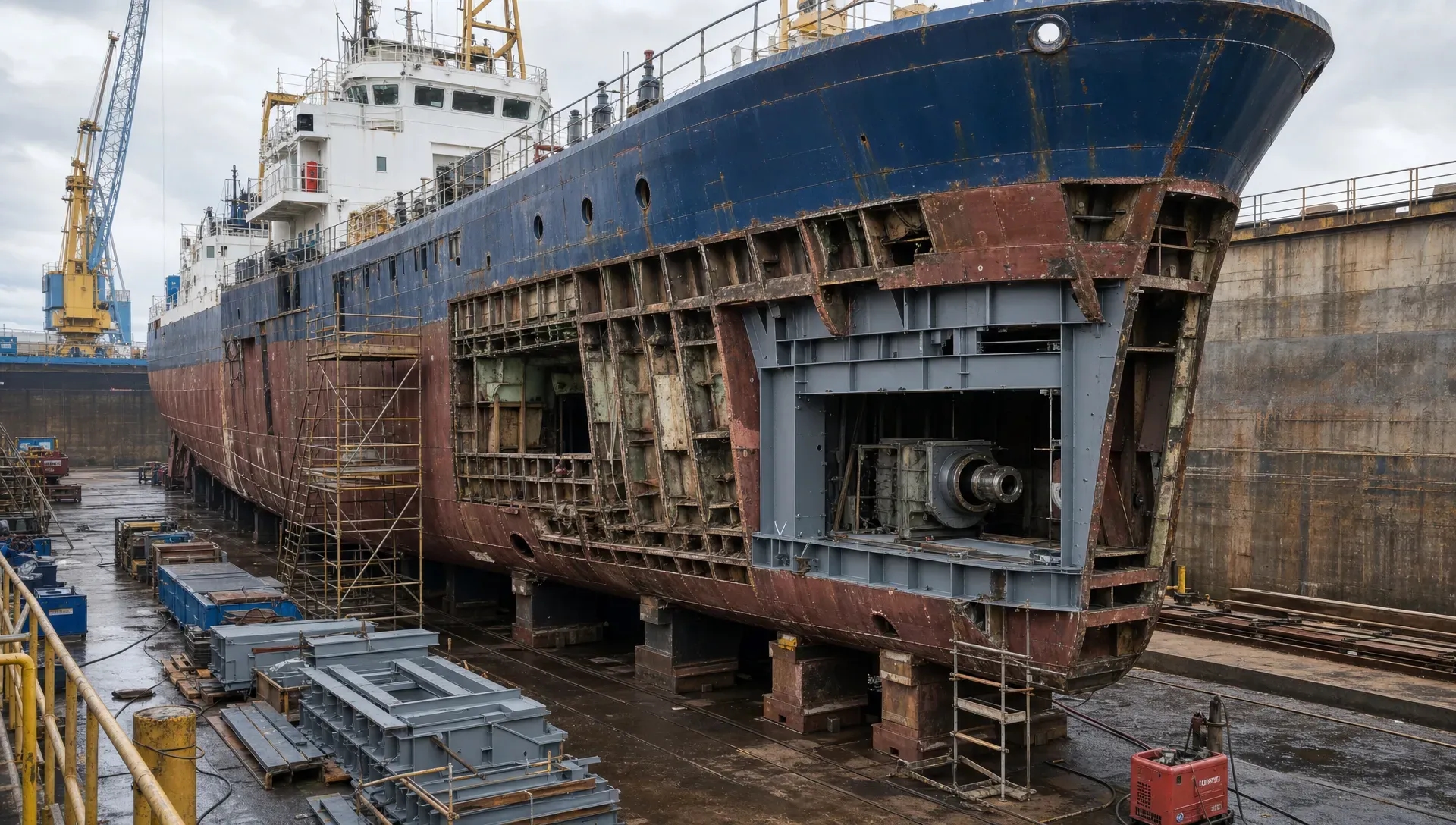
The same thinking applies to shipyard retrofit scopes. A compact new equipment foundation may look attractive, but if it requires extensive hot work in a congested machinery space, clashes with existing systems or needs repeated class clarification, it can disrupt the docking schedule.
Practical optimisation is not only about minimum mass. It is about the best balance between structural performance, fabrication hours, material availability, inspection, approval and installation risk.
Choose material and profiles that procurement can actually support
Material choice is one of the simplest ways to either protect or damage a yard schedule. Offshore and maritime projects often require controlled material grades, traceability, toughness requirements and compatibility with class rules. If the engineering package specifies too many unusual plate thicknesses, special grades or uncommon sections, procurement becomes a critical path risk.
Standardisation helps. Where possible, designers should rationalise plate thicknesses, profile sizes and material grades without overloading the structure. This simplifies ordering, nesting, cutting, traceability and replacement if a component is damaged or rejected.
Useful material decisions include:
- Limiting unnecessary variation in plate thickness and profile sizes.
- Checking local availability before specifying unusual sections or grades.
- Aligning material requirements with class, fatigue, temperature and corrosion conditions.
- Avoiding exotic material choices unless the technical benefit is clear.
- Considering fabrication waste, nesting efficiency and replacement lead times.
This does not mean selecting weaker or cheaper material by default. It means making material decisions that support the full project route. In offshore wind, ship repair, heavy lift and traditional energy work, a delayed plate order can hold up far more than one assembly. It can affect welding sequence, coating programme, loadout, MWS inspection and mobilisation.
Good engineering teams therefore evaluate material efficiency together with procurement and fabrication risk. A design that saves a few hundred kilograms of steel but introduces a long-lead material may not be the best project decision.
Design welds for access, quality and inspection
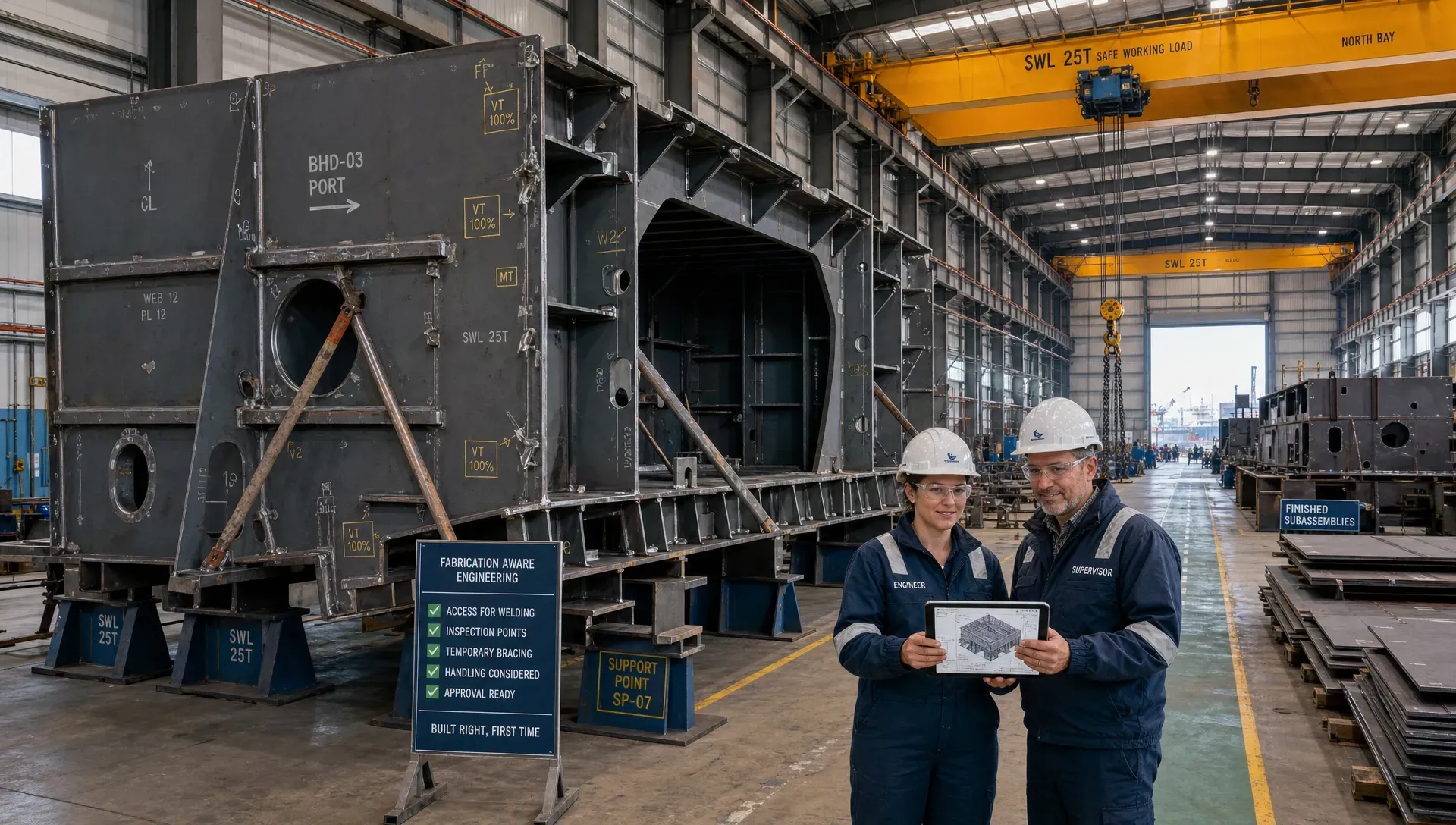
Welding often drives yard hours more than steel tonnage. A lighter design with dense welds, awkward geometry or poor access can take longer to fabricate than a slightly heavier but cleaner structure.
Weld choices affect fit-up, preheating, distortion control, welder position, non-destructive testing, repair probability and coating access. They also affect approval, especially where weld details are part of load-bearing structures, lifting points, seafastening, fatigue-sensitive details or class-reviewed modifications.
A fabrication-aware design asks practical questions early. Can the welder reach the joint safely? Can the weld be made in a favourable position? Is there enough clearance for NDT? Will the weld shrinkage distort critical dimensions? Can the joint be inspected after adjacent components are installed? Does the weld detail require avoidable grinding, gouging or repair risk?
In many yard delay cases, the issue is not one difficult weld. It is the accumulation of small difficult welds across a structure. Brackets, doubler plates, stiffeners and gussets can multiply production time when their geometry is not coordinated. Clear weld symbols, realistic throat sizes, accessible joint preparation and consistent detailing reduce uncertainty on the shop floor.
For offshore structures, heavy lift tools and seafastening systems, weld design should also be aligned with the review basis. If the MWS or class society needs to verify load paths and connection capacity, vague weld details or late weld changes can stop fabrication progress.
Control tolerances before fit-up becomes rework
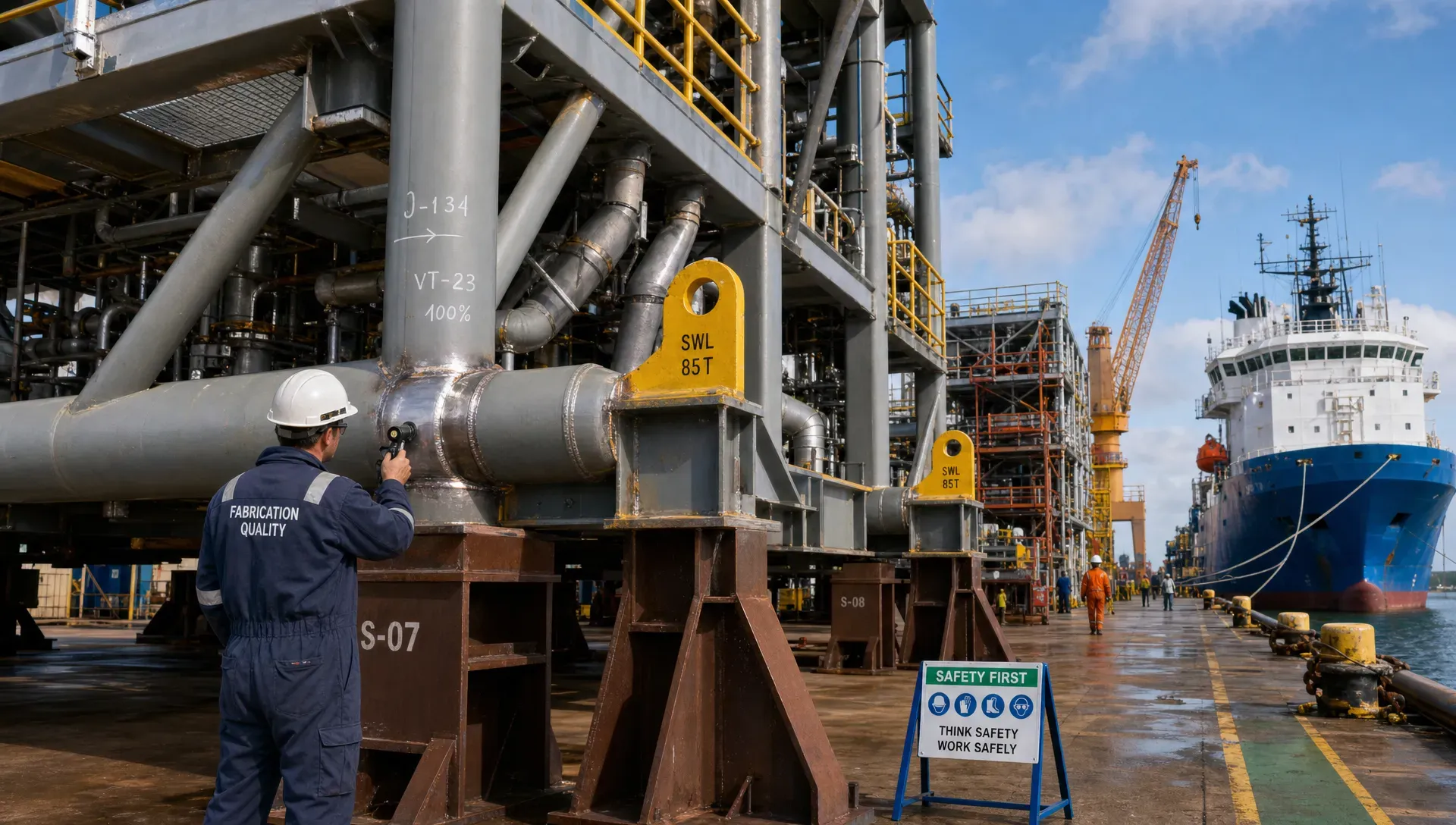
Fabrication tolerances are not only a yard issue. They need to be considered in engineering, especially where new steel connects to existing vessels, deck structures, machinery foundations, piping, skids or installation equipment.
Retrofit projects are particularly exposed. Legacy drawings may not match the as-built condition. Deck camber, previous repairs, local deformation, undocumented penetrations and old piping routes can all affect the new design. If engineering assumes ideal geometry, the yard may discover the real interface only after prefabrication.
Survey and interface control reduce this risk. Laser scans, targeted measurements, inspection photographs and verified reference points can help the engineering team design around the actual vessel or site condition. Where uncertainty remains, details can be designed with controlled adjustability, site-fit allowances or bolted interfaces, provided these choices are structurally justified and acceptable for class review.
Tolerance planning is also important for larger assemblies. Module split lines, flange faces, pin holes, guide systems, lifting lug alignment and grillage support points need realistic fabrication and assembly allowances. Overly tight tolerances can cause unnecessary rework. Overly loose tolerances can create alignment problems during installation.
For vessel modification work, the connection between engineering, yard surveys and approval requirements is critical. Fusie Engineers covers this in more detail in its article on how vessel retrofit engineering avoids class and yard delays.
Bring lifting, turning and transport into the fabrication design
A structure is not complete when it passes strength checks in its final operating condition. It must also survive and function through fabrication, handling, transport, loadout and installation. These temporary phases often create the highest practical risk to the yard schedule.
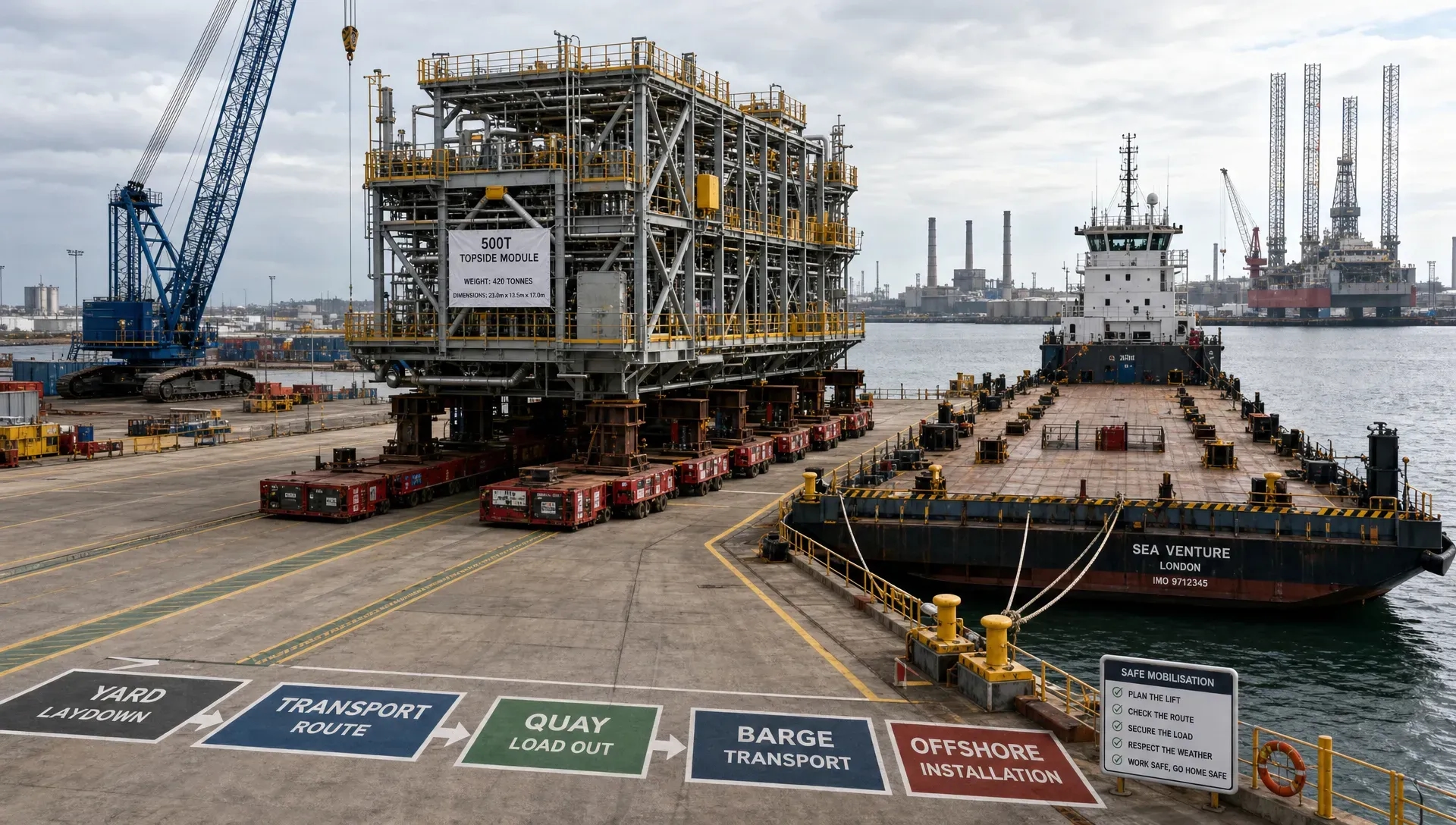
Large offshore and maritime structures may need to be turned in the workshop, moved between fabrication bays, transported to quay, lifted onto a vessel, seafastened, mobilised and then lifted again offshore. Each step introduces local load cases, centre of gravity considerations, crane limitations, sling angles, clearance issues and support reactions.
If lifting points, temporary stiffeners, transport supports and grillage interfaces are added late, they can require rework to completed steel. In worse cases, coating has to be repaired, welds need additional inspection or class documentation must be revised during the final yard phase.
Engineering should therefore include temporary works as part of the design strategy. Lifting lugs, padeyes, trunnions, spreader beam interfaces, strongbacks, sea transport supports and deck grillages should be checked early against the fabrication and mobilisation sequence. This is especially important for heavy lift engineering, offshore wind foundation transport, decommissioning structures and large shipyard assemblies.
A design that is easy to build but difficult to move is still a schedule risk.
Make coating, drainage and maintenance part of the geometry
Coating delays are common in yards because they occur late, often after fabrication has already consumed schedule float. Poor geometry can make this worse. Narrow gaps, closed pockets, difficult blast access, water traps and inaccessible corners can lead to coating repair, hold-point delays or long-term corrosion concerns.
For marine environments, design geometry should support surface preparation and coating quality. Drainage, venting, access holes, lifting arrangements and sequencing should be considered before steel is cut. If parts need to be coated before final assembly, the connection detail must allow it. If areas will be masked for welding or bolting, that work should be reflected in the fabrication plan.
Maintenance access matters too. Vessel owners, offshore contractors and renewable energy developers do not only need the structure delivered. They need it to remain inspectable and maintainable after installation. A detail that is difficult to access during fabrication is often difficult to inspect in service.
This is where fabrication and lifecycle thinking meet. Practical geometry can reduce yard delays now and reduce inspection problems later.
Release approval-ready information, not just drawings
In offshore and maritime projects, fabrication can be delayed even when the yard has drawings. If the approval package is incomplete, unclear or inconsistent, class, MWS or client reviewers may stop progress until the basis is clarified.
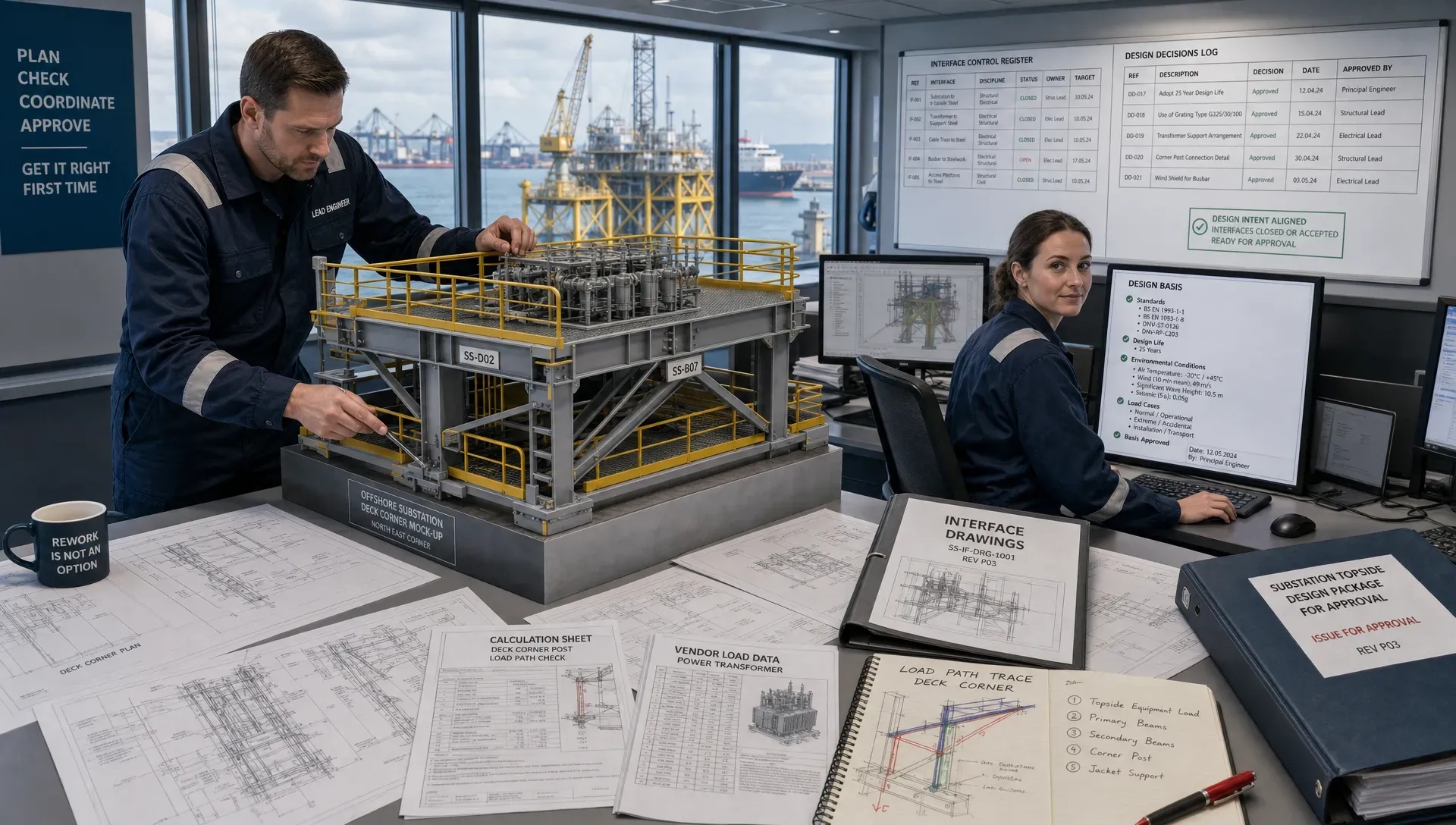
Approval-ready engineering typically needs more than structural drawings. Depending on scope, it may include design basis documents, load cases, FEM calculations, motion or stability checks, lifting analyses, mooring reports, seafastening calculations, weld assumptions, material specifications, revision histories and inspection requirements.
Class society and MWS reviewers need traceability. They need to understand what loads were used, which rules or standards apply, how interfaces were checked and how the drawings reflect the calculations. Organisations such as DNV maintain detailed rules and standards that project teams must interpret correctly for the relevant vessel, structure or operation.
Incomplete documentation creates two types of delay. The obvious delay is review time. The hidden delay is yard uncertainty. If a fabricator is not sure whether a detail is approved, superseded or still under review, production control becomes cautious. That caution is understandable, because fabricating the wrong revision can be expensive and unsafe.
A controlled engineering package should make it clear which information is approved for procurement, which is approved for fabrication and which is still subject to review. Revision discipline is not administration. It is schedule protection.
Use steel detailing to remove shop-floor interpretation
Steel detailing is where engineering intent becomes fabrication instruction. If this step is rushed or treated as simple drafting, the yard may be left to interpret connection geometry, weld details, cut lengths, hole positions, assembly sequence and bill of material information.
Good detailing reduces questions before they reach the shop floor. It coordinates part marks, material take-offs, weld symbols, assembly drawings, bolt lists, profile orientation and interface dimensions. It also helps identify clashes between structural members, piping, equipment and access requirements before fabrication starts.
The value is especially high in marine fabrication, where structures often interface with curved hulls, existing decks, local reinforcements, outfitting, cable routes and operational equipment. A small detail error can cascade into hot work, coating repair, alignment issues and delayed inspection.
Fusie Engineers has explored this subject separately in its article on steel detailing workflows that improve marine fabrication speed. The important point here is that detailing should be connected to engineering judgement, not isolated from it.
Coordinate fabrication choices across disciplines
Yard delays often occur at discipline boundaries. Structural engineering may be correct, but the piping route is blocked. Naval architecture may confirm stability, but the temporary loadout support creates local deck reactions above allowable values. Mechanical design may solve the equipment interface, but the access route for installation is not available during the docking period.
These interfaces are common in ship design, retrofits, offshore installation tools, dredging modifications, green technology integrations and decommissioning projects. The more congested the vessel or structure, the more important coordination becomes.
Effective coordination should cover:
- Structural load paths and local reinforcement.
- Vessel stability, deck strength and underdeck structure.
- Piping, equipment, cable trays and access routes.
- Lifting, mooring, seafastening and transport procedures.
- Class, MWS, client and yard review requirements.
The goal is not to slow engineering with unnecessary meetings. The goal is to identify the few decisions that could block fabrication later. A short early review between engineering, operations, fabrication and approval stakeholders can prevent days or weeks of yard rework.
Practical fabrication choices that protect the schedule
Every project has its own constraints, but several engineering choices consistently reduce yard delay risk.
Start by freezing the design basis early enough to support procurement and approval. Late changes to load cases, vessel data, environmental assumptions or interface reactions can force redesign after material has already been ordered.
Keep load paths direct and explainable. This supports calculations, class review and fabrication understanding. Complex local load transfer may be necessary in some cases, but it should be justified and clearly detailed.
Reduce unnecessary material variety. Standardised grades, sections and plate thicknesses improve procurement and production control.
Design welds around access and inspection. Weld geometry should be strong, but also buildable, testable and suitable for the yard environment.
Plan temporary conditions. Lifting, turning, transport, seafastening, grillages and loadout supports should be engineered early, not added during mobilisation.
Control revisions. Clear document status, drawing registers and approval notes help prevent the yard from building to outdated information.
These choices are not separate from engineering quality. They are part of it.
Where Fusie Engineers supports fabrication-ready engineering
Fusie Engineers supports offshore, maritime and energy projects where safety, buildability and approval readiness are closely linked. The team works across offshore structural design, heavy lift engineering, ship design, marine engineering, vessel retrofit, piping design and steel detailing.
That combination matters because yard delays rarely belong to one discipline. A seafastening frame may involve structural calculations, vessel deck checks, lifting arrangements, grillage design, MWS documentation and fabrication drawings. A vessel retrofit may involve class constraints, as-built verification, piping interfaces, steel reinforcement and docking schedule pressure.
Fusie Engineers focuses on practical engineering decisions that reduce fabrication complexity, steel waste, rework and approval risk. The objective is not only to produce calculations and drawings, but to help clients move from concept to fabrication and operational readiness with fewer avoidable delays.
For project teams facing limited internal capacity, complex approval requirements or tight mobilisation windows, an external engineering partner can add targeted support without losing control of technical quality. The best results come when engineering is involved early enough to influence fabrication choices before they become yard problems.
Frequently asked questions
What are engineering fabrication choices? Engineering fabrication choices are design decisions that affect how a structure is procured, cut, welded, assembled, inspected, coated, transported and installed. In offshore and maritime projects, they include material selection, weld access, module splits, tolerances, lifting points, seafastening details, documentation and approval strategy.
Do lighter structures always reduce yard delays? Not always. Reducing steel weight can help, but only if it does not increase weld complexity, material lead time, fit-up difficulty or approval risk. A slightly heavier design with simpler fabrication and clearer inspection access may be faster and more reliable to build.
When should fabrication input be included in engineering? Fabrication input should be included during concept and early detailed design, before key decisions on material, module splits, welding, coating and lifting are fixed. Waiting until issue for construction often leaves the yard with limited options and increases rework risk.
How do class and MWS reviews affect fabrication schedules? Class and MWS reviews can affect fabrication when documentation is incomplete, load cases are unclear or drawing revisions do not match calculations. Approval-ready packages reduce review questions and help the yard understand which information is released for production.
Can Fusie Engineers support only part of a fabrication-critical scope? Yes. Fusie Engineers can support targeted scopes such as offshore structural design, heavy lift checks, vessel retrofit engineering, piping interfaces, seafastening, grillage design or steel detailing, while working alongside the client’s internal engineering and project teams.
Need engineering support that is ready for the yard?
If your project depends on safe, buildable and approval-ready engineering, fabrication choices need to be made before the yard schedule is under pressure. Fusie Engineers can support offshore, maritime, renewable energy, decommissioning and vessel modification projects from concept and calculations through detailed engineering, drawings and review documentation.
To discuss a current scope or upcoming mobilisation, contact Fusie Engineers and involve practical engineering judgement before fabrication risk becomes a yard delay.