


Structural engineering choices that improve buildability offshore
2026-06-15
Offshore buildability is rarely lost in one dramatic decision. It is usually lost through a series of small structural engineering choices that look acceptable in isolation, but create avoidable difficulty once fabrication, mobilisation or installation begins.
A grillage with awkward weld access, a padeye that cannot be inspected properly, a seafastening layout that clashes with deck outfitting, or a reinforcement scheme that ignores underdeck structure can all slow a project down. In offshore work, that delay is not just a yard inconvenience. It can affect vessel readiness, marine warranty surveyor review, weather windows, crane availability and offshore safety.
Good structural engineering offshore is therefore not only about proving that a structure has enough capacity. It is about designing a load path, fabrication method, installation sequence and approval package that can survive contact with the real project environment.
Buildability offshore starts before detailed design
Buildability is often treated as something the fabrication team solves later. That is a costly assumption in offshore, maritime and energy projects. By the time steel reaches the yard, many of the most important choices have already been locked in: member sizes, connection types, access routes, tolerances, lift points, seafastening locations and inspection requirements.
The structural engineer has a direct influence on all of these. A design that performs well in a calculation model may still be difficult to fabricate, heavy to handle, slow to approve or risky to install. A buildable design, by contrast, is one where the engineering logic, workshop reality and offshore operation are aligned from the start.
For EPC contractors, marine contractors, shipyards and renewable energy developers, this alignment is a practical risk control measure. It reduces late redesign, limits offshore modifications and gives approval parties clearer evidence that the proposed solution is safe, traceable and executable.
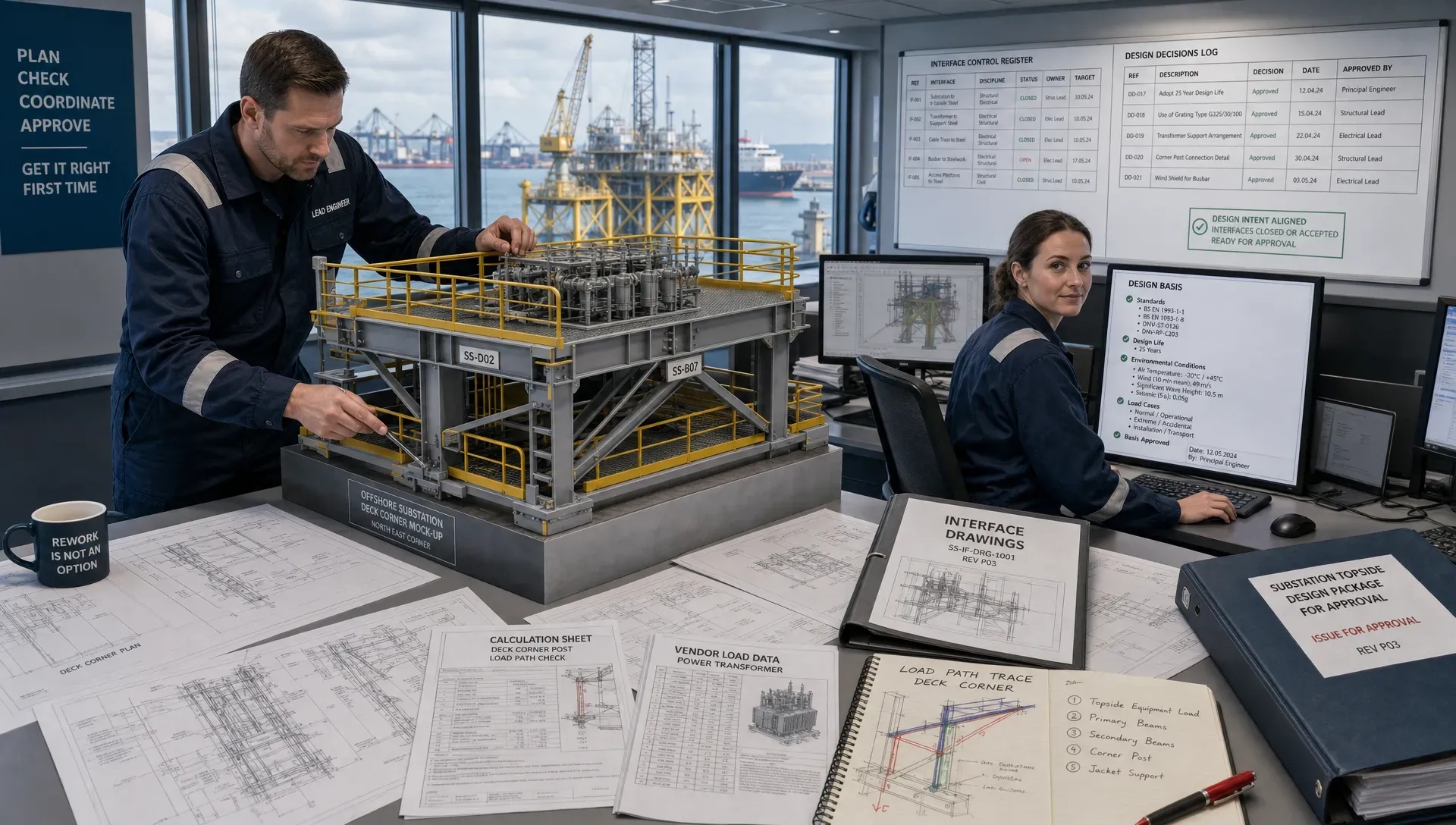
Start with a design basis that reflects the real operation
The first buildability decision is not a plate thickness or a beam size. It is the design basis.
A controlled design basis defines what the structure must do, under which load cases, in which environment and for which approval route. Offshore structures are exposed to combinations of static loads, dynamic amplification, vessel motions, crane motions, wind, waves, accelerations, impact risks and installation tolerances. Temporary structures such as grillages, lifting frames, sea fastenings and custom installation tools may also see short-duration peak loads that are very different from normal in-service conditions.
If these conditions are not understood early, the design can move in the wrong direction. Engineers may add steel where it does not improve the load path, miss critical local effects, or produce documentation that later needs rework for MWS or class review.
A strong design basis should clarify:
- The operational phase being designed for, such as transport, lift, skidding, installation, survival, decommissioning or maintenance.
- The governing loads and load combinations, including dynamic factors and environmental assumptions.
- The applicable codes, class requirements, client standards and marine warranty requirements.
- The known constraints, such as vessel deck capacity, underdeck structure, crane geometry, allowable deflection, access and fabrication limits.
- The required deliverables, including calculations, FEM reports, drawings, procedures and approval documentation.
This may seem basic, but it is where many offshore buildability issues begin. A well-controlled basis allows the design team to make fast decisions without repeatedly reopening fundamental assumptions.
Choose clear load paths before adding steel
One of the most effective ways to improve buildability is to simplify the load path. A direct, logical load path usually requires less steel, creates fewer complex details and is easier for reviewers, fabricators and offshore teams to understand.
In seafastening design, for example, load should transfer efficiently from cargo into grillage, deck structure and vessel support points. If the load path is eccentric, indirect or dependent on secondary members, the design may require extra brackets, thicker plates, larger welds and more local reinforcement. These additions can solve the calculation problem while creating fabrication and access problems.
The same applies to lifting frames, skid systems, boat landings, retrofit foundations and offshore installation aids. When loads are transferred cleanly into primary structure, the result is usually easier to fabricate, easier to inspect and easier to justify during approval.
This does not mean choosing the lightest possible structure. Offshore weight reduction must never undermine robustness, fatigue performance or tolerance sensitivity. The goal is efficient strength: steel placed where it works hardest, with connection details that can be fabricated and verified without unnecessary complexity.
Design for the fabrication sequence, not only the final structure
A structure is not fabricated in its final completed state. It is cut, fitted, tacked, welded, inspected, coated, lifted, transported and installed. Buildability improves when structural engineering accounts for this sequence.
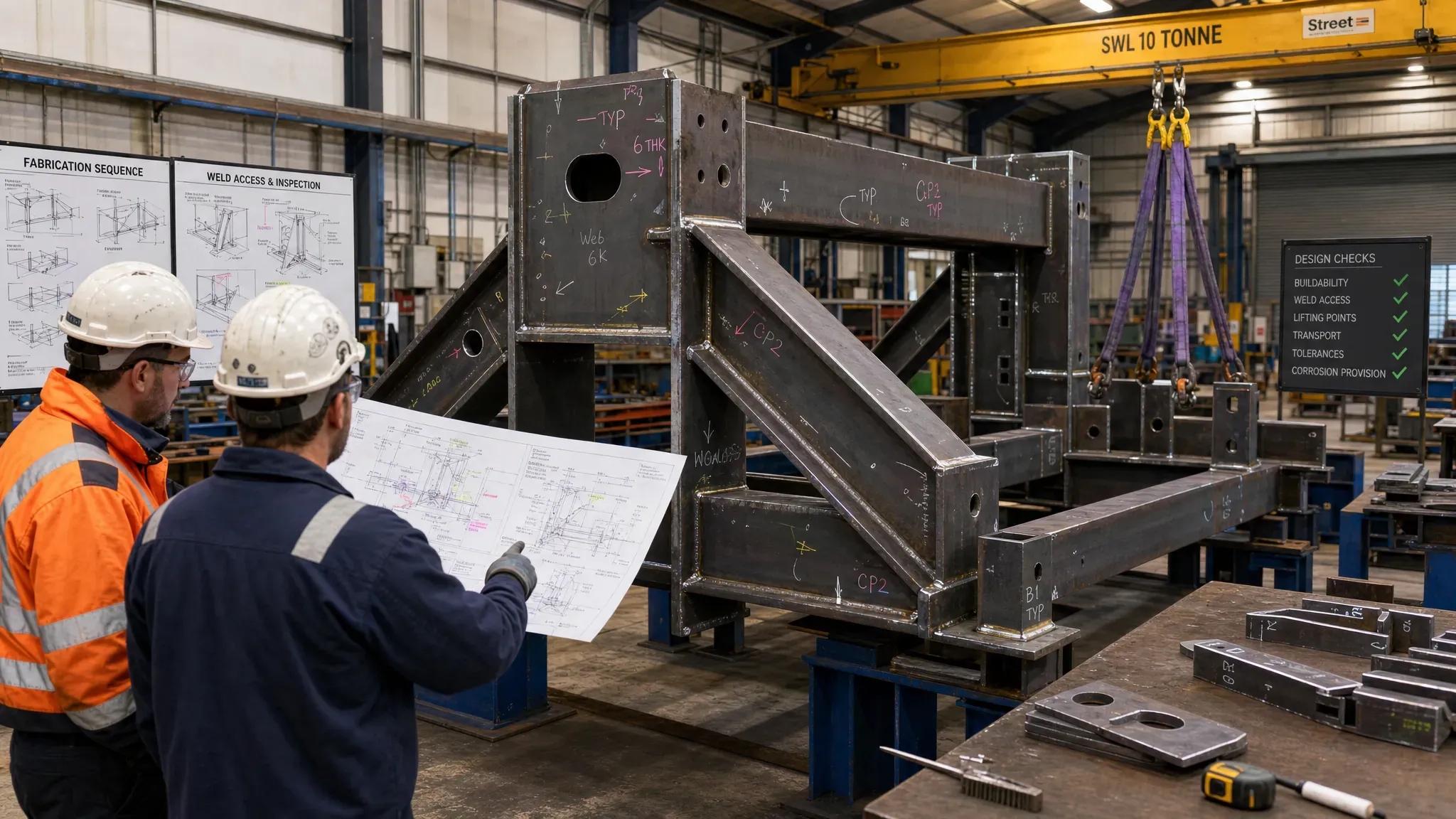
Common fabrication-related design choices include access for welding, space for non-destructive testing, realistic fit-up tolerances, sensible plate thickness transitions, manageable component weights and avoidance of trapped volumes or inaccessible coating areas. These details can strongly influence yard productivity.
Complex nodes may look compact in a 3D model, but if welders cannot reach the root, inspectors cannot access critical areas, or temporary supports are needed at every stage, the design becomes expensive. A slightly larger but more accessible detail may be more reliable, faster and cheaper overall.
The buildability principle is not limited to offshore steelwork. Any project with physical constraints benefits when designers understand how work is executed on site. Even a home renovation company in Dubai must coordinate access, sequencing, trades and approvals before work starts; offshore projects apply the same logic under much tighter safety, load and weather constraints.
For offshore projects, fabrication thinking should be part of concept design. Once procurement has started and yard slots are fixed, changing plate sizes, weld types or module breakdowns can have a disproportionate schedule impact.
Make vessel interfaces a primary structural input
Offshore structures rarely exist in isolation. They sit on, connect to or operate from vessels, barges, floating assets, jack-up vessels, heavy lift vessels or existing offshore structures. The interface with that asset is often the governing buildability constraint.
A seafastening solution may be structurally adequate on paper but unsuitable if it ignores deck load limits, underdeck stiffener positions, hatch covers, equipment foundations, mooring equipment, access routes or vessel stability. A retrofit foundation may pass local checks but create problems with piping, cable trays, fire zones or class boundaries. A lifting arrangement may work for the object being lifted but conflict with crane radius, boom clearance or rigging access.
Vessel-aware structural engineering asks practical questions early. Where does the load actually enter the vessel? Is the deck locally reinforced? Can underdeck stiffeners take the reaction? Will welding to the deck be allowed? Are bolted solutions preferable? Can the vessel still operate, ballast, moor and access critical systems during the scope?
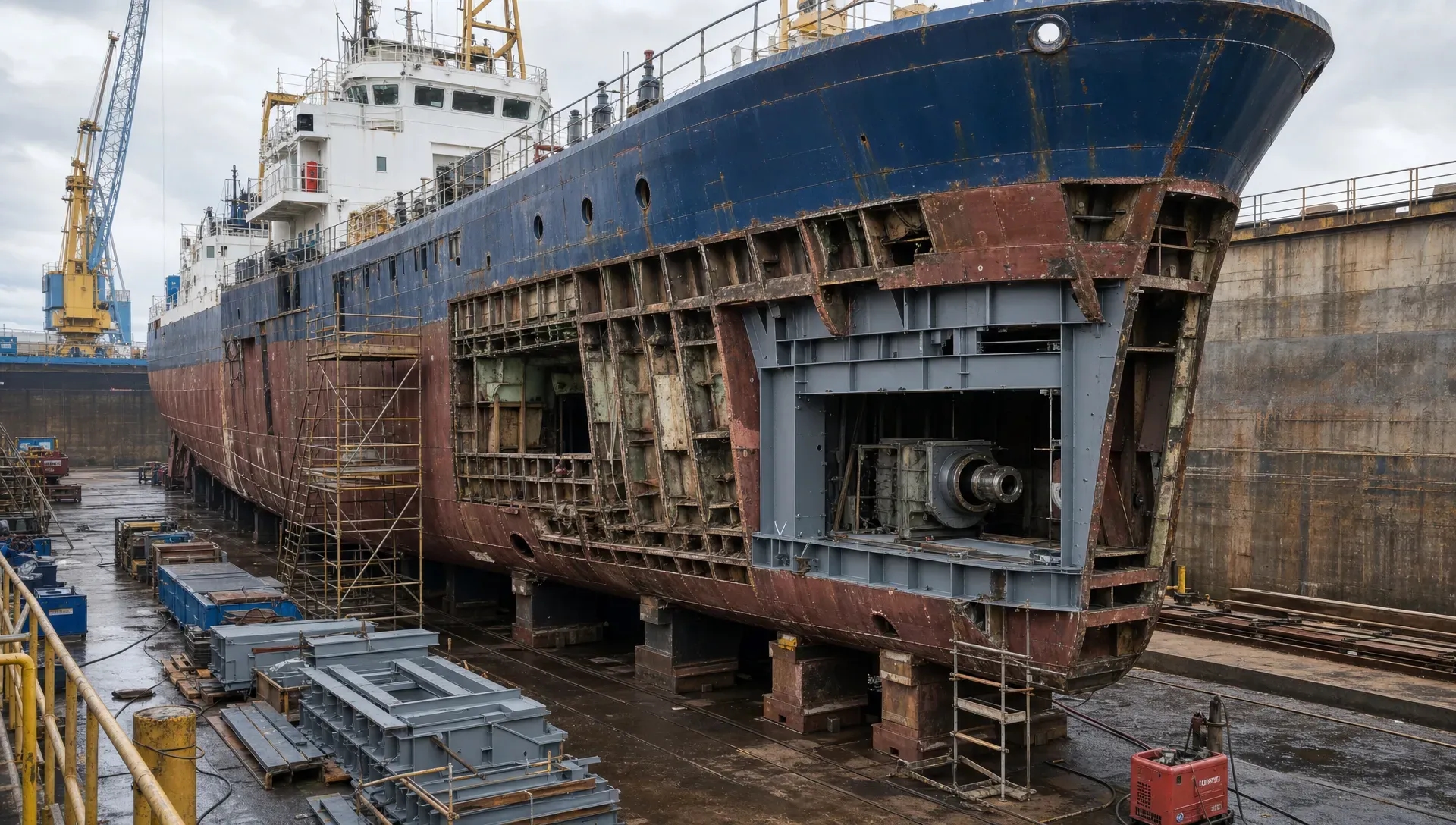
These questions are especially important for vessel retrofits, ship repair, offshore wind transport, decommissioning and heavy lift operations. They connect structural design with naval architecture, marine operations and class requirements. When they are handled late, the result is often rework.
Fusie Engineers discusses this interface-driven approach further in its article on maritime engineering checks that prevent vessel project rework.
Treat temporary works as engineered operational equipment
Temporary offshore structures often carry major project risk. Grillage systems, lifting tools, skidding structures, sea fastenings, deck supports, access platforms and installation aids may be used for a limited period, but they often experience high loads under dynamic conditions.
A buildable temporary works design should be robust, practical and easy to verify. It should not rely on details that are difficult to fabricate accurately or hard to inspect before mobilisation. It should also consider how the structure will be handled in the yard, installed on the vessel, removed after use and transported if required.
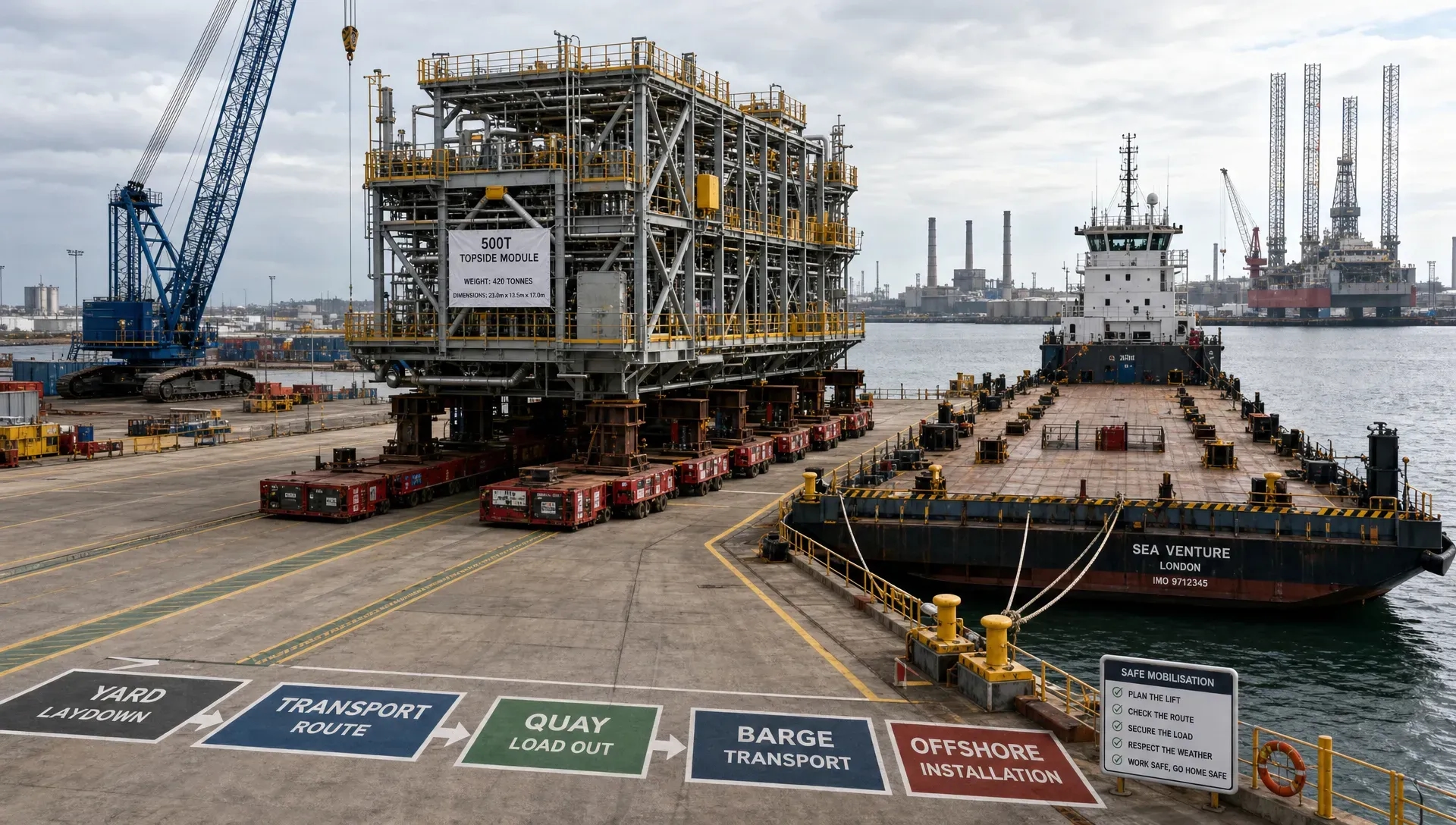
For heavy lift and transport scopes, this means designing around the full operation rather than an isolated capacity check. Sling angles, centre of gravity uncertainty, crane dynamics, lift point eccentricity, module stiffness, deck reactions and contingency cases all influence the final steel arrangement.
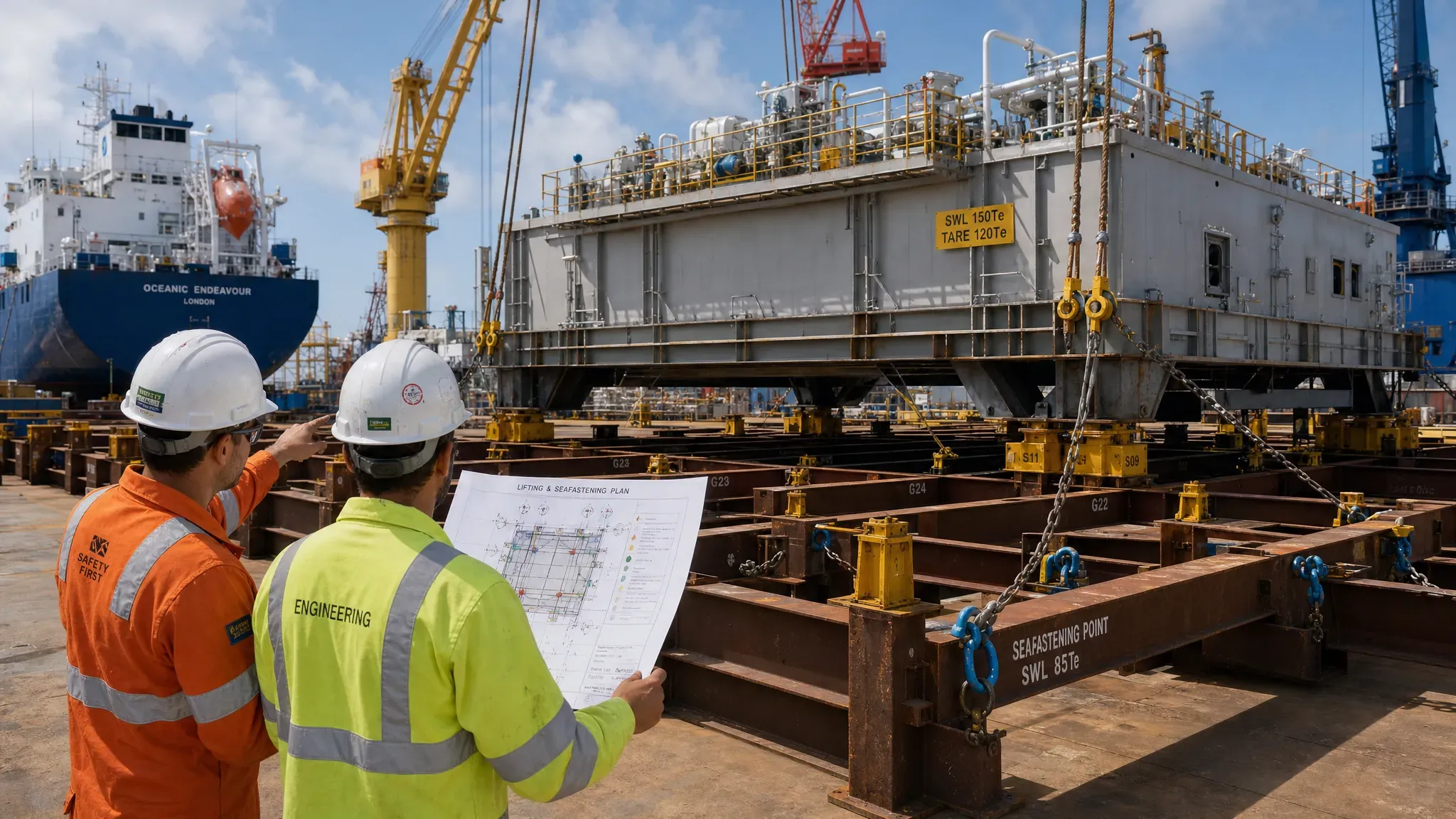
A practical design may include fewer bespoke parts, clearer weld details, modular supports that can be installed quickly, and connection locations that suit the vessel structure. These choices reduce fabrication hours and offshore preparation time without weakening the engineering basis.
For a deeper look at lift-related design factors, see Fusie Engineers’ guide to heavy lift engineering essentials.
Reduce welding complexity where it matters most
Welding is one of the largest cost and schedule drivers in offshore fabrication. It also affects fatigue performance, inspection scope, distortion control and repair risk. Structural engineering choices that reduce unnecessary welding complexity can therefore improve buildability significantly.
This does not mean avoiding welding. It means using welds where they are structurally justified and detailing them so they can be performed consistently. Long full-penetration welds, difficult overhead welds, inaccessible weld toes and tight intersecting plates should be challenged during design review. If a simpler detail can achieve the same structural intent with better access and lower inspection risk, it should be considered.
In fatigue-sensitive areas, such as offshore access structures, boat landings, lifted frames and vessel-mounted supports, weld quality and detail geometry become even more important. Poorly considered details can increase stress concentrations or make inspection difficult. A buildable fatigue detail is one that balances analysis, fabrication method, inspection access and long-term service exposure.
Engineers should also consider distortion. Heavy welds on thin or asymmetric components can cause fit-up problems later in the fabrication sequence. Adding steel to solve a local stress peak may create more welding, more heat input and more correction work. Sometimes the better solution is a revised load path or connection geometry rather than a thicker plate.
Use FEM as a decision tool, not a substitute for engineering judgement
Finite element modelling is valuable in offshore structural engineering, especially for complex load paths, local reinforcement, heavy lift points, deck interaction and retrofit structures. However, buildability improves when FEM is used to support clear decisions rather than produce attractive stress plots.
A useful model should reflect the real structure, real boundary conditions and real load cases closely enough to inform design choices. It should also be simple enough to review, explain and verify. Overly complex models can slow approval and hide assumptions. Overly simplified models can miss local effects that later appear during fabrication or class review.
The most practical approach is often a combination of global checks, local FEM, hand calculations and engineering judgement. Global analysis identifies load distribution. Local analysis verifies critical connections and reinforcements. Hand checks provide independent confidence and help reviewers understand the logic.
This matters for approval readiness. MWS, DNV, Lloyd’s Register, ABS or other review parties need traceable assumptions, understandable load cases and clear conclusions. If the analysis package is difficult to follow, approval cycles can slow down even if the design is technically sound.
Fusie Engineers has also covered this topic in the context of structural design software for offshore workflows.
Bring approval logic into the design from day one
Approval readiness is a buildability issue. A design that cannot be approved in time cannot be built or mobilised on time.
Offshore projects often involve multiple reviewing parties: the client, vessel owner, fabricator, marine warranty surveyor, class society, installation contractor and sometimes the end operator. Each party needs information in a different format and at a different level of detail. If these requirements are not considered early, the engineering team may have to produce additional checks, revise drawings or clarify assumptions late in the programme.
Good structural engineering anticipates the approval route. It defines the code basis, safety factors, material grades, weld assumptions, inspection requirements, load combinations and operational limitations early. It also keeps drawings, calculations and reports consistent with each other.
Typical approval-ready deliverables include a design basis, calculation report, FEM report where required, load case summary, general arrangement drawings, detail drawings, material specifications, weld details, lifting arrangement, seafastening report, transport notes and installation limitations.
The value is not only administrative. Clear documentation reduces ambiguity during fabrication and offshore execution. It helps site teams understand what is critical, what tolerances apply and where changes must be reviewed before implementation.
Involve steel detailing before the design is frozen
Steel detailing is often treated as the next step after engineering. In offshore work, it should influence engineering before the design is frozen.
Early detailing input can identify clashes, poor weld access, difficult plate developments, unsuitable connection geometry, excessive part counts and unclear tolerances. These issues are much cheaper to solve before drawings are issued for fabrication.
A detailer with marine fabrication experience can also help rationalise the structure. Standard sections, repeatable plates, logical stiffener layouts and clear assembly breakdowns can reduce fabrication time. This is particularly valuable for repeated offshore wind components, vessel retrofit packages, temporary deck structures and custom installation tools.
The goal is not to let detailing override structural performance. It is to ensure the structural solution can be translated into shop drawings and fabricated without unnecessary interpretation. Fusie Engineers explains this relationship in more detail in why steel detailing matters in marine fabrication.
Consider installation, inspection and maintenance access
A buildable offshore structure must be workable after fabrication. Installation access, bolt tightening space, rigging clearance, inspection routes, coating repair access and future maintenance should all be considered during structural design.
For example, a padeye may be structurally adequate but positioned where rigging cannot be connected safely. A bolted interface may look efficient but leave no room for torque tools. A reinforcement plate may solve a stress issue but block inspection of an existing weld. A new retrofit foundation may clash with piping routes or create drainage problems.
These are not minor details. Offshore work is performed under time pressure, often with limited access, weather exposure and strict permit controls. If a design requires awkward manual handling, hot work in a difficult area or extensive temporary access offshore, it increases cost and risk.
Good structural engineering therefore looks beyond the calculation report. It asks how the object will be lifted, aligned, fastened, inspected, removed and maintained. These questions improve both buildability and operational safety.
Practical signs of a buildable offshore structural design
A buildable design is not always the simplest-looking design. It is the design that aligns strength, fabrication, vessel interface, approval and offshore execution.
Strong signs include:
- The load path can be explained clearly without relying on hidden assumptions.
- The design uses steel efficiently rather than adding reinforcement everywhere.
- Welds and inspection areas are accessible in the real fabrication sequence.
- Vessel deck reactions and underdeck structure have been checked early.
- Temporary works can be installed, removed and handled safely.
- Drawings, calculations and reports tell the same technical story.
- MWS and class requirements are considered before formal submission.
- Fabrication tolerances and installation tolerances are realistic.
- The design leaves space for rigging, access, coating, inspection and maintenance.
When these signs are missing, projects may still reach approval, but they often consume more engineering hours, more yard time and more contingency than necessary.
How Fusie Engineers supports buildable structural engineering
Fusie Engineers supports offshore, maritime and energy projects where structural engineering must connect directly to fabrication, approval and execution. The team works across offshore structural design, heavy lift engineering, ship design, vessel retrofits, piping design, marine engineering and steel detailing.
This multidisciplinary capability is important because buildability problems rarely sit inside one discipline. A grillage decision may affect vessel strength. A lift point may affect crane rigging and fabrication sequence. A retrofit foundation may affect piping, class boundaries and access. A seafastening layout may influence transport procedure, deck utilisation and MWS documentation.
By combining structural engineers, heavy lift engineers, naval architects, mechanical designers and detailers, Fusie Engineers helps clients make practical decisions earlier. Deliverables can include FEM calculations, motion analyses, lifting arrangements, mooring reports, stability checks, fabrication drawings and approval documentation, depending on the project scope.
The objective is straightforward: safe, buildable and approval-ready engineering that reduces rework, controls steel use and supports on-time mobilisation.
Frequently asked questions
What does buildability mean in offshore structural engineering? Buildability means the structure can be fabricated, transported, installed, inspected and approved without unnecessary complexity or rework. It connects calculation strength with real yard and offshore execution constraints.
How early should buildability be reviewed? Buildability should be reviewed during concept and preliminary design, not only during detailing. Early decisions on load paths, vessel interfaces, welding, tolerances and approval requirements have the largest impact on cost and schedule.
Does reducing steel weight always improve buildability? No. Lower weight can reduce transport and fabrication cost, but only if the structure remains robust, accessible and practical to fabricate. A very light design with complex welding or tight tolerances may be less buildable than a slightly heavier, simpler solution.
How do MWS and class requirements affect buildability? MWS and class requirements influence load cases, safety factors, documentation, inspection requirements and allowable modifications to vessels or structures. Considering these requirements early helps prevent late redesign and approval delays.
When should an external structural engineering partner be involved? An external partner should be involved when the scope includes complex load paths, tight deadlines, vessel interfaces, heavy lifts, seafastening, retrofits, class approval or insufficient internal capacity. Early involvement usually provides the most value.
Need structural engineering support for a buildable offshore scope?
If your project depends on safe fabrication, timely approval and reliable offshore execution, Fusie Engineers can help turn structural requirements into practical engineering deliverables.
From seafastening, grillages and heavy lift structures to vessel retrofits, ship design, marine engineering and steel detailing, the team focuses on solutions that work in the yard, on the vessel and during offshore operations.
Contact Fusie Engineers to discuss structural engineering support for your next offshore, maritime or energy project.