

How offshore wind engineering shapes safer farm delivery
2026-06-03
An offshore wind farm is delivered through thousands of connected engineering decisions. Each decision affects whether foundations can be transported without overstress, whether lifting points behave as assumed, whether a vessel remains within allowable limits, whether temporary steel can be fabricated on time, and whether the marine warranty surveyor can approve the operation without late rework.
For developers, EPC contractors, marine contractors and vessel owners, safer farm delivery is not only about compliance. It is about making the project executable under real offshore conditions, with clear load paths, practical fabrication details, controlled interfaces and documentation that supports timely review. The earlier offshore wind engineering is connected to transport, lifting, installation and approval requirements, the lower the chance of costly surprises during mobilisation or offshore execution.
What safer delivery means in an offshore wind farm
Safer delivery covers the full chain from concept engineering to final offshore installation. It includes the way monopiles, transition pieces, jackets, substations, cable equipment, vessel modifications and temporary installation aids are designed, transported, lifted and secured. A technically correct design can still create risk if it is hard to fabricate, difficult to inspect, slow to approve or incompatible with the selected vessel.
In practice, safe offshore wind farm delivery depends on four engineering outcomes:
- The design is strong enough for operational, transport, lifting, fatigue and accidental load cases.
- The solution is buildable with available fabrication methods, materials, welding access and tolerances.
- The installation method is realistic for the selected vessels, ports, cranes, weather windows and offshore sequence.
- The documentation is traceable enough for client review, marine warranty surveyor approval and class involvement where required.
The challenge is that these outcomes are interdependent. Increasing local reinforcement may solve one stress issue but introduce fabrication complexity, weight growth or vessel capacity problems. Reducing steel may improve cost and handling but create fatigue, buckling or local load transfer concerns. Good offshore wind engineering balances these constraints with the execution plan in mind.
The design basis sets the safety envelope
A reliable design basis is the starting point for safe delivery. It defines the engineering assumptions that will govern calculations, drawings, temporary works and approval documentation. If the design basis is incomplete or inconsistent, errors can spread into transport frames, seafastening, lifting arrangements, vessel checks and offshore procedures.
For offshore wind projects, the design basis should capture more than structural loads. It should include metocean conditions, vessel particulars, port restrictions, crane data, allowable deck loads, grillage interfaces, underdeck structure, motion criteria, class requirements, marine warranty requirements, fabrication tolerances, survey data and operational hold points.
This is where early engineering judgement matters. A team may know that a vessel deck can take a certain global load, but local deck structure, load spreading, welding constraints or access restrictions may still limit the solution. A concept that appears efficient in a model may be impractical once the actual vessel drawings, deck penetrations, sea fastening weld access or jacking sequence are considered.
A robust design basis also prevents uncontrolled assumption changes. Offshore projects move quickly, especially when procurement, fabrication and marine operations run in parallel. When crane configuration, cargo orientation, centre of gravity, sea state limits or vessel selection changes, the design basis gives teams a controlled way to identify which calculations, drawings and procedures must be updated.
Structural design must support transport, lifting and installation
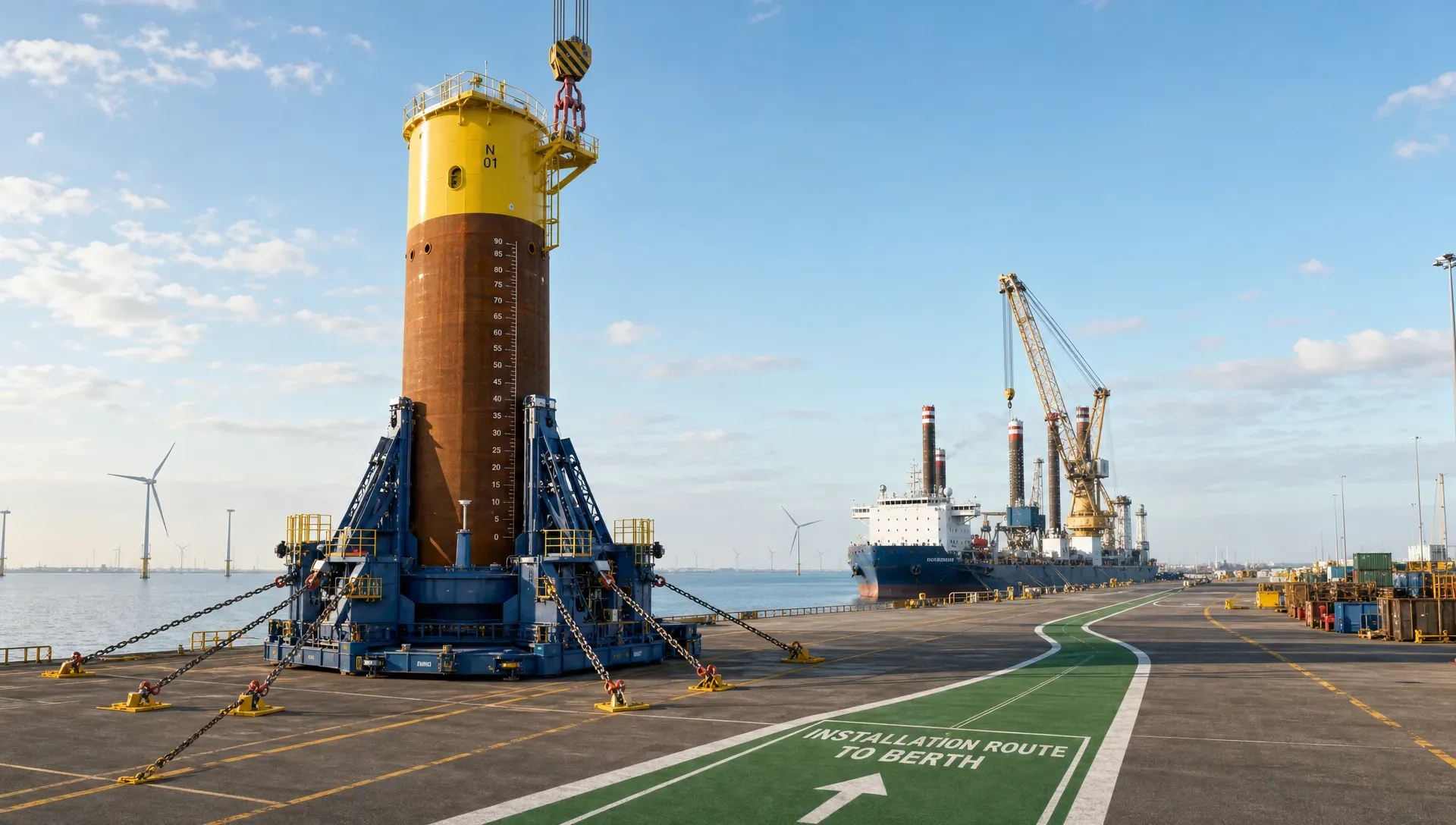
Permanent offshore wind structures are designed for decades of service, but they must also survive short, high-risk phases before they reach their final location. Load-out, sea transport, lifting, upending, positioning, temporary support and installation can produce governing load cases that are very different from in-place operation.
Structural engineering therefore needs to consider both permanent and temporary conditions. Monopiles, transition pieces, jackets and topsides may require temporary supports, trunnions, grillages, saddles, lift points, access platforms, sea fastening brackets or installation aids. Each item introduces load paths into the main structure and into the vessel or support frame.
Finite element method calculations can be valuable for checking local stresses, buckling, contact areas and load transfer. However, FEM is only as reliable as the engineering assumptions behind it. Boundary conditions, load combinations, mesh quality, weld modelling and load introduction details all need careful review. Offshore wind engineering teams must understand when a simplified hand calculation is sufficient, when a detailed FEM model is justified, and how to reconcile both into a clear design narrative.
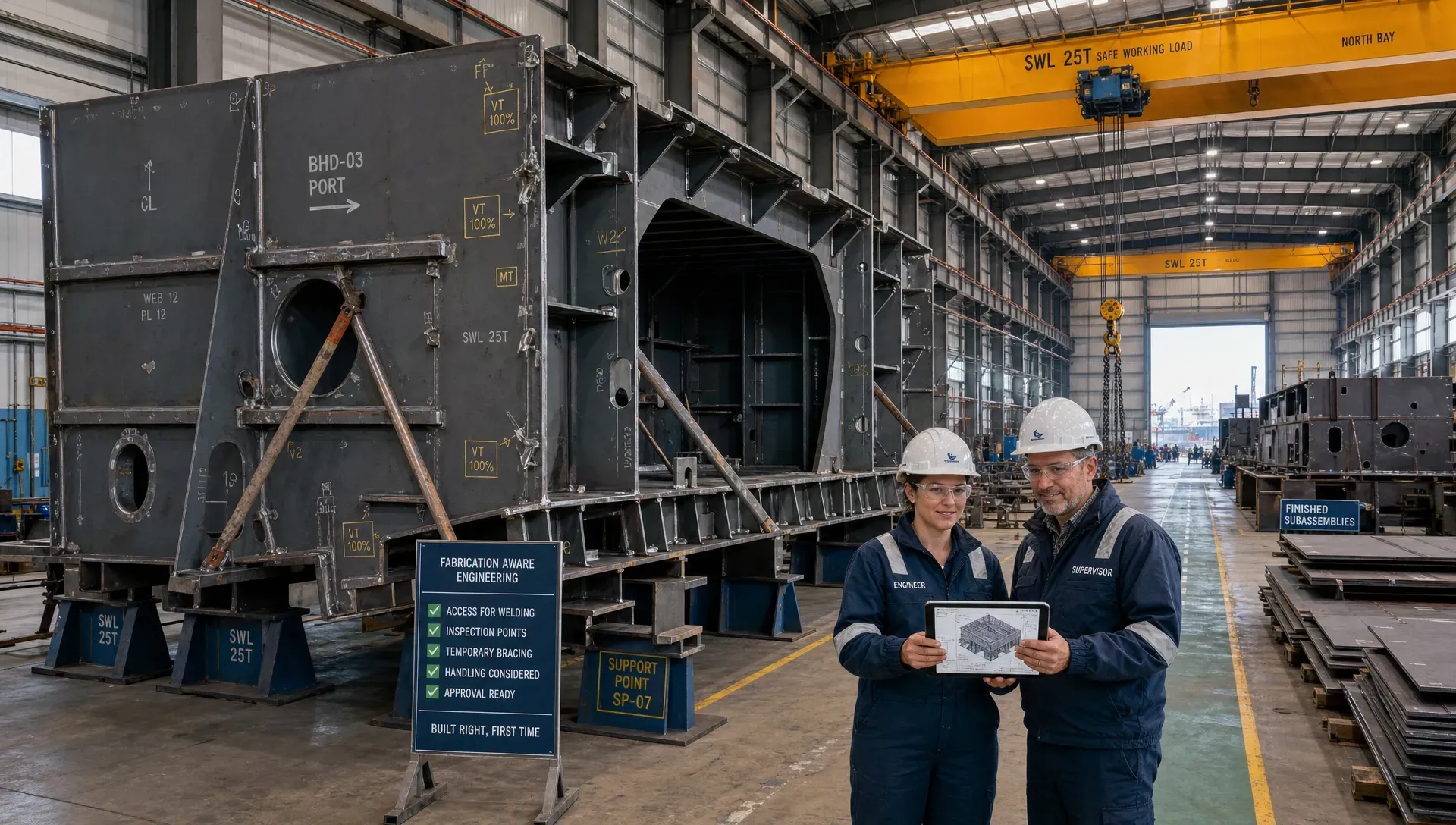
Buildability is equally important. A design with complex weld geometry, awkward access, excessive plate thickness variation or tight tolerance dependency can create problems in the yard. Practical structural design reduces these risks by considering fabrication sequence, weld inspection, fit-up, coating access, lifting during fabrication and the availability of standard materials.
Seafastening and grillages are central to delivery risk
Seafastening and grillage design often determine whether offshore wind components can be transported safely and efficiently. These temporary structures must transfer loads from the cargo into the vessel while accounting for accelerations, vessel motions, support stiffness, cargo geometry and allowable stresses.
The safest solution is not always the heaviest solution. Over-conservative temporary steel can increase fabrication time, reduce deck space, complicate installation and create unnecessary hot work offshore or in port. Under-designed seafastening, on the other hand, can create unacceptable movement, fatigue, local overstress or failure during transport.
Good seafastening design starts with realistic transport assumptions. Engineers need to understand the route, weather criteria, vessel response, cargo centre of gravity, lashing or welded restraint philosophy, fatigue exposure, inspection access and removal sequence. If the grillage must be reused across multiple voyages, repeatability and repair tolerance become important design factors.
For an offshore wind farm with multiple foundations or components, small improvements in seafastening and grillage design can have a large cumulative effect. Reduced weld length, simpler cutting details, fewer unique parts and better interface control can save days across repeated load-outs. That time saving can be significant when vessel day rates, port slots and weather windows are driving the project schedule.
Heavy lift engineering controls critical single events
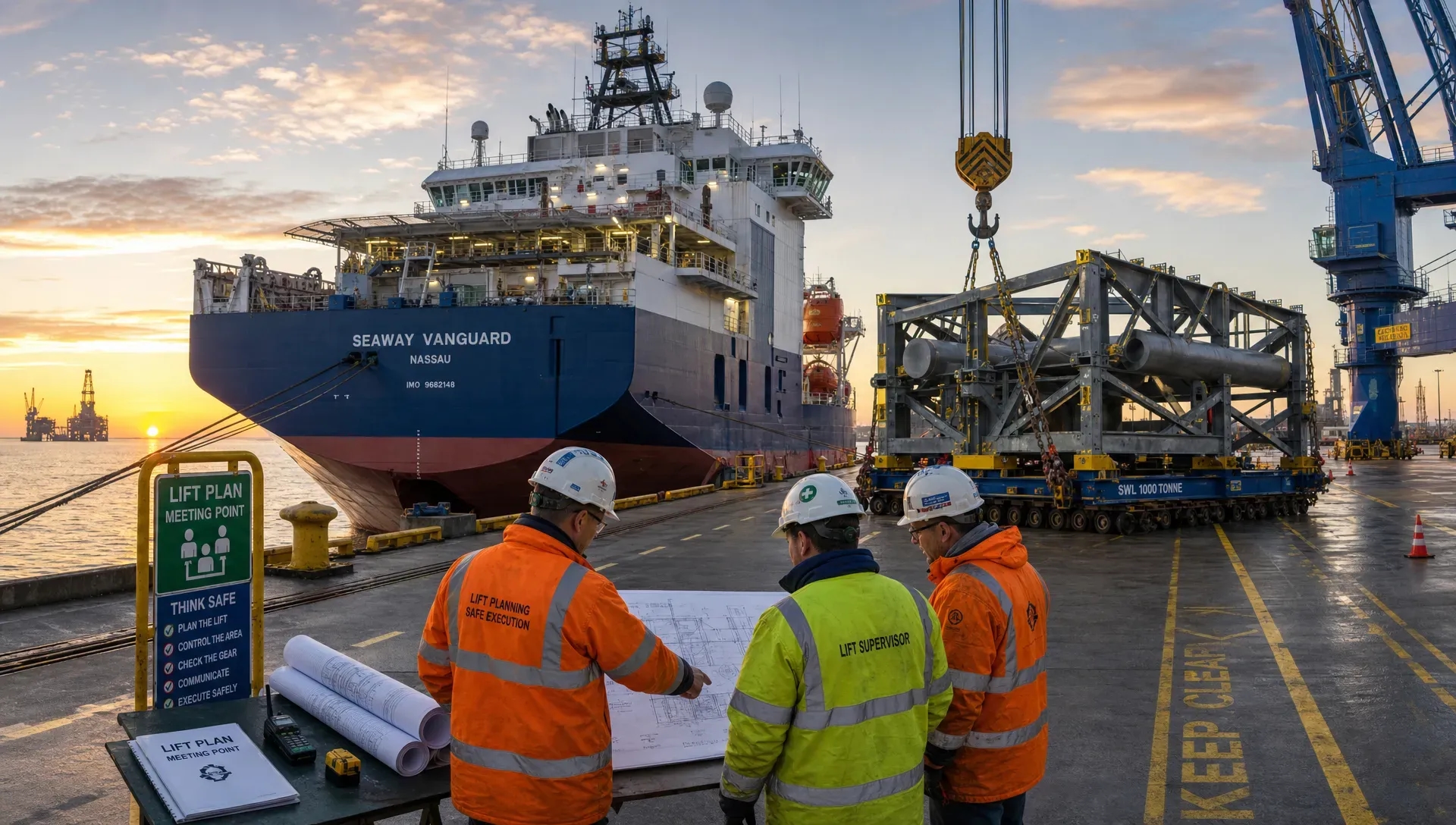
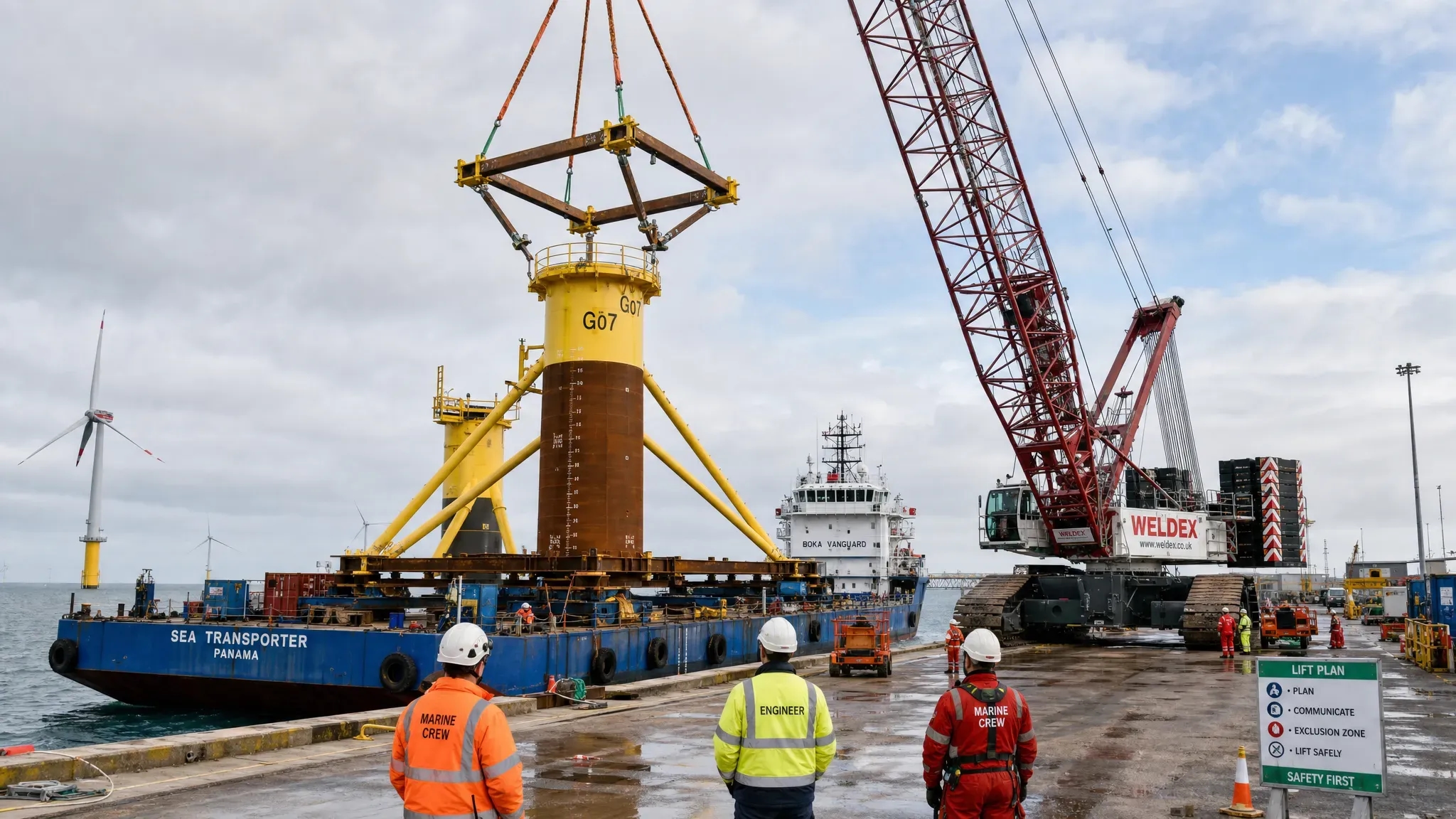
A heavy lift is often one of the most visible risk points in offshore wind delivery. Whether the scope involves lifting a transition piece, jacket, topside module, boat landing, cable equipment or temporary installation frame, the event must be engineered so the structure, rigging, crane, vessel and environment remain within allowable limits.
A complete lift engineering package typically considers lift point design, rigging geometry, sling angles, crane capacity, dynamic factors, centre of gravity uncertainty, skew load effects, padeye checks, local reinforcement, vessel stability, deck strength and operational sequence. Where offshore lifts are involved, the calculation must reflect motion, weather limits and contingency planning.
The engineering risk often sits in the interfaces. A padeye may pass its local check, but the supporting structure may need additional verification. A lift plan may be acceptable for one crane configuration, but not after a small change in radius. A component may be strong enough in final installation orientation, but weaker during upending or tailing.
This is why lift engineering should not be treated as an isolated calculation. It should be connected to fabrication drawings, rigging certificates, transport orientation, handling method, installation procedure and MWS review. The goal is to create a lift that can be executed as designed, not merely approved on paper.
Vessel-aware engineering reduces late redesign
Vessels are never neutral platforms. Their deck layout, structural arrangement, stability characteristics, crane capacity, station keeping system, mooring arrangement, DP capability, underdeck structure and operational limits all shape what is possible. Offshore wind engineering that ignores vessel realities will usually require late redesign.
Vessel-aware design is especially important for installation vessels, heavy lift vessels, jack-ups, barges, cable vessels and support vessels. The engineering team must understand how loads enter the vessel, whether local deck areas can accept concentrated reactions, how sea fastening will be installed and removed, and whether the vessel's operational procedures create constraints around access, escape routes, equipment clearance or emergency response.
For retrofit scopes, this becomes even more complex. Legacy vessel data may be incomplete, as-built conditions may differ from drawings, and class requirements may affect modifications to hull structure, piping, equipment foundations or access systems. Engineering teams need to work with survey information, vessel owner constraints and class expectations to create practical modifications that can be installed within a limited yard period.
In offshore wind farm delivery, the vessel is often part of the engineering solution. Treating it that way early helps avoid mismatches between design intent and offshore execution.
Approval readiness is engineered, not added at the end
Marine warranty surveyors and class societies such as DNV, Lloyd's Register and ABS need clear evidence that the proposed operation is safe and controlled. Approval readiness is not a final formatting task. It is built into the way assumptions are recorded, calculations are structured, drawings are revised and interfaces are managed.
A strong approval package usually includes calculation notes, FEM reports where required, drawings, material specifications, weld details, lifting arrangements, transport and installation assumptions, stability checks, motion analysis inputs, mooring reports, inspection requirements and clear revision control. It should also explain why the selected design is appropriate, not only present numerical outputs.
Late approval issues often come from missing traceability. Reviewers may ask how a load case was selected, why a dynamic amplification factor was used, whether a deck reaction was checked locally, how a centre of gravity tolerance was handled, or whether a temporary structure has been assessed for fatigue. If these answers are not already visible in the documentation, the project can lose valuable time.
Early engagement with approval parties helps. It allows teams to agree on design codes, load combinations, acceptance criteria, weather limits and documentation expectations before detailed engineering is too far advanced. This reduces the risk of redesign when fabrication has already started or the vessel mobilisation date is fixed.
Interface control keeps the farm delivery sequence aligned
An offshore wind farm is delivered by many parties working under schedule pressure. Developers, EPC contractors, foundation suppliers, transport and installation contractors, vessel owners, fabricators, port operators, surveyors, class societies and offshore crews all depend on engineering information that must be consistent.
Interface failures can be practical and costly. A fabrication team may not know that a sea fastening bracket requires a specific removal clearance. A vessel team may receive deck reaction data too late for underdeck verification. A lifting contractor may plan around a centre of gravity that has changed after equipment updates. A marine warranty surveyor may receive drawings without the calculation references needed for review.
Good offshore wind engineering supports interface control by making responsibilities, assumptions and deliverables explicit. This can include interface registers, design review meetings, controlled mark-ups, model coordination, clear drawing issue status and early identification of long-lead decisions. The discipline is simple in principle, but critical in execution.
The value is not only fewer mistakes. Better interface control allows project directors and engineering managers to make decisions faster because the technical consequences are visible. This is especially important when weather windows, vessel availability and fabrication progress are all moving at the same time.
Digital tools and visualisation improve technical alignment
Digital engineering tools help teams test options, coordinate geometry and communicate complex marine operations. Structural design software, 3D models, motion analysis, vessel stability tools and drawing automation can improve speed and consistency when used with sound engineering judgement.
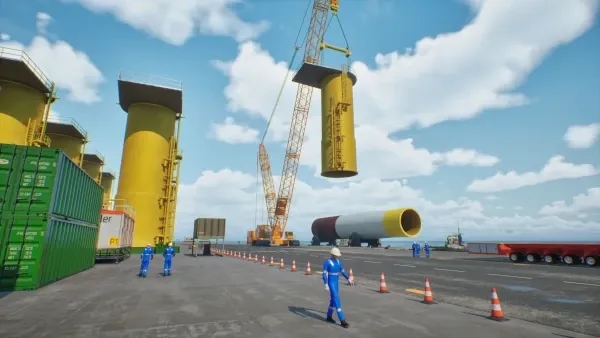
Visualisation also has a practical safety role. Technical animations and VFX can make lifting sequences, load-out operations, mooring arrangements, sea fastening removal, vessel positioning and exclusion zones easier to understand. This supports tender evaluation, client review, QHSE briefings and offshore crew preparation.
Digital workflows should remain grounded in engineering reality. A model is useful only if it reflects the right design basis, boundary conditions, load cases and fabrication constraints. Likewise, an animation must match the approved method statement and actual equipment configuration. When visual content is technically accurate, it becomes more than presentation material. It becomes a tool for alignment.
Some project teams also use digital platforms for field reporting, inspection workflows or stakeholder communication. Where a dedicated mobile product is required, specialist mobile app development partners such as Appzay can support the software side, while engineering teams define the technical data, inspection logic and operational requirements that need to be captured.
Safer farm delivery continues into operation and decommissioning
Offshore wind engineering does not stop once assets are installed. Decisions made during design and installation affect inspection, maintenance, repair, retrofit and eventual decommissioning. Access systems, boat landings, lifting points, corrosion protection, replaceable components and documentation quality all influence lifecycle safety and cost.
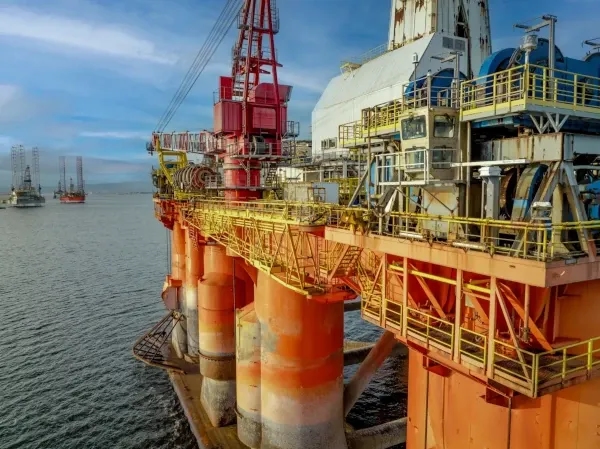
For vessel owners and marine contractors, this lifecycle view is also relevant to fleet readiness. Offshore wind scopes may require vessel modifications, new access arrangements, equipment foundations, piping changes, mooring upgrades, deck strengthening or mission equipment integration. These modifications must work structurally, operationally and within class constraints.
Decommissioning experience is valuable here. Removal operations often reveal how important original design assumptions, lifting points, structural redundancy and documentation are when assets must be handled years later. Engineering teams that understand both installation and removal can make better decisions for future offshore wind farm delivery.
How Fusie Engineers supports safer offshore wind delivery
Fusie Engineers supports offshore wind, maritime and energy projects with multidisciplinary engineering that connects structural design, heavy lift engineering, ship design, marine engineering, vessel retrofit, piping design, steel detailing and technical visualisation. The focus is not only to calculate a design, but to make it practical for fabrication, review, approval and execution.
Typical support can include offshore structural design, seafastening and grillage engineering, custom tools, lifting arrangements, FEM verification, motion-related checks, mooring and stability support, vessel modification engineering, detailed drawings, steel detailing and approval documentation. These scopes are often connected, which is why coordination between structural engineers, heavy lift engineers, naval architects and mechanical designers matters.
For technical directors and project managers, the key benefit is controlled delivery risk. A buildable design can reduce fabrication time. A vessel-aware solution can prevent late clashes with deck capacity or operational limits. A clear calculation package can speed up MWS and class review. A practical installation aid can reduce offshore handling uncertainty. A technically accurate animation can improve understanding before the operation reaches the deck.
In offshore wind farm projects, safety is shaped long before offshore execution starts. It is shaped in the design basis, the grillage layout, the weld detail, the lift point, the vessel check, the calculation note, the drawing revision and the approval response. When these elements are engineered as one delivery system, the project has a stronger chance of reaching the field safely, efficiently and on schedule.
Frequently asked questions
What does offshore wind engineering include? Offshore wind engineering can include foundation and support structure design, transport engineering, seafastening, grillages, lifting arrangements, vessel checks, installation aids, motion analysis, mooring support, cable equipment interfaces, retrofit engineering and approval documentation.
Why is seafastening so important for an offshore wind farm? Seafastening controls how components are restrained during sea transport. It must transfer cargo loads safely into the vessel while accounting for accelerations, vessel motion, support stiffness and practical installation or removal requirements.
When should MWS and class requirements be considered? They should be considered early, ideally during concept or preliminary engineering. Late alignment on load cases, acceptance criteria or documentation requirements can cause redesign, review delays and mobilisation risk.
How can engineering reduce offshore wind project costs without reducing safety? Cost can be reduced through smarter load paths, simpler fabrication details, reduced unnecessary steel, better interface control, reusable temporary works, fewer late changes and documentation that supports faster approval.
Why does vessel data matter in offshore wind delivery? Vessel data affects deck strength, stability, crane capacity, seafastening layout, access, mooring, station keeping and operational limits. Without accurate vessel information, a design may be structurally correct but unsuitable for execution.
Plan offshore wind delivery with engineering that holds up offshore
Safer offshore wind farm delivery depends on practical engineering, not assumptions. If your project needs support with structural design, heavy lift engineering, seafastening, grillages, vessel modifications, marine engineering, steel detailing or approval-ready documentation, Fusie Engineers can help turn the delivery method into a buildable and reviewable engineering package.
From concept and calculations to detailed drawings and operational readiness, the team works with the realities of fabrication, vessel constraints, marine operations and approval processes. That is where safer farm delivery starts: with engineering decisions that are clear, traceable and ready for offshore execution.