

Practical renewable energy engineering for offshore assets
2026-07-20
Offshore renewable energy projects are often judged by capacity, availability and carbon impact. In execution, however, they succeed or fail through practical engineering decisions: how a structure is loaded, how a vessel behaves, how a lift is controlled, how a grillage is fabricated, and how quickly the design can be approved without creating offshore risk.
That is why renewable energy engineering for offshore assets has to go beyond concept studies and calculations. It must connect structural design, marine operations, vessel capability, fabrication, class requirements and site execution into one coherent engineering route.
For technical directors, EPC contractors, marine contractors, shipyards and renewable energy developers, the main question is rarely whether a design can be made to work on paper. The real question is whether it can be built, transported, installed, inspected and maintained under offshore conditions, within the available schedule and budget.
Practical engineering does not mean simplifying offshore risk. It means identifying where that risk sits early enough to control it.
Why offshore renewable assets need a different engineering mindset
Offshore renewable assets operate in a demanding interface between energy production and marine engineering. Fixed-bottom wind foundations, floating wind units, offshore substations, cable handling systems, installation aids, service vessels, retrofit packages and decommissioning tools all face a similar challenge: they must perform structurally while being exposed to vessel motion, weather windows, fatigue, corrosion, dynamic lifting loads and strict approval requirements.
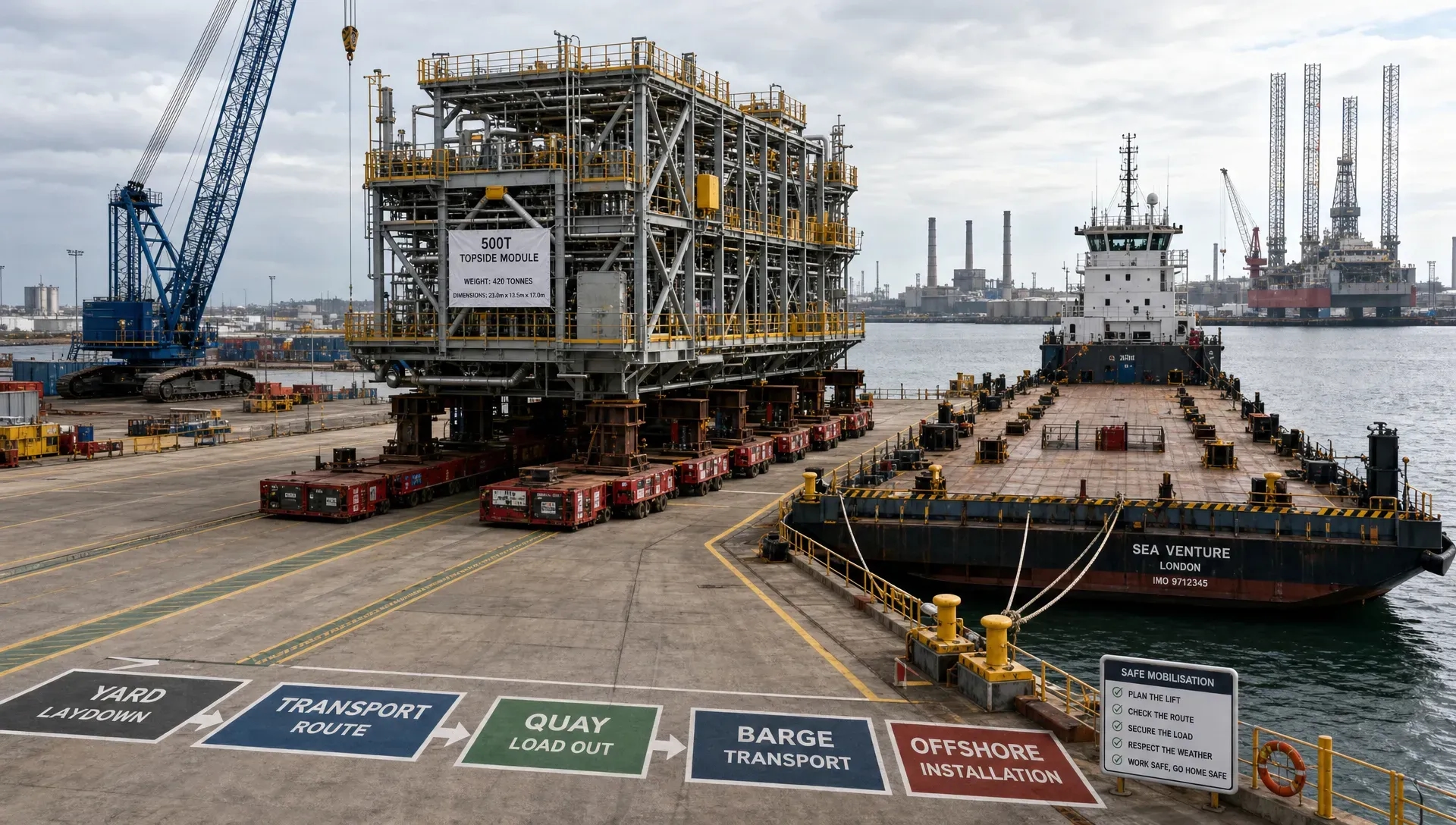
The temporary phases are often as critical as the final operating condition. A jacket, monopile, transition piece, floater module or topside may be structurally sound in service, but still require careful engineering for load-out, transport, seafastening, lifting, upending, mooring or towage. These phases can introduce high local loads, acceleration effects, impact risks and interface constraints that are easy to underestimate if marine operations are treated as a late-stage add-on.
This is where practical renewable energy engineering creates value. It brings the asset, the vessel, the operation and the approval path into the same design conversation. The result is not just a stronger structure, but a more executable project.
Start with a design basis that matches real offshore conditions
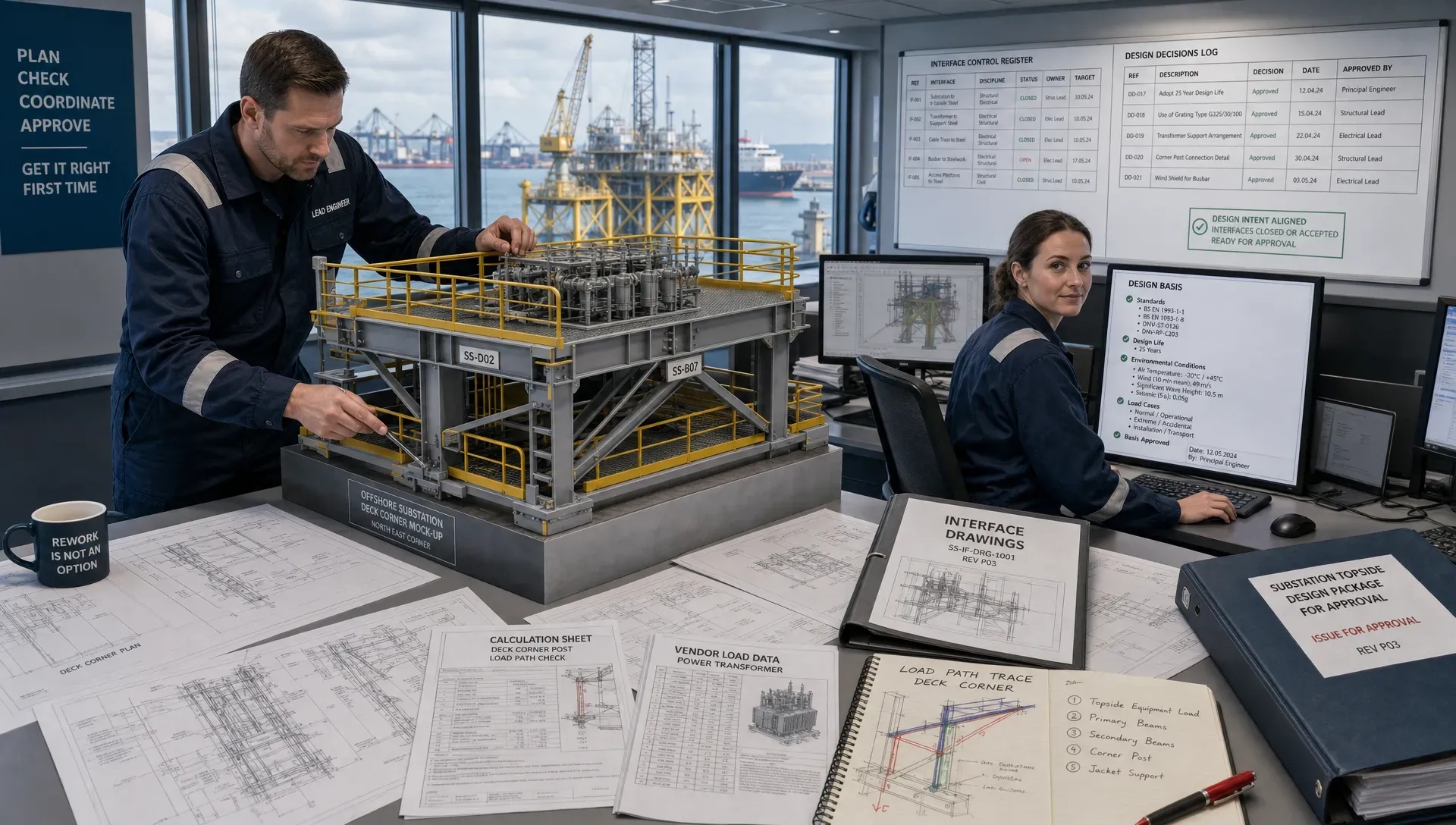
A renewable offshore project needs a design basis that is specific enough to support decisions and stable enough to prevent rework. If the design basis is too generic, structural models may look complete while hiding assumptions that later fail during MWS review, class approval or fabrication planning.
A useful design basis should define the asset function, design life, temporary conditions, metocean data, route conditions, vessel particulars, installation sequence, governing standards, inspection requirements and approval route. It should also record constraints such as deck load limits, crane curves, allowable accelerations, underdeck capacity, welding access, material availability and mobilisation schedule.
The most important inputs are not always the most complex. A missing vessel drawing, uncertain centre of gravity, outdated as-built information or unclear interface load can delay engineering more than a difficult FEM calculation. Early alignment between the engineering team, operations team, fabricator, vessel owner and approval body reduces the risk of late-stage changes.
In practice, teams should confirm the following before detailed design progresses too far:
- The governing load cases for transport, lifting, installation, operation and maintenance.
- The vessel data, including deck strength, stability limits, crane capacity and motion response assumptions.
- The approval route, including MWS, class society and client review requirements.
- The fabrication strategy, including weld access, tolerances, coating, modularisation and lifting points.
- The documentation package needed for review, traceability and offshore execution.
When these inputs are not fixed, engineering should clearly identify assumptions and hold points. That makes risk visible and gives project managers a stronger basis for schedule decisions.
Structural design must serve fabrication and installation
A technically correct structure is not necessarily a good offshore structure. If it depends on complex welds, difficult fit-up, excessive plate thickness, tight tolerances or poor access for inspection, it can create cost and delay long before it reaches the quayside.
Practical structural design starts with clear load paths. Loads from turbines, foundations, cable systems, topsides, cranes, tools or temporary supports must be transferred into the supporting structure without creating avoidable stress concentrations or hidden local failures. For vessel-based work, this also means checking how loads travel through grillages, seafastening, deck plating, stiffeners, girders and underdeck structures.
FEM is valuable, but it should not replace engineering judgement. Boundary conditions, contact assumptions, weld modelling, load combinations and fatigue details must reflect how the asset will actually be fabricated and used. A model that is too idealised can give false confidence. A model that is too complex without clear assumptions can slow review and approval.
Buildability should be considered from the first design iterations. Standard sections, accessible welds, logical plate thicknesses, realistic tolerances and simple inspection routes often reduce cost without reducing safety. This is especially important in offshore wind, floating renewables, vessel retrofits and green technology projects, where delivery schedules can be tight and fabrication capacity may be shared across multiple scopes.
Marine operations are part of the engineering package
Offshore renewable assets are moved, lifted, towed, moored and installed in dynamic marine environments. The engineering package therefore has to account for vessel behaviour, not just structural capacity.
Transport and installation engineering should connect accelerations, sea states, route limitations, towing arrangements, lifting geometry, rigging design, mooring layouts, stability and operational weather limits. If these items are developed separately, interface gaps appear. A seafastening design may pass local strength checks but conflict with access routes. A lifting arrangement may be structurally acceptable but unsuitable for the available crane radius. A mooring concept may work globally but overload local padeyes or fairlead supports.
For a broader view of how vessel capability, structural design and approval documentation interact, Fusie Engineers has also covered how marine engineering cuts risk in offshore projects.
The key is to treat marine operations as design drivers. For example, accelerations during transport can govern seafastening loads. Dynamic amplification can govern lift points and rigging. Vessel stability can limit deck layouts. Mooring loads can govern local reinforcements. Installation clearances can influence temporary structures and access platforms.
This is especially relevant for floating wind and other floating renewable assets, where coupled behaviour between the floater, mooring system, tow arrangement and installation sequence can dominate project risk. Early engineering decisions need to reflect the full marine operation, not only the final asset configuration.
Retrofit engineering for vessels and legacy assets
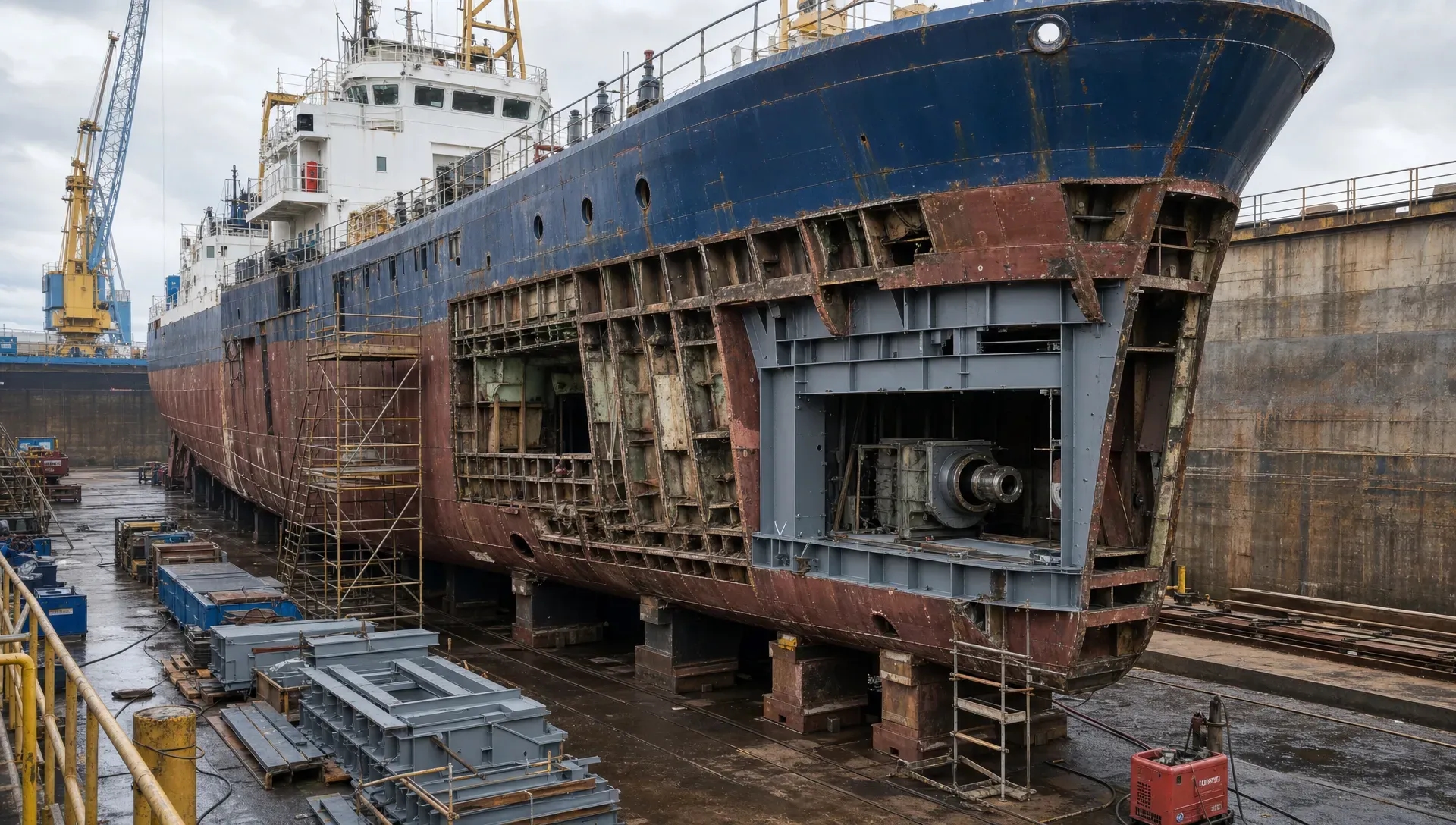
The energy transition is not only about new offshore assets. Many projects depend on adapting existing vessels, structures and systems for renewable energy work. Cable lay vessels, jack-ups, barges, service operation vessels, construction vessels and support craft may need new equipment, piping, foundations, power systems, accommodation changes, mission equipment or class-approved modifications.
Retrofit engineering can be more constrained than newbuild design. Legacy drawings may be incomplete. As-built conditions may differ from documentation. Existing structures may have limited remaining fatigue life. Class rules may restrict modifications. Space, weight, access, stability and operational downtime all become design constraints.
For renewable energy scopes, vessel retrofits may include grillages and foundations for cable carousels, upgraded crane supports, offshore charging interfaces, hybrid or battery-related systems, new piping routes, walk-to-work equipment, survey spreads or installation tools. Each change must be checked against vessel structure, stability, maintainability, safety systems and approval requirements.
The practical challenge is to improve vessel functionality without creating new operational restrictions. A retrofit that overloads an underdeck structure, blocks maintenance access or complicates class approval can cost more than it saves. Good engineering keeps the vessel’s operating profile, mobilisation window and approval route in view from the start.
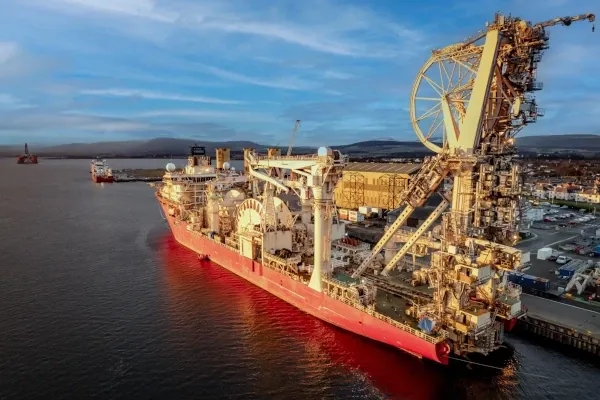
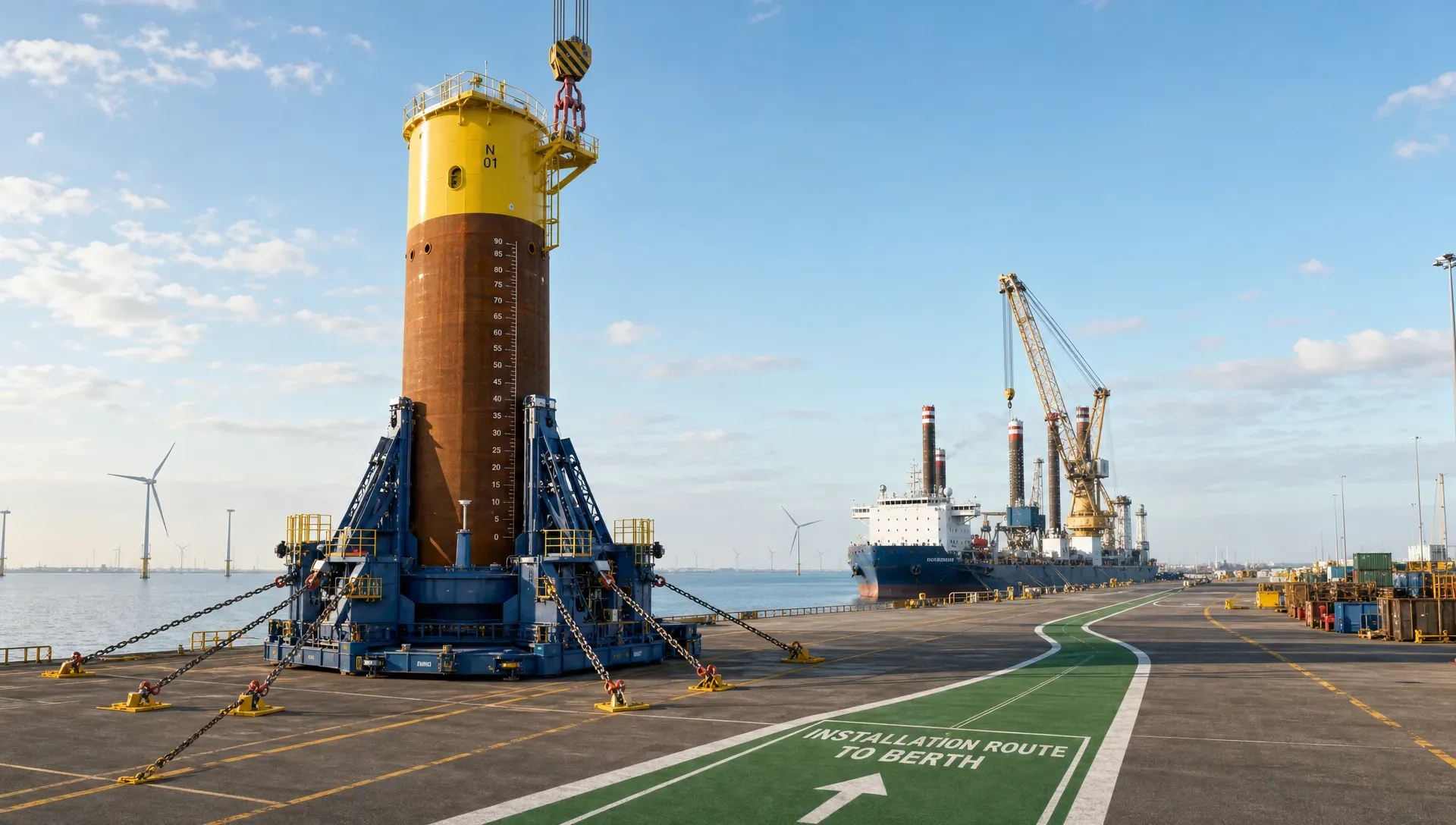
An offshore renewable energy installation vessel alongside a quay carrying wind turbine components on deck, with visible seafastening grillages, lifting equipment and mooring lines, viewed from low over the water so the deck interfaces and support structures are clear.
Approval-ready documentation reduces execution risk
Offshore renewable projects involve multiple reviewers: client engineering teams, MWS, class societies, fabricators, vessel owners, insurers, marine warranty surveyors and site teams. Each party needs information at a different level of detail, but all of them need traceability.
Approval-ready engineering is not just a final calculation report. It is a structured set of documents that explains the design basis, assumptions, load cases, analysis methods, code checks, drawings, weld details, inspection requirements and operational limits. Public frameworks such as DNV’s rules and standards show how closely structural integrity, marine systems and safety requirements are linked in offshore and maritime work.
A strong documentation package usually includes calculation notes, FEM reports where required, lifting studies, motion or transport assumptions, stability checks, mooring reports, design drawings, fabrication drawings, MTOs, interface registers and method-related engineering notes. For temporary works, the package should clearly distinguish between transport, lifting, installation and standby conditions.
Incomplete documentation can delay approval even when the design itself is sound. Missing assumptions, unclear load paths, unsupported allowable values or inconsistent drawings force reviewers to ask questions that should have been answered before submission. In offshore projects, each review loop can affect mobilisation, vessel availability and installation windows.
The objective is not to produce more paperwork. It is to produce the right documentation so that reviewers can understand, verify and approve the design efficiently.
Reducing steel, cost and rework without weakening the design
Cost control in renewable energy engineering is often discussed in terms of cheaper fabrication or faster installation. In reality, major savings usually come from engineering decisions made before fabrication starts.
Reducing steel use is not about making structures lighter at any cost. It is about understanding the governing load cases, removing unnecessary conservatism, improving load paths, selecting practical sections, avoiding difficult details and coordinating temporary and permanent requirements. Sometimes a slightly heavier but simpler detail is better than a lighter detail that requires complex welding, long lead materials or difficult inspection.
Early structural optimisation can also reduce rework. If the underdeck support, lifting arrangement, seafastening concept and fabrication method are aligned early, the project is less likely to face late reinforcement, drawing revisions or offshore workarounds. Fusie Engineers explores this project-driven approach further in its article on sustainable engineering that lowers steel cost and rework.
For offshore renewable assets, practical cost reduction often comes from:
- Designing direct load paths instead of solving avoidable stress concentrations with extra steel.
- Using standard materials and profiles where possible to reduce procurement risk.
- Simplifying weld details and improving access for fabrication, NDT and coating.
- Checking temporary phases early so that seafastening and lifting aids do not require redesign.
- Coordinating drawings, calculations and fabrication planning before approval submission.
These choices support sustainability as well as cost. Less unnecessary steel, fewer transport emissions, fewer rework hours and shorter mobilisation periods all contribute to a more efficient project.
Technical visualisation helps teams understand complex operations
Complex offshore operations can be difficult to explain through drawings and method statements alone. A lift sequence, float-off, mooring operation, cable handling route or heavy transport arrangement may involve multiple moving parts, tight clearances and time-sensitive decisions.
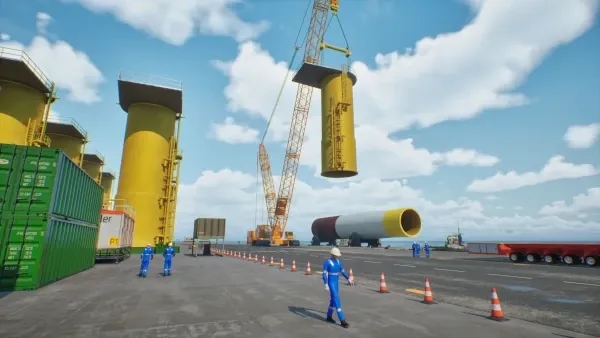
Technical animation and visualisation can support tenders, QHSE briefings, client reviews and offshore execution planning. When developed from reliable engineering data, visualisations can show the intended sequence, exclusion zones, equipment interfaces, vessel positions, rigging layout and installation constraints in a way that non-specialist stakeholders can understand.
This does not replace calculations or method statements. It improves communication around them. For project directors and lead engineers, that can mean fewer misunderstandings between engineering, operations, marine crew, fabrication teams and client representatives.
Visualisation is especially valuable when a project involves new installation methods, unusual vessel modifications, floating assets, decommissioning sequences or multiple contractors working around the same offshore asset.
What to look for in a renewable energy engineering partner
The right engineering partner should be able to move between concept, calculation, detailed design, fabrication support and approval documentation without losing sight of offshore execution. That requires more than drafting capacity. It requires engineering judgement across structures, vessels, marine operations and class requirements.
For offshore renewable projects, decision-makers should look for a team that can challenge early assumptions, identify practical constraints, communicate clearly with reviewers and produce buildable designs. The partner should understand that schedule pressure is real, but that speed without traceability can create larger delays later.
Fusie Engineers supports renewable energy, maritime and offshore clients with structural design, heavy lift engineering, ship design, marine engineering, vessel retrofits, piping design, steel detailing, technical animation and related engineering support. The team works across offshore wind, maritime, traditional energy, decommissioning, dredging and green technology projects, with a focus on safe, practical and approval-ready solutions.
Depending on the scope, deliverables may include FEM calculations, lifting arrangements, seafastening and grillage design, motion analyses, mooring reports, stability checks, fabrication drawings, shop drawings and approval documentation for MWS or class society review.
The value is not only in producing calculations. It is in helping project teams make better engineering decisions before those decisions become expensive offshore constraints.
Frequently asked questions
What is renewable energy engineering for offshore assets? Renewable energy engineering for offshore assets covers the design and verification of structures, vessels, tools, systems and marine operations used in offshore renewable energy projects. It can include offshore wind foundations, floating assets, substations, installation aids, vessel retrofits, cable handling equipment, lifting arrangements, mooring systems and approval documentation.
When should structural and marine engineering start in an offshore renewable project? Structural and marine engineering should start as early as possible, ideally during concept and method development. Early input helps identify vessel limits, installation constraints, class requirements, fabrication issues and temporary load cases before they create redesign or approval delays.
How does practical engineering reduce project cost? Practical engineering reduces cost by improving load paths, avoiding unnecessary steel, simplifying fabrication, reducing weld complexity, preventing late reinforcement and creating clearer approval documentation. The aim is not to under-design, but to remove avoidable complexity while maintaining safety and compliance.
Why are temporary works so important in offshore renewable projects? Temporary works such as seafastening, grillages, lifting aids, transport supports and installation structures often govern project risk. They may only be used for a short period, but they must withstand dynamic marine loads, vessel motion, lifting effects and approval scrutiny.
Can existing vessels be retrofitted for renewable energy work? Yes, many renewable energy projects rely on retrofitted vessels. However, retrofit engineering must account for existing structure, stability, class requirements, space constraints, equipment loads, piping routes, maintenance access and vessel downtime. As-built information and approval planning are critical.
Need practical engineering support for offshore renewable assets?
If your project involves offshore renewable structures, vessel modifications, heavy lifts, seafastening, marine operations or approval documentation, early engineering alignment can reduce risk before mobilisation pressure builds.
Fusie Engineers supports clients globally with practical renewable energy engineering for offshore and maritime assets, from concept and calculations through detailed design, documentation and operational readiness.