

How marine and engineering teams reduce offshore risk
2026-06-29
Offshore risk is rarely caused by one calculation being wrong. More often, it grows in the gaps between disciplines: a vessel assumption that is not carried into the structural model, a lift point that is strong enough locally but difficult to fabricate, a seafastening concept that passes analysis but delays MWS approval, or a retrofit interface that is discovered too late in the yard.
That is why effective marine and engineering teams reduce risk by working across interfaces, not by treating naval architecture, structural design, lifting, fabrication and approvals as separate workstreams. The objective is practical control: safe designs, clear documentation, realistic execution methods and fewer surprises during mobilisation or offshore work.
Offshore risk is an interface problem
Marine projects sit at the intersection of moving vessels, temporary structures, heavy components, class rules, weather windows and high-cost assets. A technically correct design can still create offshore risk if it does not match the vessel, installation method, fabrication route or approval requirements.
For example, a grillage may be structurally adequate in isolation, but if it transfers load into weak deck areas, obstructs access for welding, clashes with sea fastening removal, or requires late underdeck strengthening, it can still threaten the schedule. The same applies to lifting tools, retrofit foundations, piping routes, temporary supports and mooring arrangements.
Strong marine and engineering coordination reduces this risk by making each discipline accountable for how its decisions affect the next step. Naval architects, structural engineers, heavy lift engineers, designers, fabricators and operations teams need a shared view of the complete method, from concept to offshore execution.
Start with a controlled design basis
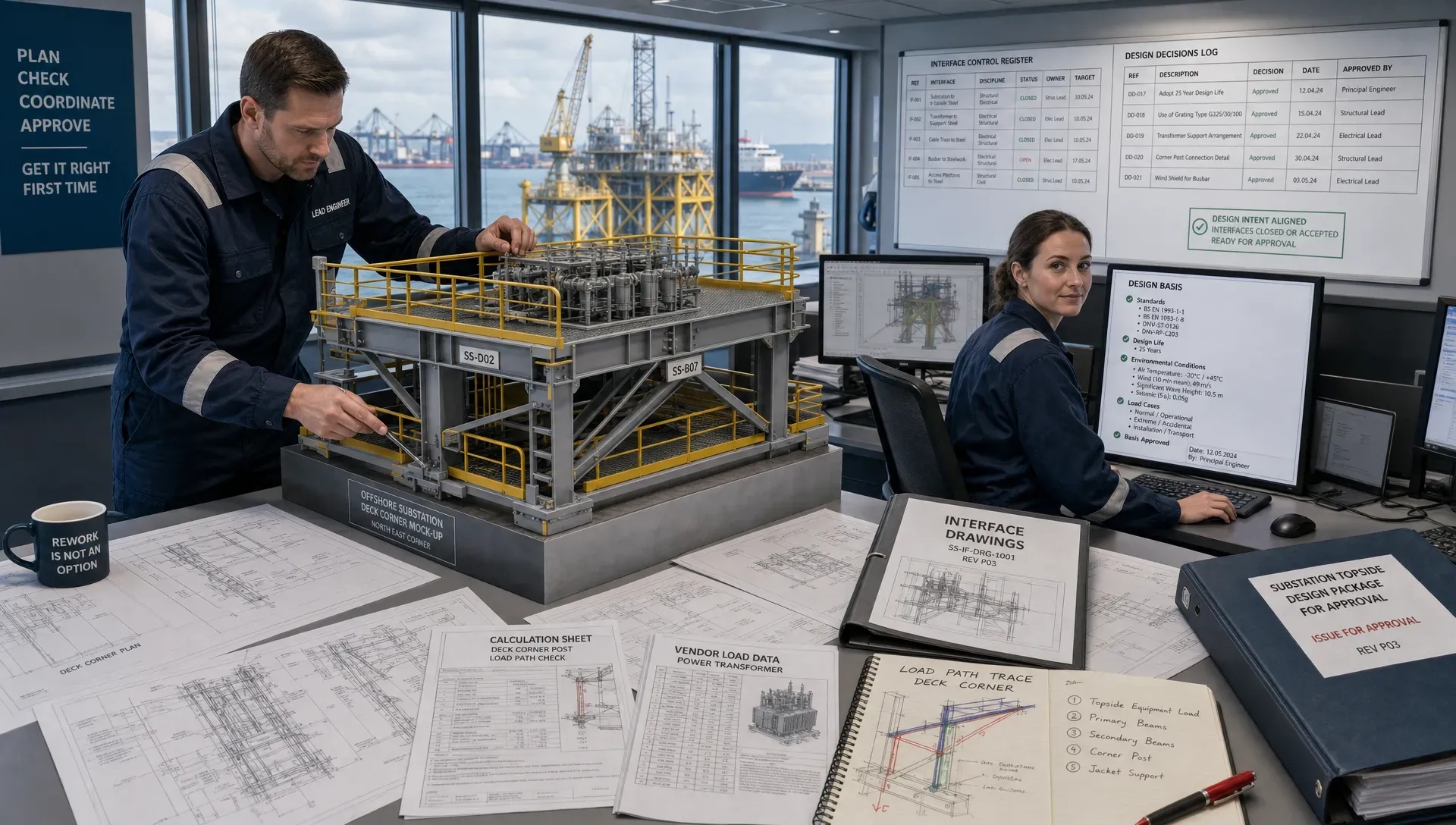
Risk control starts before detailed calculations. The design basis is where the team fixes the assumptions that will govern the project. If those assumptions remain vague, every later decision becomes harder to verify.
A robust design basis should define the operating envelope, the applicable codes, the governing load cases, the vessel data, the component weights, the centre of gravity assumptions, the allowable deck loads, the approval route and the documentation requirements. It should also identify what is confirmed, what is assumed and what still needs validation.
Typical items that marine and engineering teams need to align early include:
- Vessel particulars, deck strength, underdeck structure and operational limitations.
- Metocean criteria, transit condition, installation window and allowable motions.
- Cargo geometry, weights, centre of gravity data and lifting points.
- Applicable class, MWS, client, yard and project-specific requirements.
- Fabrication tolerances, weld access, coating requirements and inspection needs.
- Temporary conditions such as loadout, transport, lift-off, upending, installation and removal.
This stage is also where teams should challenge assumptions that look convenient but may not be realistic. If the weather window is too optimistic, if the vessel roll response is not compatible with the cargo, or if the proposed installation sequence leaves no tolerance for delay, the project risk is already visible. The value of early engineering is to expose those issues while they are still inexpensive to solve.
Bring vessel behaviour into structural decisions
Offshore structures do not experience loads in a static environment. During transport, lifting, installation or decommissioning, the vessel introduces motions, accelerations and operational constraints that must be reflected in the engineering.
A seafastening design, for example, is not only about steel strength. It must consider vessel motions, cargo accelerations, local deck capacity, load paths into the hull, fatigue-sensitive details, access for fabrication, and removal after arrival. If the cargo is tall or has a high centre of gravity, the design must also account for stability, clearance and operational limitations.
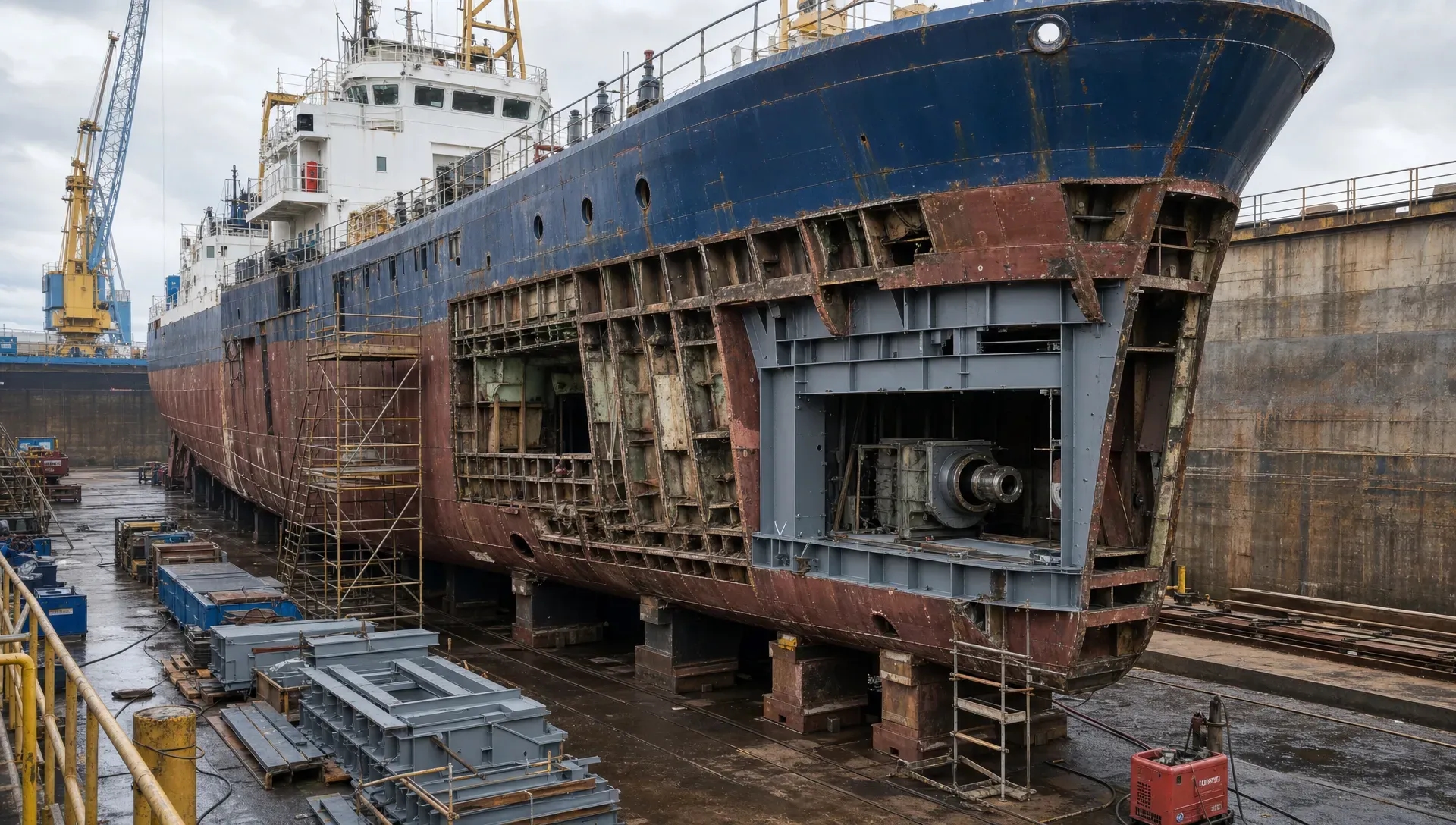
The same principle applies to vessel retrofits and piping modifications. A new foundation, pipe support or machinery arrangement must suit the vessel structure, class requirements, maintenance access and existing systems. Legacy vessel data may be incomplete, so engineers often need to combine drawings, surveys, class information and practical judgement.
When marine behaviour is integrated into structural design, teams can make better decisions about grillage layout, stool spacing, sea fastening strategy, underdeck reinforcement and acceptable operational limits. That is far more reliable than designing the steel first and trying to force the vessel to accept it later.
Buildability is a risk control, not a secondary detail
Many offshore delays start in fabrication. A design may pass FEM checks but still be slow to build, difficult to inspect or expensive to modify. Excessive welding, awkward access, unnecessary material thickness, complex joint geometry and tight tolerances all increase the probability of rework.
Buildability should therefore be treated as a core engineering requirement. Good designs reduce the number of special details, simplify welds where possible, consider plate availability, provide clear lifting and handling points, and allow inspection teams to do their work without dismantling half the structure.
This is also where cost control and safety align. Reducing steel is not just a commercial exercise. Less unnecessary steel can mean easier handling, shorter fabrication time, fewer weld hours, reduced coating scope and less offshore removal work. The key is to optimise without reducing safety margins or making approval harder. For a deeper view of this topic, Fusie Engineers has covered how sustainable engineering can lower steel cost and rework in offshore and energy projects.
Practical design reviews should ask direct questions. Can this be welded in the proposed sequence? Can the yard access both sides of the joint? Can NDT be performed properly? Will the structure clash with rigging, temporary access or removal tools? Are tolerances realistic for the fabrication method? These questions are not minor details. They are often the difference between a design that works on paper and one that works offshore.
Heavy lift and installation risks need disciplined checks
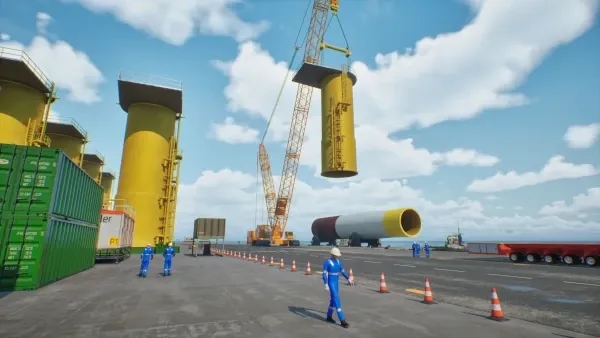
Heavy lift operations concentrate risk into short, high-consequence windows. Once a crane is connected, the project has limited tolerance for uncertainty. That makes lift engineering one of the most important areas where marine and engineering teams can reduce offshore risk.
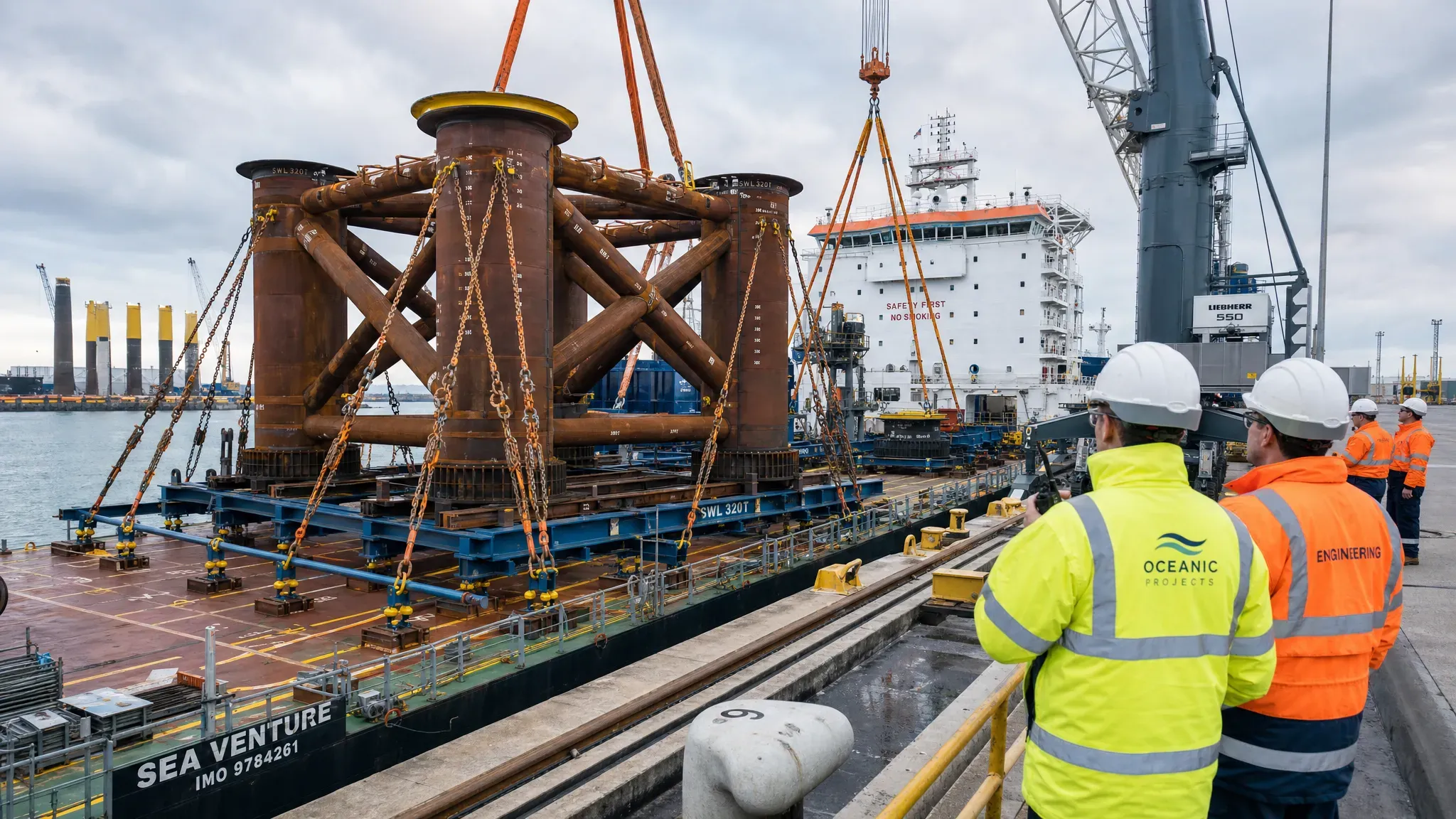
A lift study must verify more than the crane capacity. The team needs to confirm weight and centre of gravity data, sling angles, rigging geometry, dynamic factors, lift point strength, local reinforcement, hook height, clearances, tugger line strategy, landing tolerances and contingency positions. The lift must also be compatible with vessel motions, deck layout and the actual offshore sequence.
Temporary structures need the same discipline. Spreader beams, lifting tools, grillages, grillage supports, sea fastening and installation aids may only be used for a short period, but they carry critical load cases. These temporary conditions can govern the design more than the final installed condition.
A disciplined review process should check whether every load path is traceable from the lifted object through rigging, tools, connection points, local structure and supporting vessel or foundation. It should also identify which load cases control the design and where operational limits are required. Fusie Engineers has also discussed the importance of heavy lift engineering checks that prevent offshore delays, especially where approval and mobilisation dates are tight.
Approval readiness reduces schedule uncertainty
MWS and class approval are not administrative afterthoughts. They are part of the risk control system. A design that cannot be reviewed efficiently can become a schedule risk, even if the engineering itself is sound.
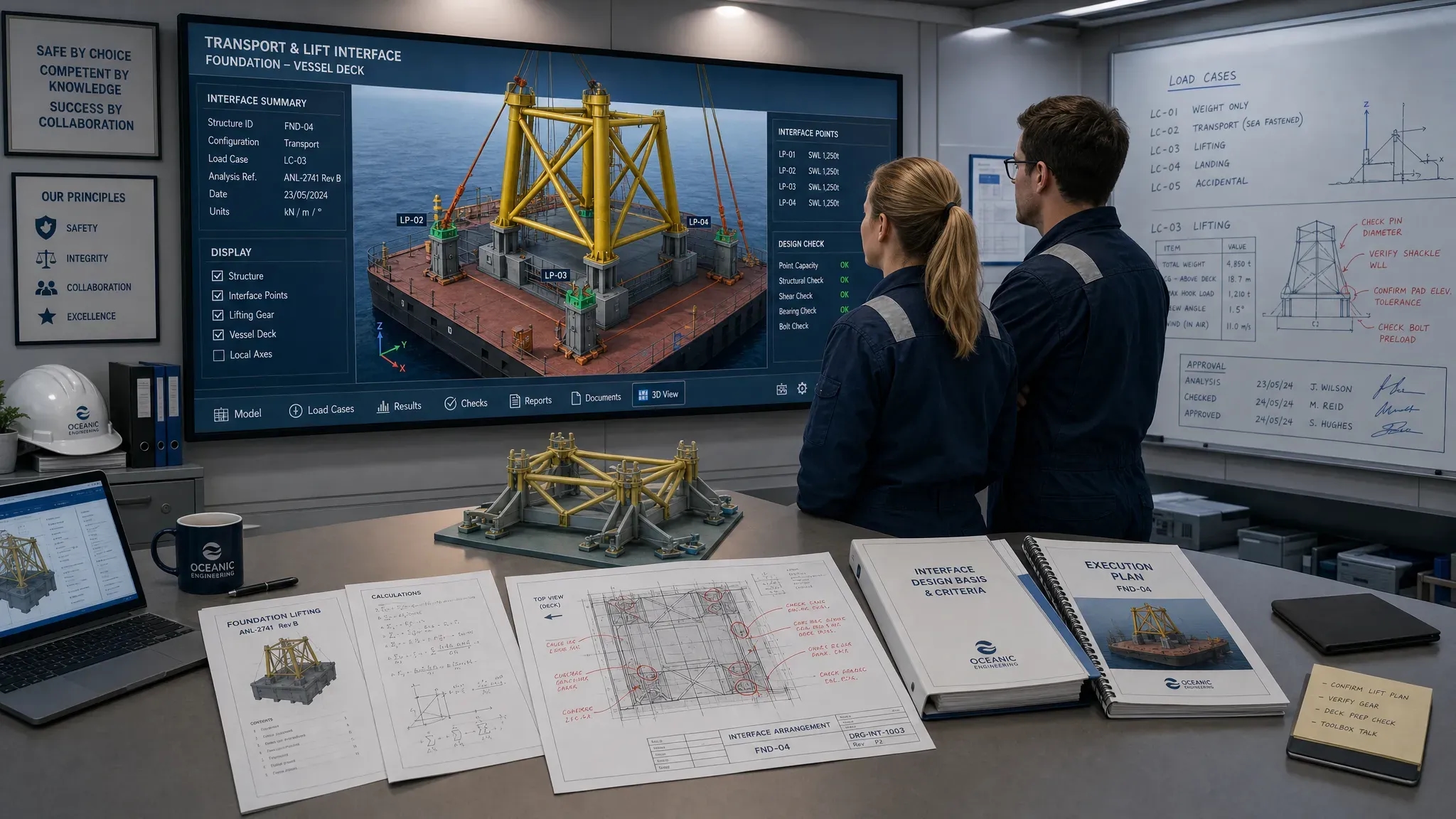
Approval-ready documentation should be clear, traceable and consistent. Reviewers need to understand the design basis, assumptions, applicable rules, load cases, calculation methods, model boundaries, safety factors, drawings, inspection requirements and operational limits. If the package leaves key decisions hidden inside disconnected files, review comments can multiply quickly.
Marine and engineering teams reduce this risk by building the approval logic into the work from the beginning. Calculation reports should reference the same weights and dimensions as drawings. Drawings should match the FEM model and the fabrication method. Method statements should reflect the actual lift arrangement, not an outdated concept. Deviations should be recorded and justified.
This matters across DNV, Lloyd's Register, ABS, MWS and client review processes. Each reviewer may focus on different details, but all require a coherent technical story. If you want to understand why drawings alone are not enough, the article on what offshore engineering companies must deliver beyond drawings explains the broader package needed for safe execution and approval.
Mobilisation and logistics affect engineering risk
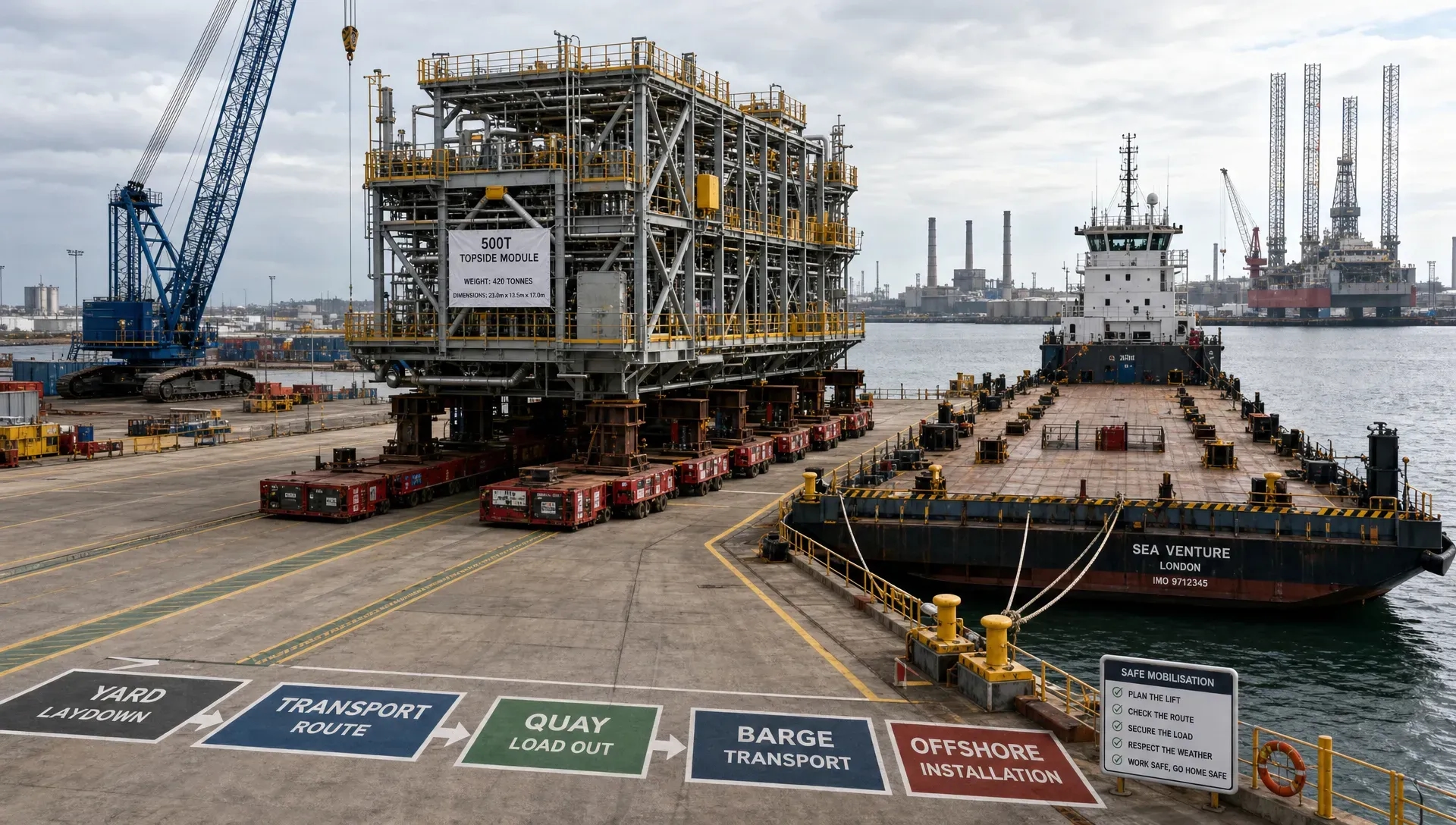
Offshore risk does not begin at the worksite. It starts during planning, procurement, fabrication, storage, transport to quay, loadout and mobilisation. Missing bolts, incomplete coating repairs, delayed tools, unclear packing lists or late transport frames can create operational pressure before the vessel even sails.
Engineering teams should therefore coordinate closely with procurement, fabrication and logistics. Temporary structures need clear identification, lifting arrangements, transport supports, preservation requirements and installation sequence information. Critical items should be available early enough for trial fit-up and inspection. Documentation should travel with the equipment, not chase it after the vessel has mobilised.
While offshore heavy transport is a specialist discipline, the same schedule-control mindset is visible in shore-side supply chains, where providers of UK 3PL logistics, warehousing and same-day transport demonstrate how storage, traceability and timed delivery can protect operations before goods reach their final destination. For offshore projects, the stakes are higher, but the principle is similar: poor material control can become execution risk.
Digital tools help, but judgement keeps control
Modern marine projects rely on analysis software, 3D modelling, finite element methods, stability tools, motion analysis, drawing automation and document control systems. These tools can speed up iterations and reduce manual errors, but they do not remove the need for engineering judgement.
The risk is not that teams use software. The risk is that models become disconnected from reality. Boundary conditions may be too stiff, load cases may omit a temporary condition, or a 3D model may show a clean interface that cannot be welded in the yard. The best teams use software to test decisions faster, but they still challenge the inputs and outputs.
Visual communication is also becoming more important. Technical animations and VFX can help explain lifting sequences, vessel movements, exclusion zones, mooring plans or installation steps to clients, crew, QHSE teams and site personnel. This is not a substitute for method statements or calculations, but it can reduce misunderstanding during tenders, briefings and offshore preparation.
Risk reduction should follow the project phases
The most effective marine and engineering teams do not wait for the final design review to manage risk. They apply phase-specific controls throughout the project.
- During tender and concept, they validate vessel suitability, installation philosophy, major temporary structures, approval route and high-risk assumptions.
- During basic engineering, they define load cases, structural concepts, marine constraints, fabrication approach and documentation structure.
- During detailed engineering, they complete calculations, drawings, FEM checks, lifting arrangements, mooring reports, stability checks and review packages.
- During fabrication, they support yard queries, weld detail clarification, tolerance issues, inspection requirements and as-built changes.
- During mobilisation and execution, they confirm readiness, close technical actions, support method statements and help resolve last-minute interface issues.
This phased approach prevents late discovery. It also allows project directors and engineering managers to make decisions with a realistic view of technical risk, schedule pressure and cost impact.
What strong marine and engineering support looks like
A reliable engineering partner should bring more than drafting capacity. Offshore and maritime projects need judgement, practical design experience and an understanding of how decisions affect fabrication, approval and offshore execution.
For marine contractors, EPC contractors, shipyards, vessel owners and renewable energy developers, the right support may include offshore structural design, heavy lift engineering, seafastening, grillages, ship design, vessel retrofit engineering, piping design, steel detailing, mooring checks, stability work and approval documentation. In complex projects, it may also require technical visualisation or software support to improve coordination.
Fusie Engineers works across offshore wind, maritime, energy, decommissioning, retrofit and heavy lift scopes, with a focus on practical engineering that can be fabricated, reviewed and executed safely. The value lies in connecting disciplines early, reducing avoidable rework and producing clear deliverables that support decisions under real project pressure.
Frequently asked questions
How do marine and engineering teams reduce offshore risk early? They reduce risk by aligning the design basis, vessel limitations, load cases, fabrication method, approval route and installation sequence before detailed engineering progresses too far. Early coordination prevents assumptions from becoming late-stage problems.
Why is buildability important in offshore engineering? Buildability affects fabrication time, weld quality, inspection access, yard productivity and offshore installation. A design that is strong but hard to fabricate can still create delay, rework and safety exposure.
When should MWS or class approval requirements be considered? Approval requirements should be considered at concept stage. Waiting until the design is complete often leads to rework because calculation formats, load cases, documentation and operational limits may not match reviewer expectations.
What role does heavy lift engineering play in offshore risk reduction? Heavy lift engineering verifies that the lifted object, rigging, lift points, temporary structures, crane arrangement and supporting vessel can safely handle all relevant load cases. It is critical because lift operations are short, expensive and high consequence.
Can technical animations reduce offshore execution risk? Yes, when used alongside approved calculations and method statements. Animations can help crews and stakeholders understand sequences, hazards, exclusion zones and interfaces more clearly before offshore work begins.
Reduce offshore risk with practical engineering support
Offshore risk is controlled through disciplined interfaces, not isolated deliverables. If your project needs structural design, heavy lift engineering, ship design, marine engineering, retrofit support, seafastening, grillages, piping, steel detailing or approval-ready documentation, Fusie Engineers can support the work from concept through execution preparation.
The earlier the right engineering questions are asked, the easier it is to protect safety, schedule and cost offshore.