


What good engineering services deliver beyond calculations
2026-07-10
Calculations are essential, but in offshore, maritime and energy projects they are only one part of the engineering service. A beam check, FEM model or lift calculation may prove that a structure can resist a defined load case, but it does not automatically prove that the solution is practical, buildable, approvable or safe to execute offshore.
For CTOs, technical directors, EPC contractors, shipyards, marine contractors and renewable energy developers, this distinction matters. The cost of poor engineering is rarely limited to design hours. It can appear later as fabrication delays, class comments, MWS hold points, vessel downtime, extra steel, offshore rework or a missed mobilisation window.
Good engineering services deliver beyond calculations by turning technical analysis into controlled project decisions. They connect the design basis, vessel limitations, class requirements, fabrication reality and marine operations into one coherent package that can be reviewed, approved and executed.
Calculations confirm decisions, they do not replace engineering judgement
A calculation is only as reliable as the assumptions behind it. If the design acceleration is wrong, if the underdeck structure is not verified, if the lift geometry changes, or if the load path is misunderstood, a precise calculation can still support the wrong decision.
Strong engineering services begin before the first spreadsheet or FEM model is built. They define and challenge the design basis. That means confirming what loads apply, which standards and class rules govern the work, which vessel data can be trusted, what fabrication constraints exist, and how the structure will actually be used.
In offshore and marine work, this front-end judgement is critical because project inputs are rarely perfect. Legacy vessel drawings may not match the as-built condition. Crane curves may restrict options. Deck strength may be governed by local underdeck members rather than global capacity. A temporary structure may need to survive transport, lifting, standby conditions and installation, each with different governing load cases.
Good engineers do not simply ask, “Does it pass?” They ask, “Is this the right concept to analyse, fabricate, approve and operate?”
Turning analysis into project decisions
In a complex project, the most valuable output is often not a single calculation result. It is a technically justified decision between several workable options.
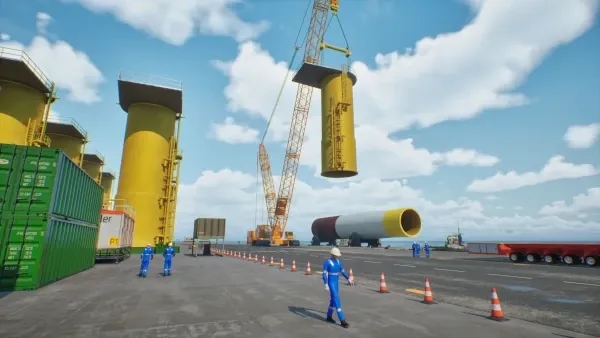
For example, a seafastening arrangement for offshore wind foundations may pass structurally in more than one configuration. The better solution is the one that also reduces fabrication hours, avoids difficult weld access, respects deck capacity, simplifies inspection, supports the transport procedure and gives the MWS reviewer a clear load path to follow.
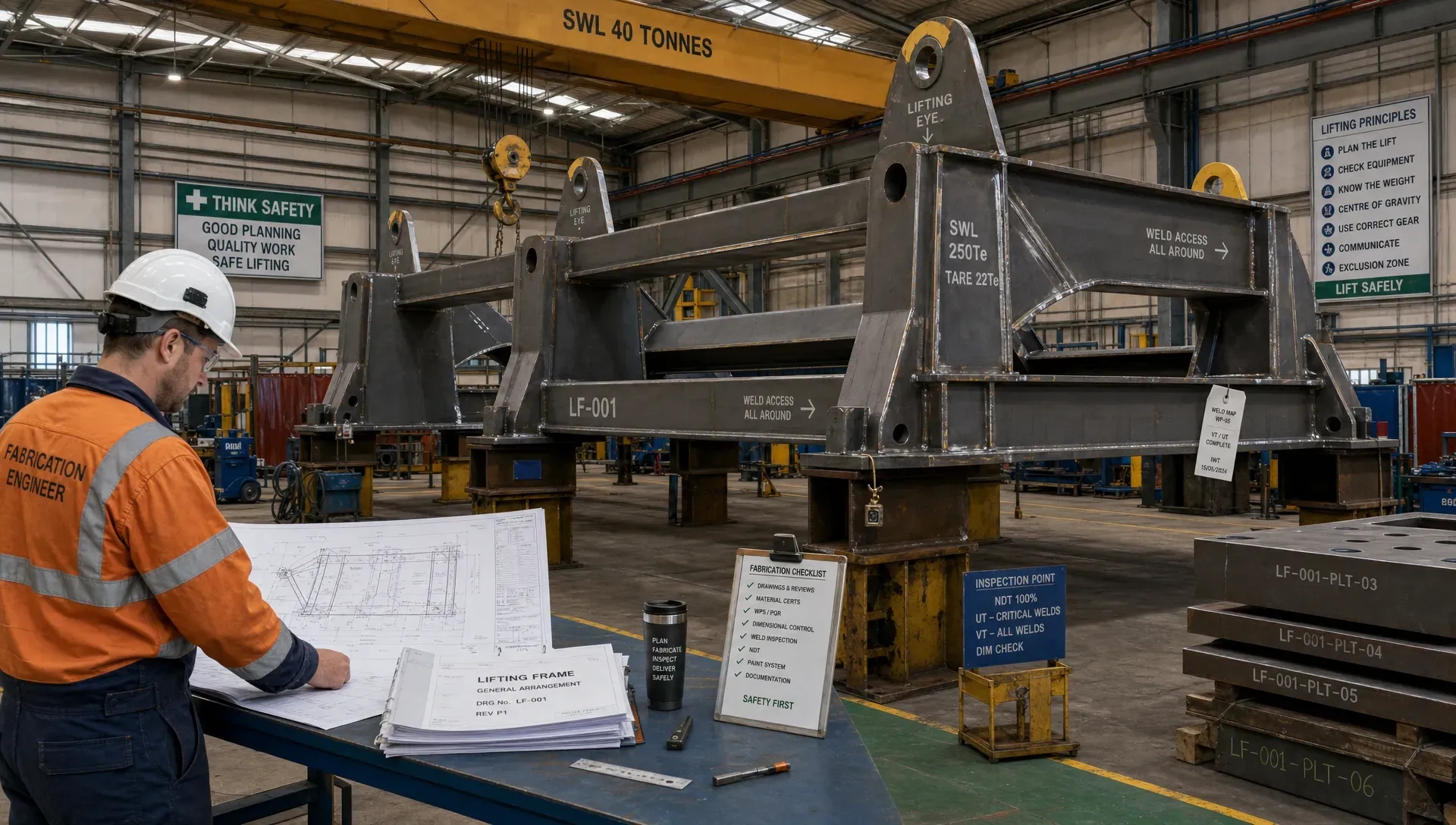
The same applies to heavy lift engineering. A lift point, spreader beam or temporary support can be designed in many ways. The right answer depends on rigging geometry, allowable sling angles, crane capacity, centre of gravity uncertainty, dynamic factors, padeye access, local reinforcement and how the item will be landed after the lift.
This is where experienced engineering services add value. They do not treat the calculation as an isolated technical task. They use calculation as evidence for a broader recommendation: which concept should move forward, what needs to be verified, and where the project carries residual risk.
Buildability is where engineering value becomes visible
Many designs are technically correct on paper but difficult to fabricate. In offshore and maritime projects, that difference can be expensive.
A structure with excessive plate thickness, complex weld details, awkward fit-up, tight tolerances or unusual material requirements may pass analysis but fail commercially. It can slow procurement, extend yard time, increase NDT scope and create unnecessary hot work. If the design also needs late class or MWS approval, every change can trigger another review cycle.
Good engineering services account for fabrication from the start. They consider standard profiles, available plate sizes, welding sequence, access for inspection, lifting points for the temporary structure itself, coating zones and installation constraints. They also look for ways to reduce steel without reducing safety, such as improving load paths, using local reinforcement intelligently or simplifying details that are difficult to fabricate.
This is not about making structures light at all costs. Offshore design still needs robust safety margins, fatigue awareness, corrosion allowance where relevant and practical tolerance for site conditions. The goal is to avoid unnecessary steel and complexity while maintaining a clear, defensible safety case. Fusie Engineers explores this balance further in its article on design engineering that cuts steel cost and approval risk.
Approval readiness starts with traceability
For offshore transport, lifting, vessel retrofit, ship repair, decommissioning and marine installation scopes, approval is not a final administrative step. It is a design requirement from the beginning.
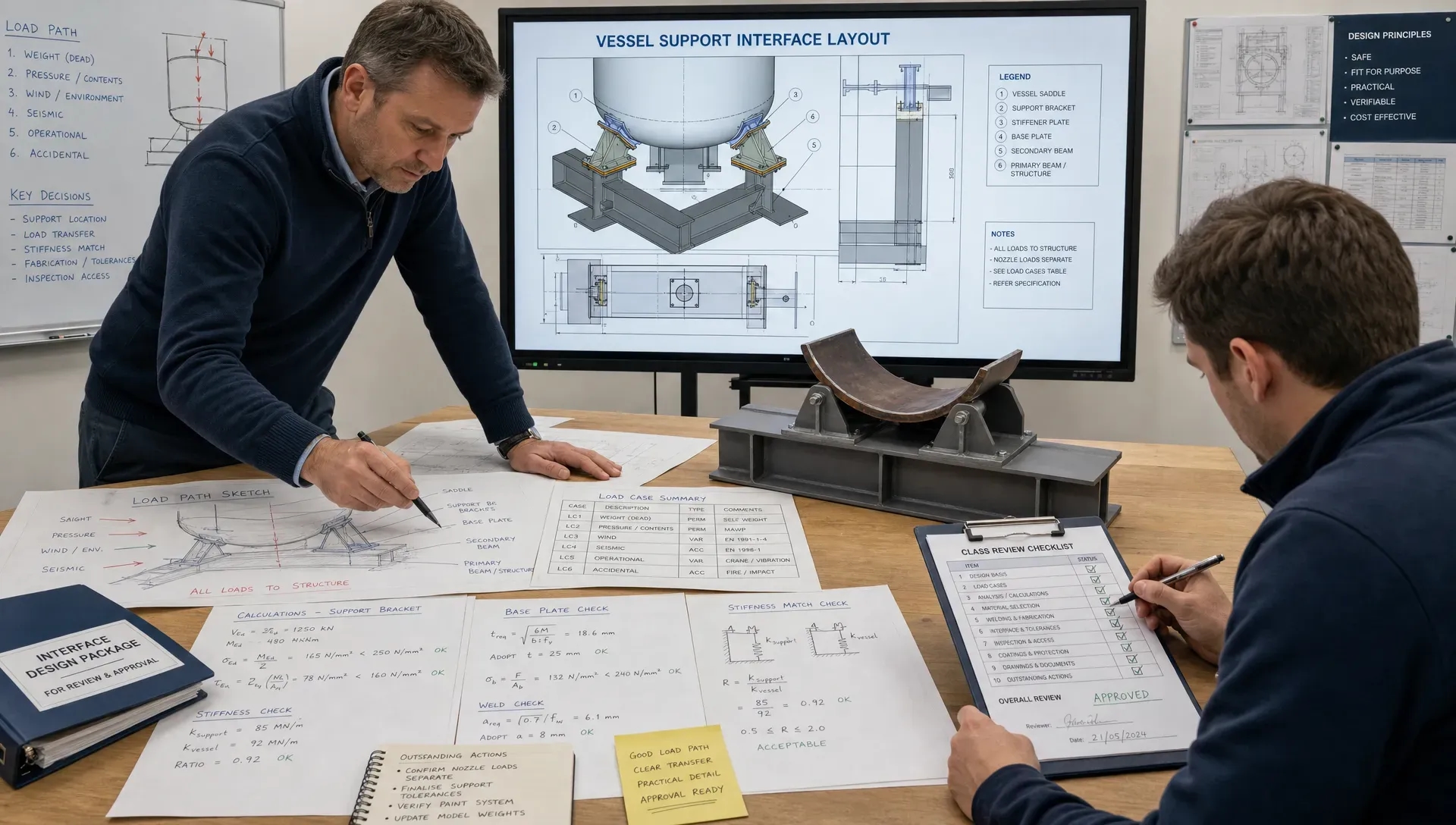
MWS, DNV, Lloyd’s Register, ABS or another reviewing body will not only look at whether a stress ratio is acceptable. They will want to understand the assumptions, load cases, environmental limits, vessel data, stability implications, fatigue considerations where applicable, operational procedure and how the drawings reflect the calculations.
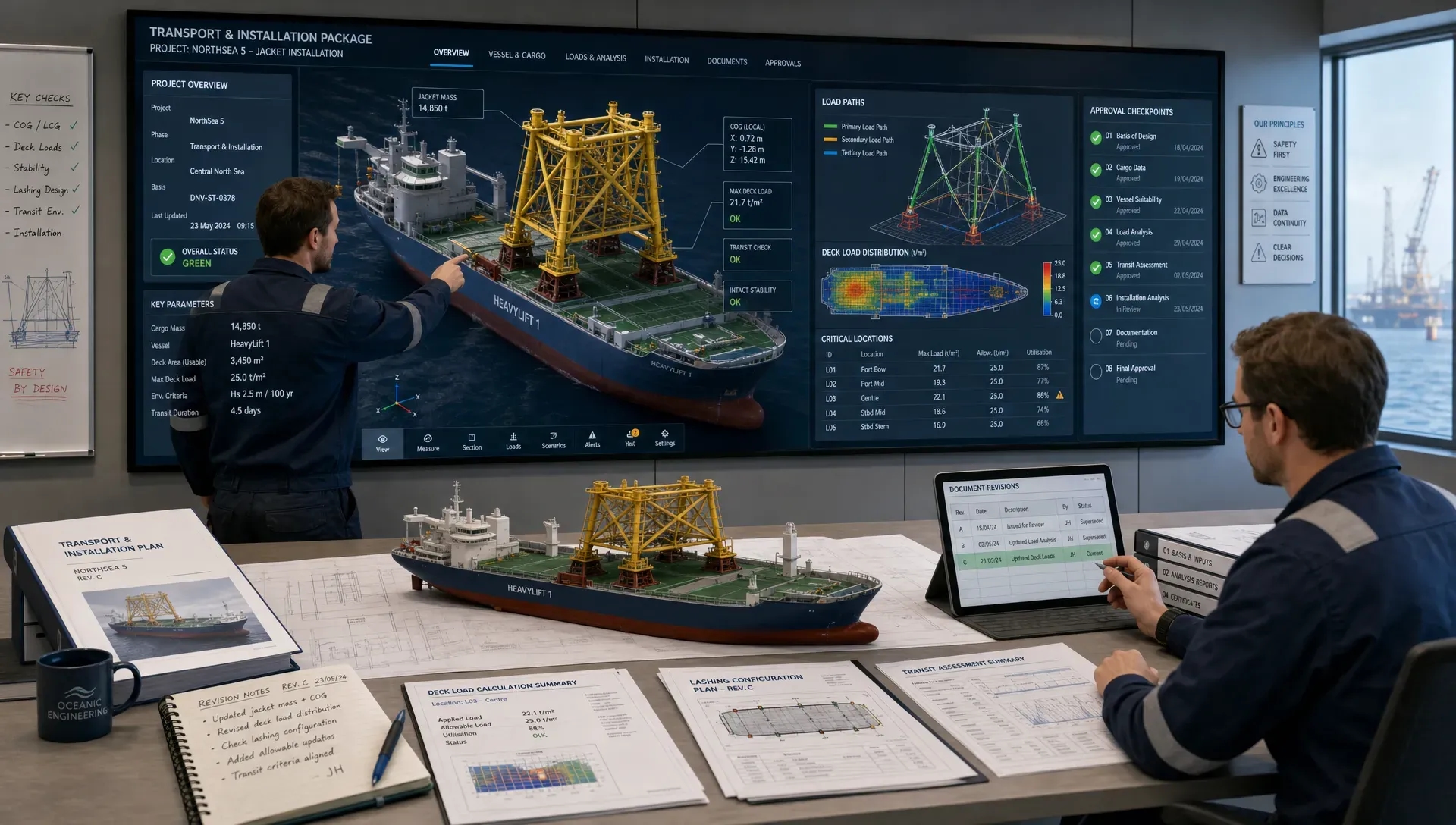
An approval-ready package should make the technical story easy to follow. The design basis should connect to the calculation report. The calculation report should connect to the drawings. The drawings should connect to the fabrication method and offshore procedure. Revision control should show what changed and why.
This level of traceability reduces review friction. It helps reviewers find the information they need, reduces clarification loops and gives project teams more confidence before mobilisation. It also protects the client if project conditions change, because the original assumptions are clear enough to reassess.
Interfaces are where offshore risk often hides
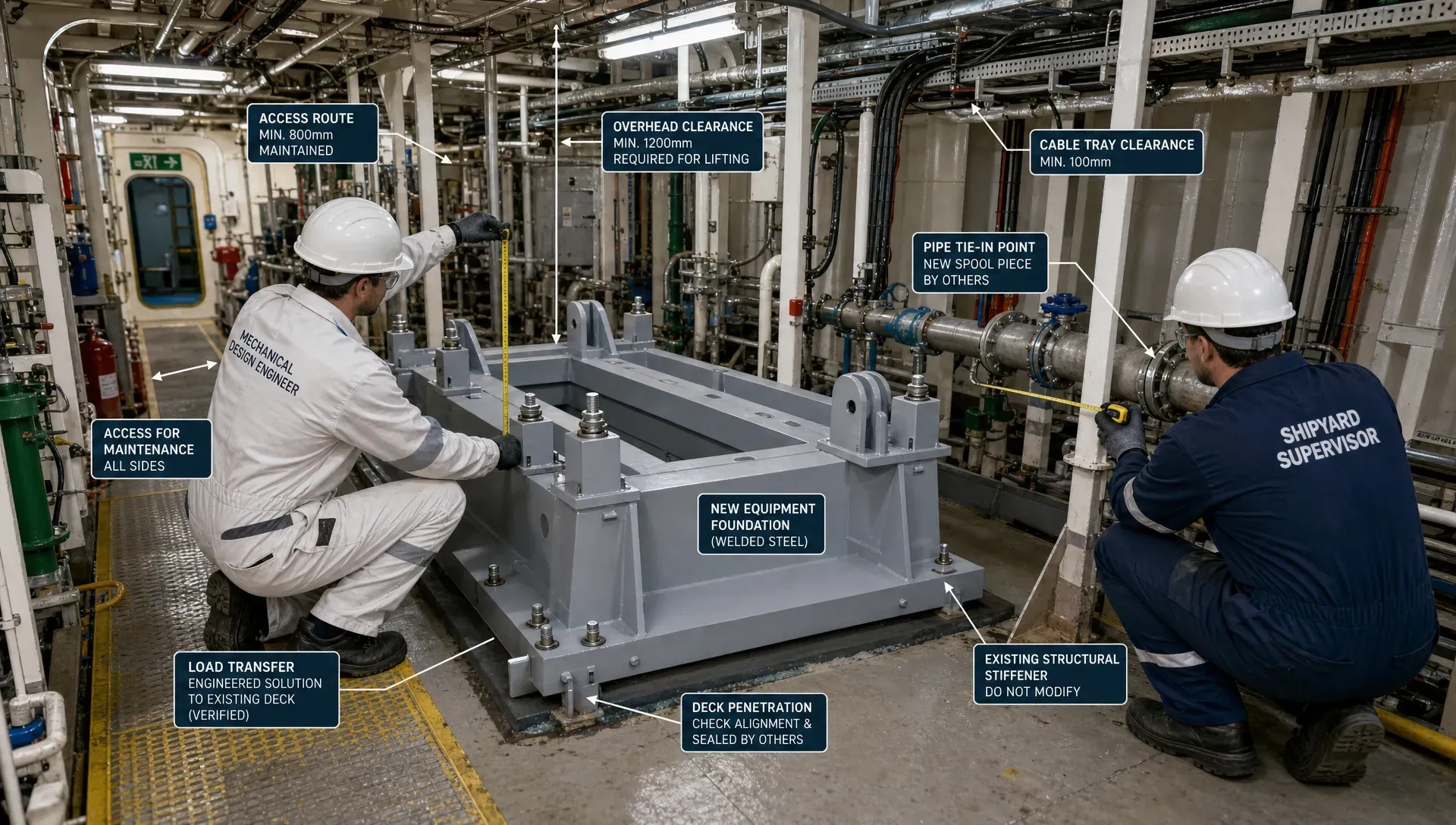
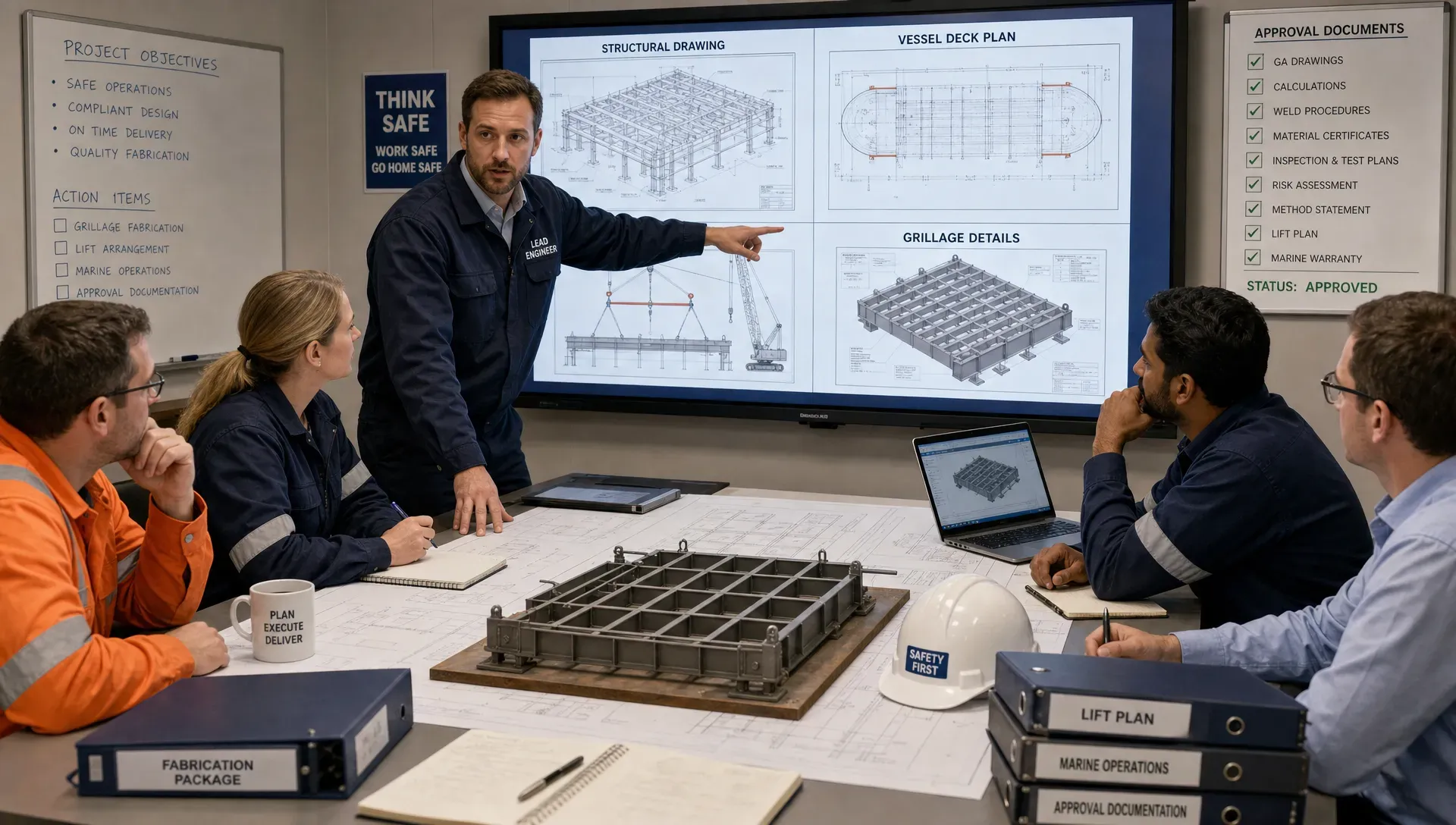
Offshore and maritime engineering rarely belongs to one discipline. A vessel retrofit may involve naval architecture, structural engineering, piping, class rules, machinery interfaces, stability, access, fire safety and maintenance requirements. A heavy lift campaign may involve structural checks, rigging design, crane vessel limitations, grillage design, mooring analysis, transport engineering and offshore procedures.
Poor interface control is one of the fastest ways for a technically sound calculation to lose value. A deck grillage might be strong enough, but not aligned with underdeck stiffeners. A piping route might fit the model, but conflict with access or class requirements. A temporary support might work structurally, but block installation equipment. A mooring arrangement might be acceptable in theory, but impractical for the vessel spread or seabed conditions.
Good engineering services actively manage these interfaces. They ask for the right data early, highlight uncertainty, define hold points and communicate constraints between engineering, operations, fabrication and approval parties. In vessel projects, controlled checks can be especially important because legacy information and real vessel condition do not always match. Fusie Engineers covers this issue in more detail in its guide to maritime engineering checks that prevent vessel project rework.
Commercial control depends on technical clarity
Engineering decisions have commercial consequences. A small change in concept can affect steel tonnage, yard hours, vessel readiness, crane selection, mobilisation schedule and offshore exposure. When the engineering package is unclear, project managers are forced to carry contingency, chase clarifications or accept risk late in the schedule.
Good engineering services help project teams control cost by making trade-offs visible. If one design option saves steel but increases welding complexity, that should be clear. If a heavier temporary structure reduces offshore installation risk, that may be the better commercial decision. If additional analysis can avoid unnecessary reinforcement, the saving may exceed the engineering cost.
This is similar to other specialist advisory work in complex businesses. Just as companies may rely on specialist tax and accounting services to keep financial decisions compliant and traceable, offshore and maritime project teams rely on specialist engineering support to keep technical decisions controlled, justified and auditable.
The real value is not only in producing a deliverable. It is in reducing uncertainty before uncertainty becomes expensive.
What strong engineering services should deliver in practice
A capable engineering partner should provide more than a calculation file and a drawing issue. For offshore, maritime and energy projects, the deliverables should support the full path from concept to execution.
Strong engineering services typically contribute:
- A clear design basis that defines loads, rules, vessel data, acceptance criteria, environmental limits and project interfaces.
- Practical concept input that compares options for safety, fabrication, installation, approval and cost.
- Structural and marine calculations that are transparent, traceable and suitable for review.
- Drawings and details that consider buildability, inspection, lifting, access, tolerances and yard execution.
- Review support for MWS, class societies and client technical authorities, including structured responses to comments.
- Coordination between naval architecture, structural design, heavy lift engineering, piping, steel detailing and marine operations.
- Technical reports, method support and visualisations that help stakeholders understand complex operations.
The balance between these outputs depends on the scope. A small vessel modification may need rapid class-oriented checks and practical drawings. A foundation transport campaign may need motion analysis, seafastening design, grillage checks, underdeck verification, lifting arrangements and MWS documentation. A decommissioning lift may require careful centre of gravity management, temporary strengthening, rigging checks and contingency planning.
The common thread is that the engineering package must help the project move safely and confidently into execution.
How to recognise engineering services that go beyond calculations
When selecting an engineering partner, technical capability is only one part of the decision. The partner also needs to understand project pressure, marine constraints, approval routes and fabrication reality.
A useful test is how they respond to incomplete information. A calculation-only supplier may wait for perfect inputs or proceed with assumptions that are not clearly flagged. A stronger engineering partner will identify missing data, explain the effect on risk, propose verification steps and define which assumptions can be carried temporarily.
Another test is whether they can communicate across disciplines. Offshore and maritime projects need engineers who can speak to naval architects, fabricators, lift supervisors, class reviewers, project managers and site teams. The best technical answer is not useful if it cannot be explained to the people who must approve, build or execute it.
Finally, look at how they treat documentation. Reports should not be written only for the engineer who created the model. They should be understandable to reviewers, future project teams and operational decision-makers. Clear documentation is part of the safety case, not an afterthought.
If you are evaluating suppliers for a marine, offshore or energy scope, Fusie Engineers has also published a practical guide on how to choose engineering design services for offshore projects.
The role of visualisation and software in better engineering delivery
Modern engineering delivery is not limited to static documents. Software, automation and visualisation can improve review speed and stakeholder understanding when used with proper engineering control.
For repetitive checks, structured calculation tools can reduce manual errors and make review faster. For complex operations, animations and technical visualisations can help tender teams, QHSE teams, clients and offshore crews understand the sequence before the work starts. This is particularly useful for heavy lifts, vessel manoeuvres, foundation transport, decommissioning operations and retrofit scopes where several activities must happen in the correct order.
However, software and visualisation do not replace engineering judgement. A clear animation of a poor method is still a poor method. A fast calculation tool is only useful if the design basis, load cases and acceptance criteria are correct. The value comes from combining digital efficiency with experienced technical review.
Why this matters before mobilisation
The offshore phase is usually the most expensive place to discover a design issue. Once a vessel is mobilised, teams have limited time, limited access and limited tolerance for unresolved engineering questions. Weather windows, crane availability, crew planning and client commitments all add pressure.
Good engineering services reduce this pressure before it reaches the vessel. They clarify assumptions, close technical gaps, support approval, simplify fabrication and make the execution method easier to understand. They do not remove all risk, because offshore and maritime projects are inherently complex, but they help ensure that the remaining risk is visible, managed and accepted.
That is the difference between calculation output and engineering value. Calculations prove capacity. Engineering services should improve decisions.
Frequently asked questions
What do engineering services deliver beyond calculations? Good engineering services deliver a controlled design basis, practical concept decisions, buildable details, approval-ready documentation, interface management and support for fabrication and offshore execution.
Why are calculations alone not enough for offshore and maritime projects? Calculations depend on correct assumptions, accurate vessel data, suitable load cases and a practical execution method. If these inputs are weak, the calculation may be technically precise but still lead to rework, approval delays or unsafe execution.
How do engineering services reduce project cost? They reduce cost by avoiding over-engineering, improving load paths, limiting unnecessary steel, simplifying fabrication, reducing review loops and preventing late changes during mobilisation or offshore work.
What should an approval-ready engineering package include? It should include a clear design basis, traceable calculations, relevant drawings, revision control, interface information, operational assumptions and enough explanation for MWS, class or client reviewers to follow the technical reasoning.
When should an engineering partner be involved? The earlier the better, especially when vessel capacity, class requirements, heavy lift operations, seafastening, retrofit interfaces or fabrication constraints can influence the concept. Early input often prevents expensive redesign later.
Work with an engineering partner focused on execution
Fusie Engineers supports offshore, maritime, renewable energy and traditional energy projects with practical engineering services across structural design, heavy lift engineering, ship design, vessel retrofit, piping design, marine engineering, steel detailing and technical visualisation.
If your project needs more than calculations, the right support can help you control risk, simplify fabrication, prepare for review and move towards safe execution with confidence. To discuss a current scope or upcoming project, contact Fusie Engineers.