

Why floating wind farms demand a different design approach
2026-06-27
Floating wind is often discussed as the next step for offshore wind, but from an engineering perspective it is not simply fixed-bottom wind moved into deeper water. A floating project behaves as a coupled marine system. The turbine, floater, moorings, anchors, dynamic cables, vessels, ports, temporary works and installation sequence all influence each other.
That difference changes the design approach from the first concept study. Loads are more dynamic. Interfaces are more numerous. Temporary phases can govern permanent design. Approval documentation must demonstrate not only that individual structures are strong enough, but that the complete system can be fabricated, transported, installed, operated, inspected and eventually removed safely.
For renewable energy developers, EPC contractors, marine contractors and technical directors, this creates a clear challenge: floating wind farms need engineering that connects naval architecture, structural design, heavy lift, marine operations and approval readiness from the beginning.
Fixed-bottom logic reaches its limit in deeper water
In a fixed-bottom offshore wind project, the main structural load path is relatively direct. The turbine loads pass through the tower, transition piece and foundation into the seabed. Installation often centres on heavy lift, pile driving, grouting, cable pull-in and offshore commissioning. The engineering is still complex, especially at large scale, but the foundation is designed around a relatively fixed position and a well-defined structural connection to the seabed.
Floating wind changes that basis. The turbine is mounted on a moving platform. The station-keeping system resists drift rather than holding the structure rigidly in place. Motions affect turbine performance, fatigue, access, cable response and installation loads. The floater may be assembled in port, towed to site and connected offshore, meaning the temporary tow-out and hook-up phases can be as important as the operating condition.
This is why a floating design cannot be developed as a set of separate packages and then stitched together late in the project. If the floater geometry changes, mooring tensions change. If the mooring layout changes, dynamic cable routing may change. If the port cannot handle the draught or assembly sequence, the fabrication concept may need revision. If the tow route imposes restrictions, temporary stability and marine operations become design drivers.
A practical floating wind approach therefore starts with interfaces, not only components. The question is not just whether the structure can survive a design storm. It is whether the full system can pass through every project phase without creating unacceptable risk, delay or rework.
The design basis must be coupled from the start
Floating wind farms demand a more integrated design basis because structural response is closely linked to hydrodynamics, aerodynamics and control behaviour. The turbine controller, floater natural periods, mooring stiffness, wave loading and wind loading all interact. This can create fatigue and extreme load cases that are not obvious when each discipline works in isolation.
A strong design basis should define the governing environmental conditions, site assumptions, operating limits, transport cases, installation stages, inspection philosophy and approval route. It should also clarify which analyses are required at each maturity stage. Early concept models may be enough to compare floater types, but later stages require traceable calculations, finite element verification, stability checks, motion response, mooring analysis, fatigue assessment and review-ready drawings.
This is where the approach differs from conventional sequential engineering. Floating wind design typically needs design loops. The team must test an assumption, review its impact on connected systems, adjust the layout and repeat until the structure is safe, buildable and commercially realistic. For a broader view of how these interfaces affect delivery, Fusie Engineers has also covered how offshore wind engineering shapes safer farm delivery.
Motions influence every discipline
The floater type has a major impact on the engineering strategy. Semi-submersibles, spars, tension leg platforms and barge-type concepts each bring different motion characteristics, fabrication demands, port requirements and installation methods. Selecting one is not only a question of hydrodynamic performance. It affects steel weight, weld complexity, draught, quay requirements, tow-out stability, mooring loads and maintenance access.
For structural engineers, motion means fatigue becomes a central design concern. Connections, brackets, tower interface structures, boat landings, cable supports, access platforms and internal stiffening arrangements may all experience cyclic loading. Details that look acceptable under static strength checks can become problematic when fatigue, weld quality and inspection access are considered.
For naval architects, stability and motions must be managed through all phases, including construction, launch, wet storage, tow-out, hook-up and operation. Temporary conditions can introduce risks that do not appear in the final installed configuration. Ballast arrangements, freeboard, towing resistance, emergency scenarios and marine warranty requirements must be considered early enough to influence the design rather than becoming late constraints.
For operations teams, motions affect personnel transfer, inspection windows, component replacement and emergency response. A floating asset that is structurally strong but difficult to access or maintain can create high lifetime cost and operational risk.
Mooring and anchoring become part of structural design
In floating wind, the mooring system is not a secondary package. It is a core part of the structural and operational concept. Mooring stiffness influences floater motions, offset limits, fatigue response and dynamic cable loads. Anchor selection affects seabed interaction, installation vessel requirements and field layout. Line configuration affects clashing risk, corridor planning and future maintenance.
This creates several practical engineering questions. Can the floater tolerate the expected offset without overloading the cable? Are mooring line tensions compatible with the anchor concept and installation method? Is there sufficient redundancy if a line is damaged? How will the project verify as-installed line geometry and tension? Can inspection or replacement be performed with available vessels?
These questions must be resolved before detailed fabrication starts. A late change to mooring layout can affect fairlead structures, local reinforcement, access arrangements and cable routing. It can also change installation procedures and approval documentation. For commercial floating wind farms, where units may be repeated many times, unresolved mooring interfaces can multiply into significant schedule and cost exposure.
Dynamic cables introduce a different fatigue problem
Export and inter-array cables in fixed-bottom wind farms are challenging, but floating wind adds continuous motion at the floater interface. The cable must tolerate dynamic bending, tension variation, vortex effects, seabed touch-down movement and potential interaction with moorings. The hang-off arrangement, bend stiffeners, buoyancy modules and protection systems all need careful integration with the floater structure.
The structural team cannot treat cable supports as simple brackets. Local loads, fatigue, installation tolerances and inspection access matter. The marine operations team cannot treat pull-in as a routine operation either, because cable handling must account for floater position, weather limits and temporary loads. The cable design team needs reliable motion and offset data. The approval package must show how the complete arrangement behaves under normal, extreme and accidental conditions.
This is one of the clearest examples of why floating wind design needs joined-up engineering. A small interface detail can affect cable life, installation risk and operational availability.
Installation shifts from lift-and-place to assemble, tow and connect
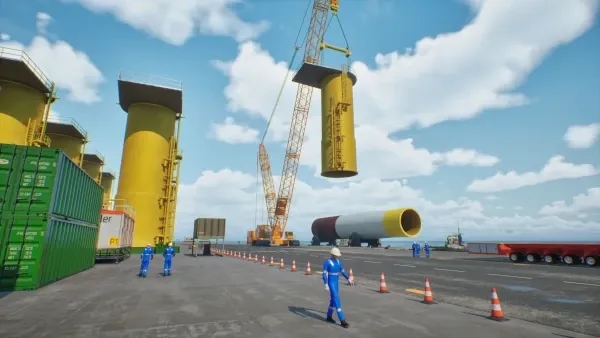
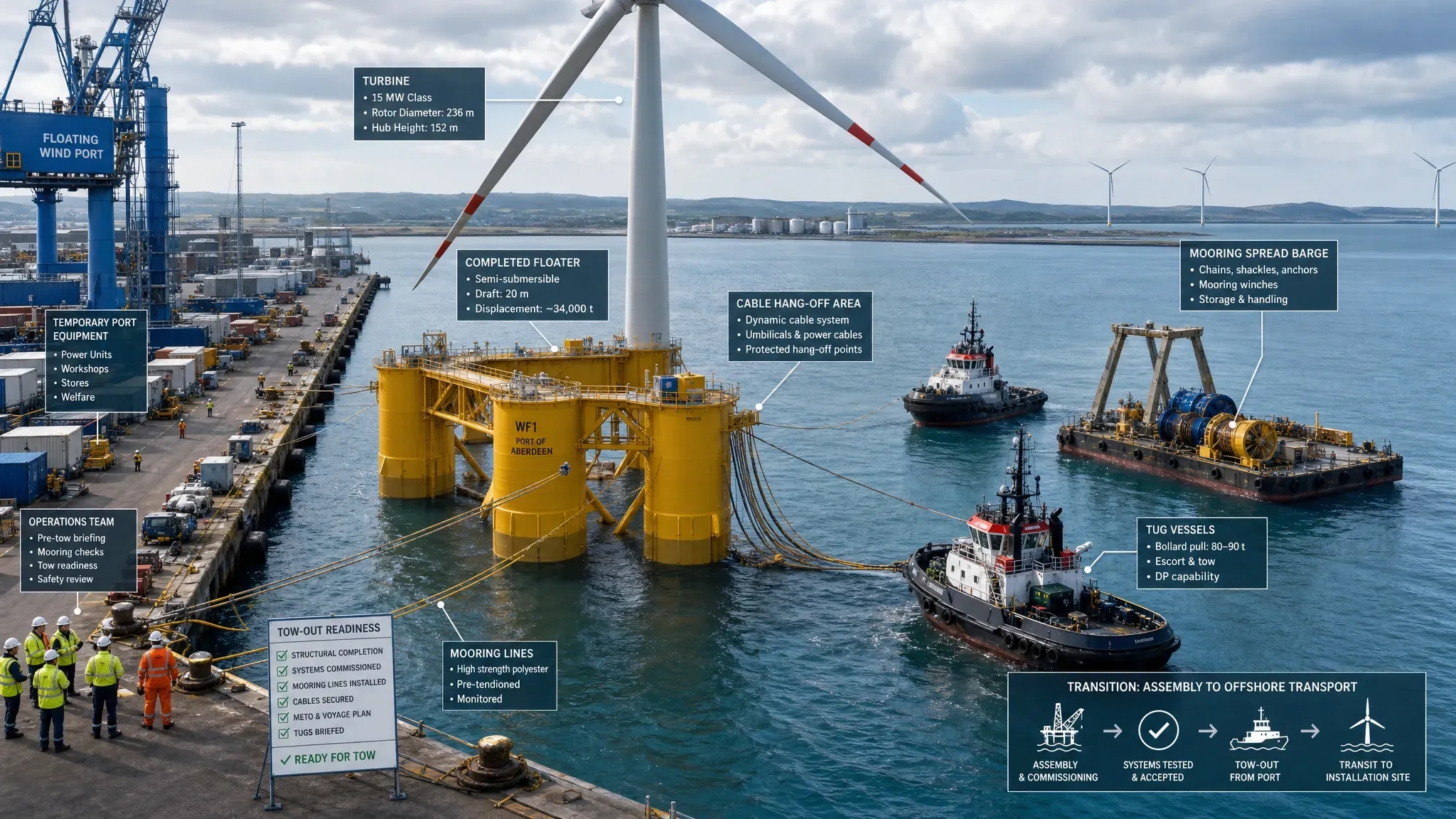
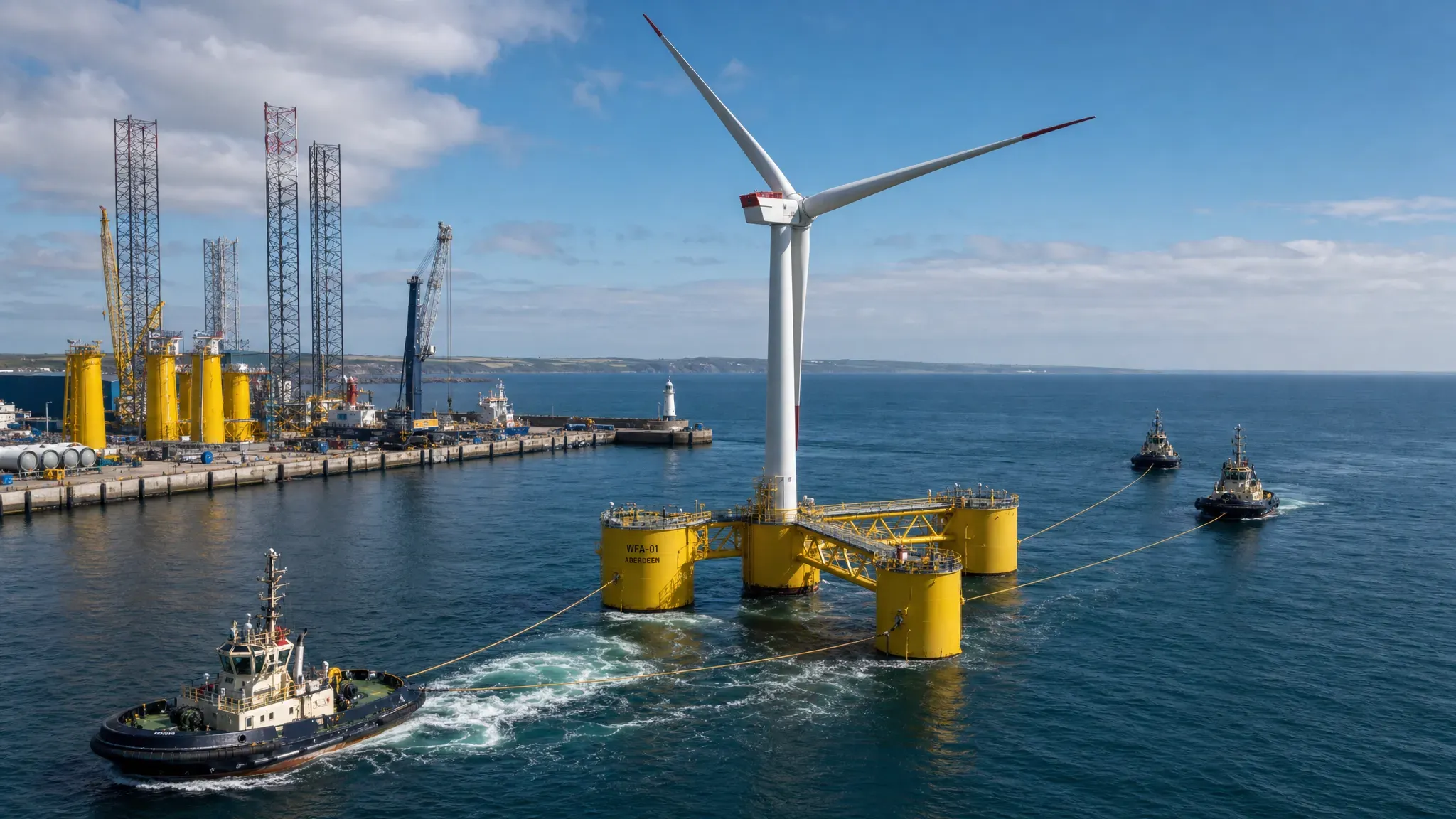
Many floating wind concepts aim to reduce offshore heavy lift by completing more work quayside and towing completed units to site. This can reduce exposure offshore, but it transfers complexity into port logistics, temporary stability, towing arrangements, wet storage, hook-up sequencing and marine coordination.
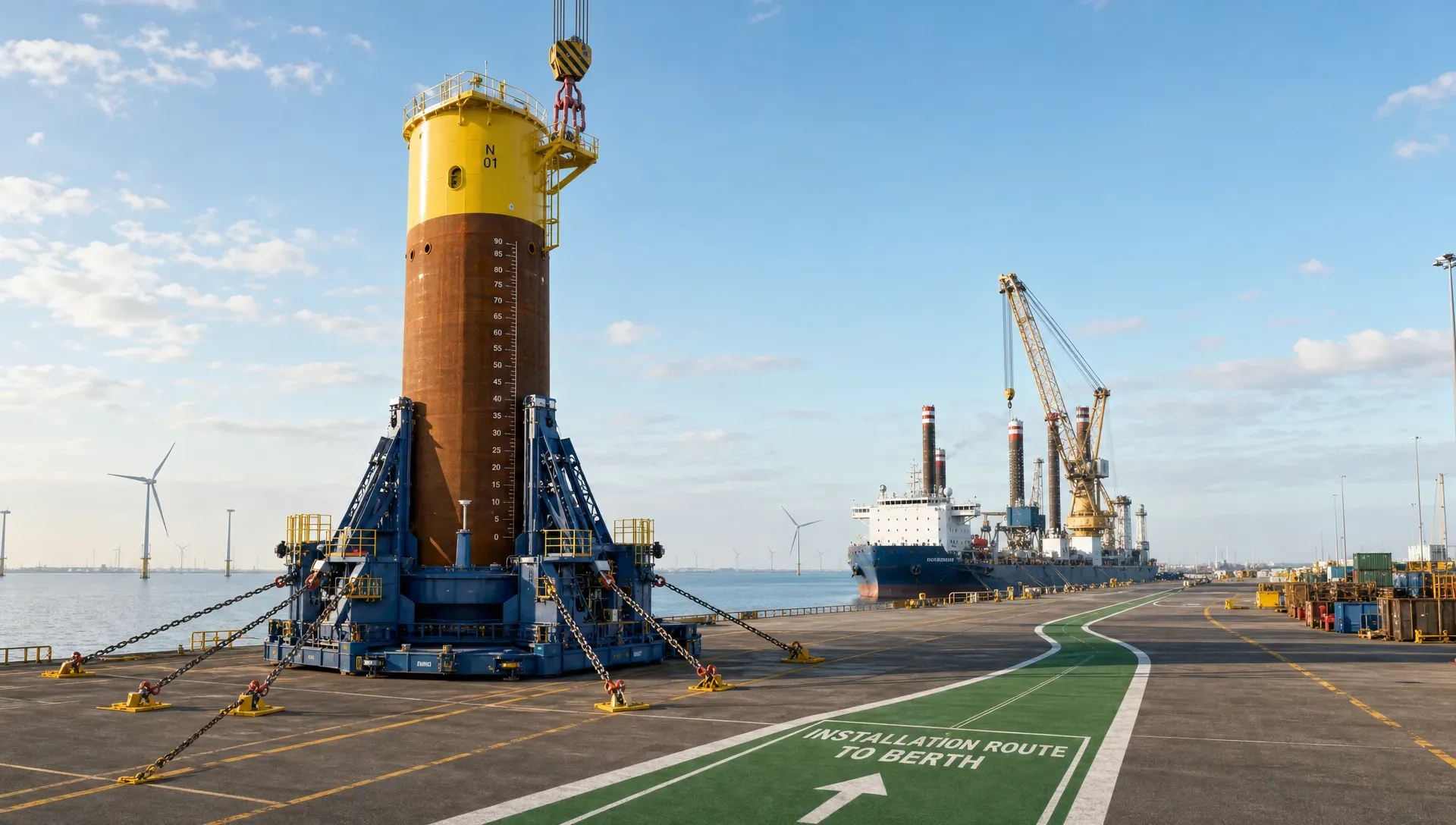
Port limitations become design constraints. Quay strength, available draught, crane capacity, assembly area, load-out method and access for suppliers can all influence the floater concept. A design that is efficient in operation may be impractical if it requires unavailable port infrastructure or excessive temporary works.
Tow-out engineering also requires close attention. Towing brackets, bollard pull requirements, line arrangements, weather windows, fatigue during transit, emergency tow scenarios and temporary instrumentation may all need to be considered. For projects with multiple floating units, repeatability becomes essential. Procedures, temporary structures and documentation should be designed so the first unit informs the next rather than creating repeated uncertainty.
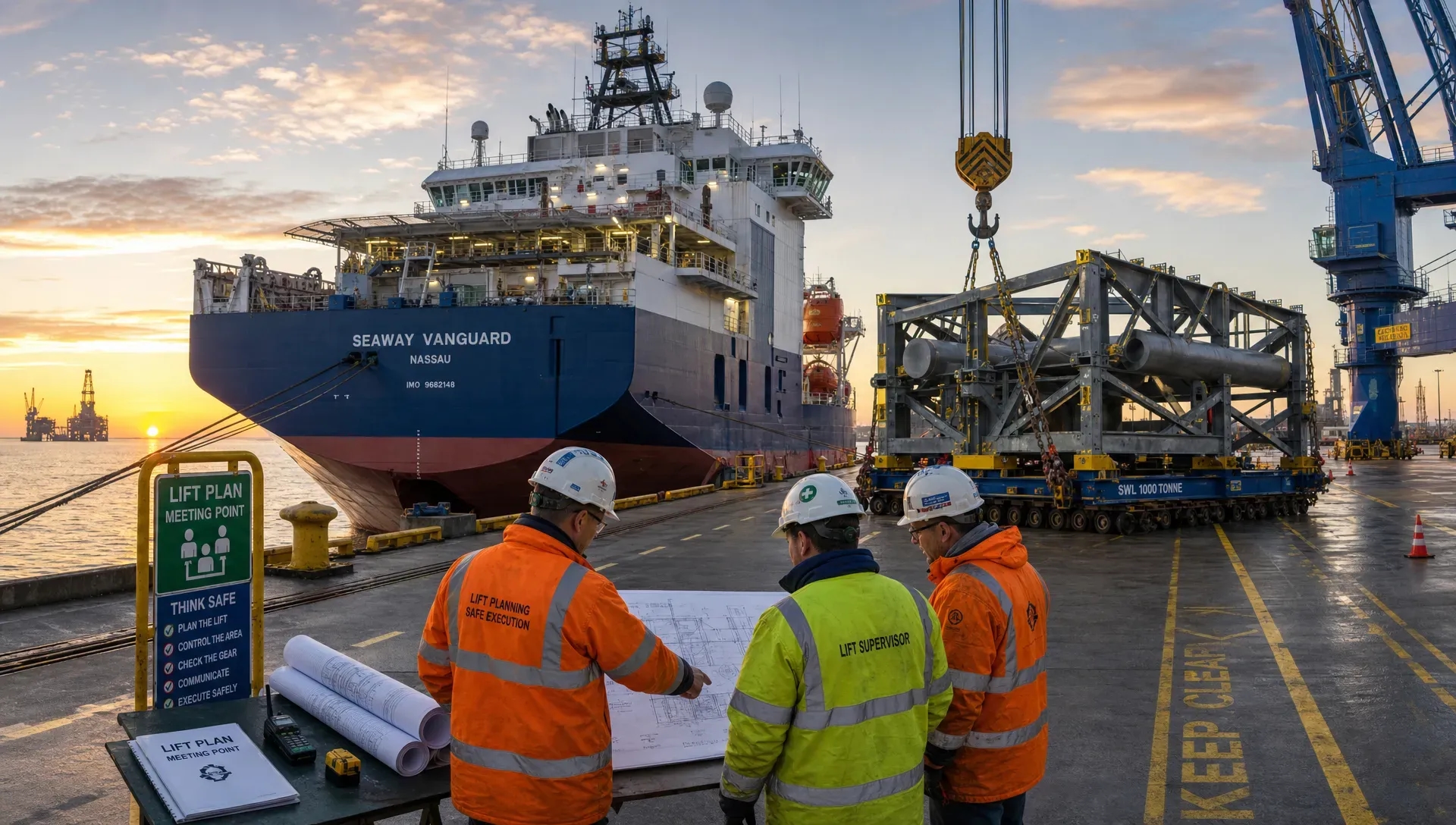
Marine operations are also safety-critical because they bring together vessel crews, riggers, survey teams, ROV teams, divers, client representatives and marine warranty surveyors. Competence, communication and emergency planning matter, especially around subsea interfaces and inspection tasks. Specialist providers of technical diving and corporate safety training show why structured training and safety discipline remain relevant when offshore projects involve underwater work, even when much of the engineering is performed digitally.
Buildability is not optional at commercial scale
Pilot floating wind projects can tolerate a certain amount of bespoke engineering. Commercial arrays cannot. When dozens of floating units, mooring systems and cable interfaces must be fabricated and installed, buildability becomes a core design metric.
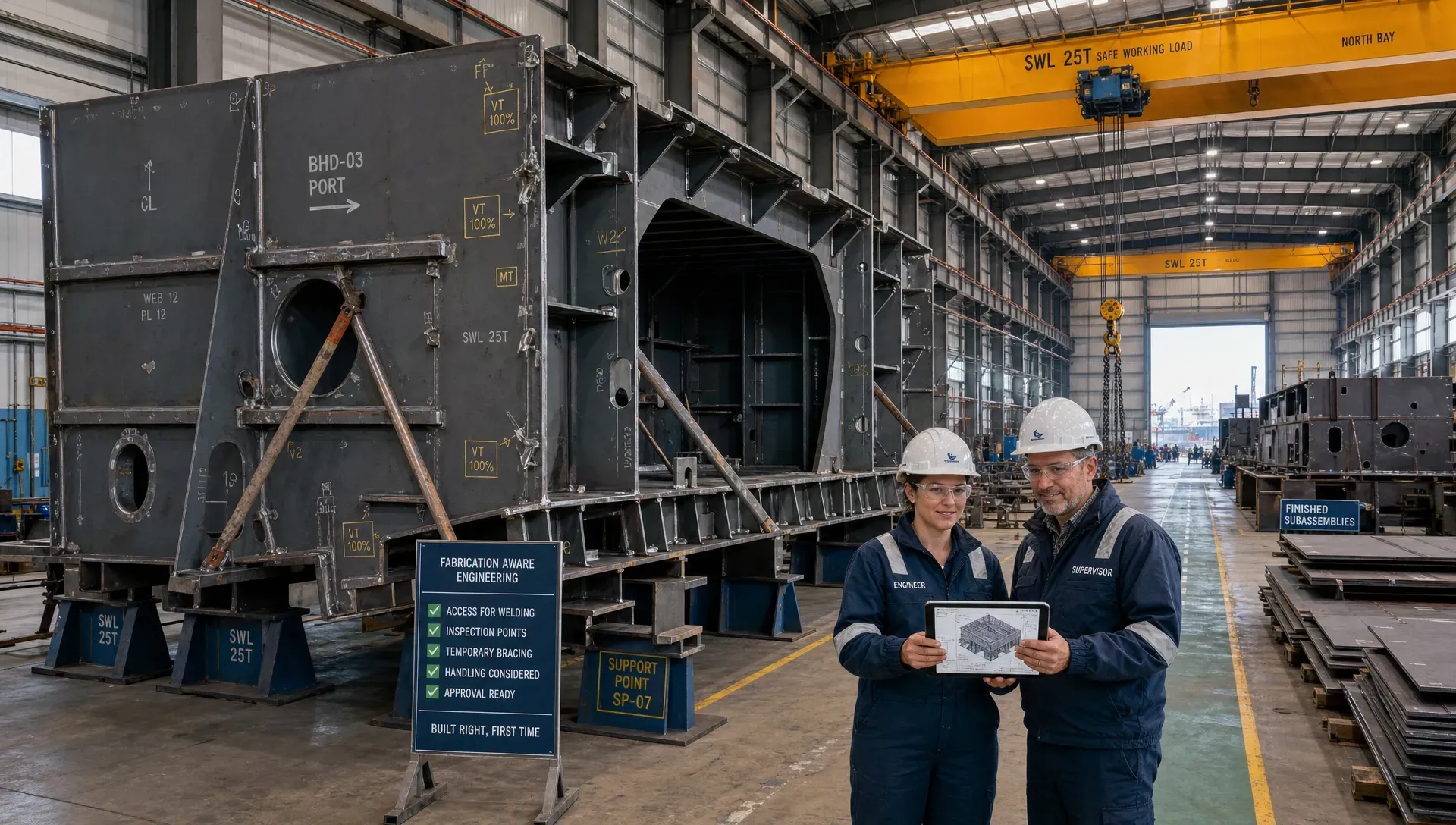
That means reducing unnecessary steel, simplifying weld details, avoiding inaccessible connections, standardising repeated components and designing around realistic fabrication tolerances. It also means understanding how yards will cut, fit, weld, inspect, paint, transport and assemble the structure. A technically correct design can still create problems if it needs complex weld sequences, difficult access for non-destructive testing or heavy temporary support during fabrication.
For floating wind, steel efficiency must be balanced with fatigue performance, robustness and approval confidence. Removing steel without understanding load paths can increase risk. Adding steel everywhere can increase cost, draught, tow resistance and fabrication time. The value lies in controlled optimisation, where load paths are clear and details are practical to build. This aligns closely with the principles behind structural engineering choices that improve buildability offshore.
Approval readiness needs stronger interface control
Floating wind farms involve multiple approval stakeholders. Depending on the project, documentation may be reviewed by class societies, marine warranty surveyors, insurers, certifying bodies, vessel owners, port authorities and client technical teams. Each party needs confidence that assumptions are traceable and that the engineering reflects the real execution method.
Approval delays often occur when documentation is technically detailed but poorly connected. For example, a lifting analysis may use one centre of gravity, a stability report another, and a transport drawing a third. A mooring report may assume a fairlead geometry that has changed in the structural model. A cable analysis may rely on offset values that are no longer current. These inconsistencies are not only administrative problems. They can lead to rework, missed weather windows and uncertainty offshore.
A floating wind design package should therefore maintain strict control of revisions, design assumptions and interface data. Calculations, drawings, procedures and reports should tell the same story. The approval team should be able to follow the load path, understand the governing cases and verify that temporary phases have been assessed.
This is where practical engineering judgement is valuable. The objective is not to produce more documents than necessary. It is to produce the right documents, at the right level of detail, with enough clarity for review and execution.
Operations, retrofit and decommissioning should be designed in early
Floating wind assets will operate in demanding marine environments for many years. Maintenance access, inspection points, corrosion protection, component replacement and tow-back strategies should be considered during design, not after commissioning.
Access systems need to account for platform motion and vessel interaction. Internal spaces need safe routes for inspection and repair. Piping, ballast systems and electrical interfaces need maintainability. Mooring and cable components need inspection strategies that are realistic for the available vessels and metocean conditions. If major component replacement requires a tow-to-port strategy, the design should support safe disconnection, tow preparation and reconnection.
End-of-life planning also matters. Floating wind may offer advantages for decommissioning because units can potentially be disconnected and towed away, but this still requires engineered procedures, temporary structures, marine spreads and approval documentation. Designing for removal from the outset can reduce future risk and support a more responsible project lifecycle.
These considerations are not unique to offshore wind. They are familiar in ship design, vessel retrofit, heavy lift, decommissioning, dredging and traditional offshore energy projects. The difference is that floating wind combines many of these challenges into a repeated renewable energy asset.
What a different design approach looks like in practice
A suitable design approach for floating wind farms is integrated, iterative and execution-led. It connects concept decisions to fabrication, marine operations and approval requirements before those decisions become expensive to change.
In practical terms, this means focusing on:
- A controlled design basis that includes operating, transport, installation, inspection and accidental cases.
- Coupled analysis that reflects the interaction between turbine, floater, moorings, cables and environmental loads.
- Structural details that are fatigue-resistant, fabrication-friendly and accessible for inspection.
- Marine operations planning that accounts for port limits, tow-out stability, weather windows and vessel capability.
- Interface management between naval architecture, structural engineering, cable design, mooring design, heavy lift and installation teams.
- Approval-ready documentation that keeps assumptions, drawings, calculations and procedures aligned.
- Lifecycle thinking that considers maintenance, retrofit, tow-back and decommissioning from the concept stage.
This approach does not remove complexity. It makes complexity manageable by identifying the right constraints early and keeping engineering decisions connected to offshore execution.
How Fusie Engineers supports floating wind and marine project teams
Floating wind requires the same discipline that applies to demanding offshore, maritime and energy projects: clear load paths, practical details, reliable calculations, buildable structures and documentation that can stand up to review.
Fusie Engineers supports clients across offshore structural design, heavy lift engineering, ship design, vessel retrofits, piping, marine engineering, steel detailing, renewable energy and decommissioning projects. For floating wind and related marine scopes, that can include engineering support for temporary structures, seafastening, grillages, custom tools, lifting arrangements, vessel interfaces, stability checks, FEM calculations, motion-related assessments, drawings and approval documentation.
The key value is not only producing drawings. It is connecting design decisions to fabrication, installation, vessel behaviour, class requirements and marine operations. That helps project teams reduce rework, control steel use, improve approval readiness and protect critical mobilisation dates.
Frequently asked questions
Why do floating wind farms need a different design approach from fixed-bottom wind farms? Floating wind farms use moving platforms held by mooring systems, so the turbine, floater, cables and marine operations are dynamically connected. This requires coupled engineering rather than separate structural, marine and installation packages developed in isolation.
What are the main engineering risks in floating wind design? Key risks include fatigue, floater motions, mooring loads, dynamic cable behaviour, port constraints, tow-out stability, interface errors and incomplete approval documentation. Temporary phases can be as critical as permanent operation.
How early should transport and installation be considered? Transport and installation should be considered during concept design. Port capacity, tow routes, vessel availability, hook-up sequence and temporary structures can all influence the floater geometry, structural details and project cost.
Does floating wind reduce offshore heavy lift requirements? In many concepts, more assembly is performed quayside and completed units are towed offshore, which can reduce some offshore lifting. However, it increases the importance of port engineering, towing analysis, hook-up procedures, mooring installation and marine coordination.
What documentation is important for approval? Typical approval needs may include a clear design basis, structural calculations, FEM reports, stability checks, mooring and motion assessments, lifting or tow procedures, interface drawings, inspection assumptions and revision-controlled calculations that match the execution method.
Bring floating wind engineering into the execution reality
Floating wind farms succeed when the design is not only technically sound, but also buildable, towable, installable, maintainable and review-ready. The earlier those constraints are integrated, the lower the risk of late redesign, approval delays and offshore downtime.
If your project needs structural, marine, heavy lift or vessel-related engineering support for floating wind or other offshore energy scopes, Fusie Engineers can help connect concept decisions to practical execution and approval documentation.